S
Suvam SwainPublished on April 15, 2026
16 min read
Microservices vs Monolith: Making the Right Choice in 2026
Explore key differences, pros and cons, and when to choose each architecture.
Explore key differences, pros and cons, and when to choose each architecture.
Banner image depicting microservices as interconnected shapes and monolith as a solid block. The words 'Microservices vs Monolith in 2026: Making the Right Choice' are written in the center.
As we navigate the digital landscape of 2026, the ongoing discussion surrounding "microservices vs. monolith" continues to resonate within the software architecture community. The choice between these two approaches primarily hinges on the specific project requirements and the capabilities of the development team involved.
The monolith architecture centers on an application design that consolidates all components into a single, cohesive codebase, encompassing both the user interface and data storage. Conversely, Microservices Architecture disaggregates an application into smaller, distinct units, each tasked with specific functionalities that communicate through APIs within a distributed network.
| Feature | Microservices | Monolith |
|---|---|---|
| Scalability | Facilitates independent scaling tailored to demand | Scales as a unified entity |
| Team Impact | Developers concentrate on particular components, boosting productivity | Requires comprehensive knowledge of the entire system, demanding a generalist skill set |
We should also consider the concept of a modular monolith, a hybrid architectural model in which the application is structured as a monolith but divided into distinct modules, each with specific responsibilities. This approach offers advantages of both paradigms by enabling individual module scaling similar to microservices while preserving the monolith's inherent simplicity.
The decision between microservices and a monolith can appear overwhelming; however, it ultimately boils down to a balance between project requirements, team agility, and financial considerations. Throughout this journey, we must remain attentive to migration factors and real-world scenarios to guide our decisions.
In the subsequent sections, we will explore the advantages and disadvantages of both microservices and monolithic architectures, examine the implications of a modular monolith, offer guidance on when to adopt each approach, and address frequently asked questions.
Stay tuned as we delve into the complexities of this critical topic in greater detail in the following sections.
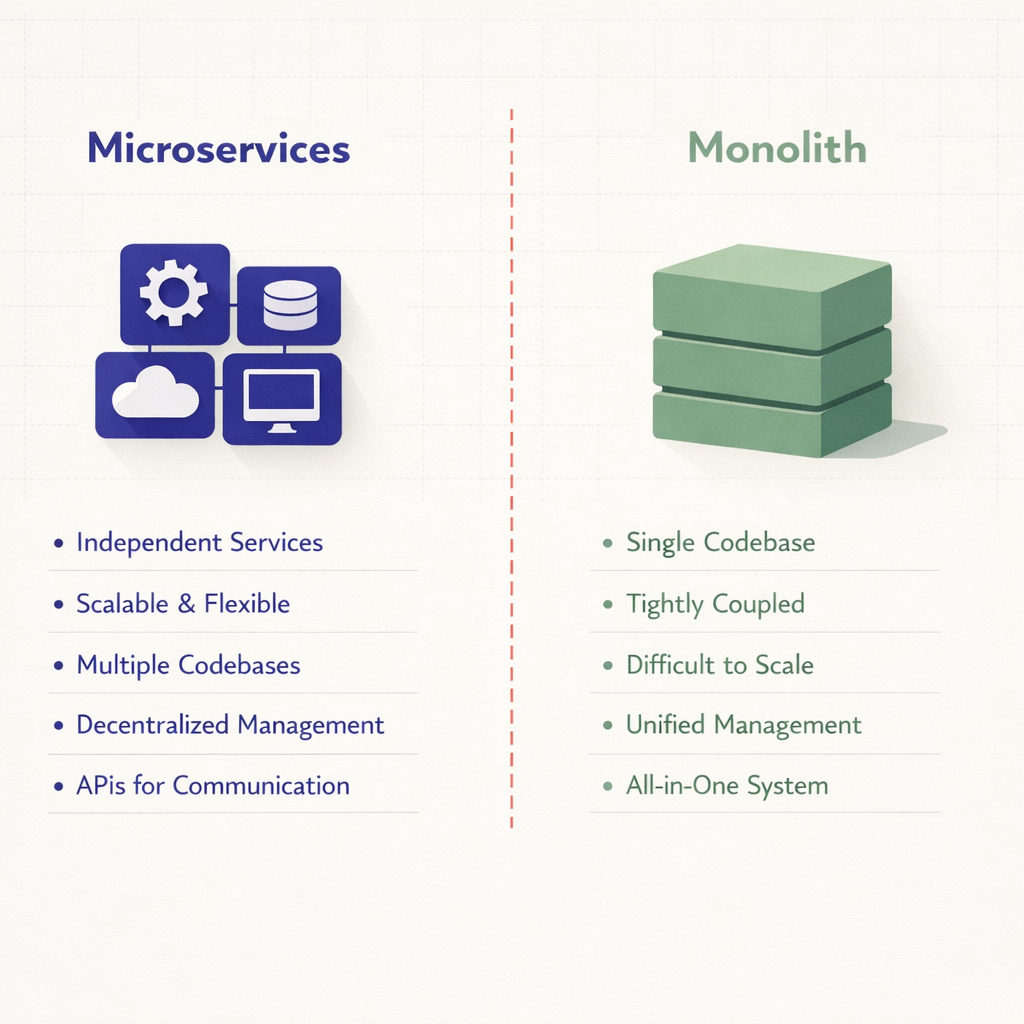 Diagram illustrating the core differences between microservices and monolith architectures.
To make informed decisions in the "microservices vs monolith" debate, understanding their core differences is crucial. These differences encompass aspects such as design, deployment, size, communication, and more.
Monoliths maintain a unified approach, consolidating all components—UI, data storage, etc.—into a single codebase. This 'one for all' structure offers simplicity and allows for quicker development in the initial stages.
In contrast, microservices decompose an application into smaller, individual services. Each service is designed to perform specific tasks and interconnects via APIs, allowing for independent evolution and granular control over each component of the application.
Monolithic Architecture: Deployment necessitates updating the entire system, even for minor changes, which poses risks. A single error can lead to a complete system breakdown.
Microservices: Individual services can be deployed and updated independently. Due to their isolated nature, any error is confined to the problematic service, ensuring minimal impact on the overall system.
| Aspect | Monolith | Microservices |
|---|---|---|
| Size | Can grow large and complex, often becoming cumbersome | Naturally small; easily managed, tested, and updated |
In a monolith, communication between different functionalities occurs internally, as all parts of the application share access to a common memory space.
Conversely, microservices utilize external mechanisms, such as APIs, leading to a system that operates within a distributed network. This necessitates a robust and efficient infrastructure for effective communication.
While monoliths and microservices showcase distinct differences, a hybrid model known as the modular monolith is gaining traction. This approach retains the monolithic premise of a single codebase but organizes code in a manner reminiscent of microservices. It offers a blend of benefits from both paradigms, serving as a viable alternative in specific situations.
Stay tuned to explore the pros and cons of each approach, as well as their impacts on scalability, team dynamics, and more in the forthcoming sections.
The choice between microservices and monolith architectures depends significantly on the specifics of your project and the capabilities of your team. In this section, we will examine the advantages and disadvantages of both architectures, with a focus on their implications for scalability, team dynamics, and complexity.
A critical factor in the microservices versus monolith discussion is scalability, which refers to the ability to handle growth, particularly during sudden spikes in user demand:
| Feature | Microservices | Monolith |
|---|---|---|
| Scalability | Offers robust scalability; each service can scale independently according to demand, providing a dynamic and efficient expansion mechanism that enhances overall performance and resource usage. | Can scale as a single unit; horizontal scaling is straightforward but may result in resource wastage if only certain parts of the application require increased capacity. |
It is essential to consider how each architecture influences your team’s workflow and coordination:
| Feature | Microservices | Monolith |
|---|---|---|
| Team Impact | Enables developers to work on different services concurrently, enhancing productivity and flexibility. | Requires developers to possess a comprehensive understanding of the entire system, encouraging a broad skill set but potentially leading to coordination challenges due to system interdependencies. |
Lastly, the financial implications and complexity of monolith versus microservices can significantly impact your decision:
| Feature | Microservices | Monolith |
|---|---|---|
| Cost & Complexity | While microservices offer independent scalability and flexibility, they introduce operational complexity; managing a network of services can be challenging and typically requires more advanced tooling, monitoring, and error handling. | Simpler to develop and deploy, often leading to lower initial costs; however, making changes to the monolithic codebase can be complicated and may affect the entire system, leading to potentially high long-term maintenance and update costs. |
In conclusion, the decision between microservices and monolith architectures depends on various factors. It is crucial to evaluate the advantages and disadvantages of each approach in relation to your specific requirements, external influences, and decision-making criteria. Additionally, the concept of a modular monolith can serve as a viable middle-ground solution in appropriate scenarios.
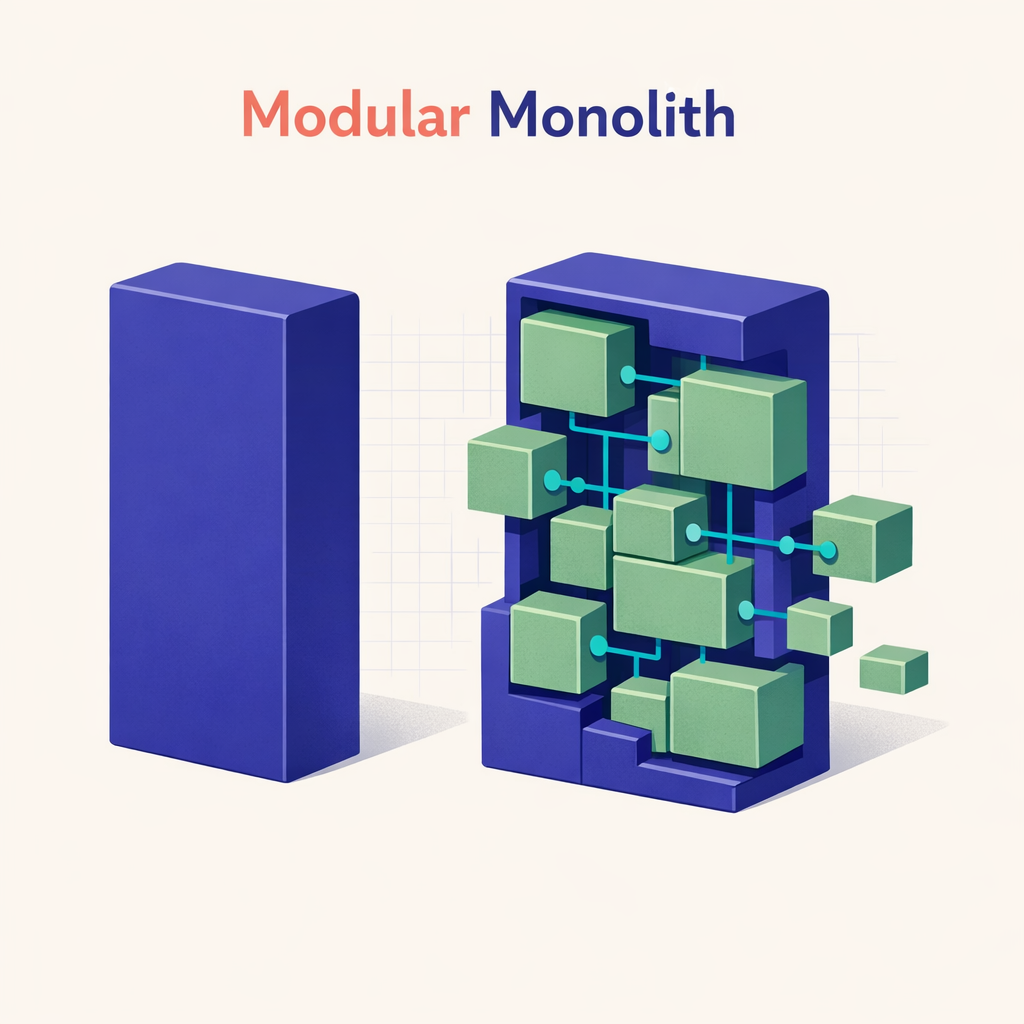 Illustration depicting the concept of a 'Modular Monolith' as an interconnected structure within a single entity.
A significant contender has emerged in the "microservices vs. monolith" debate: the modular monolith. This architectural approach, often viewed as a hybrid solution, skillfully integrates the strengths of both monolithic designs and microservices. But what exactly is this innovative structure, and how does it fit into the longstanding discussion of monolith versus microservices?
In essence, a modular monolith aims to leverage the improved scalability and team-focused advantages of microservices while preserving the simplicity inherent in monolithic architectures. This is accomplished by organizing the monolith into distinct modules. Each module operates independently, akin to a microservice, but still utilizes a shared codebase, much like a traditional monolith.
The combination of these two approaches yields several notable advantages:
| Advantage | Description |
|---|---|
| Scalability | Similar to microservices, individual modules within a modular monolith can be scaled independently, promoting greater flexibility. |
| Simplicity | The system maintains the simplicity of a monolith, allowing for quicker and easier error diagnosis and resolution. |
| Team Impact | Closely resembles the dynamics of a microservices environment. Developers can focus on individual modules rather than the entire system, enabling specialization and parallel workflows. |
However, like any architectural choice in software development, the modular monolith comes with its own trade-offs.
When should one opt for a modular monolith over a traditional monolith or a microservices approach? This decision necessitates a careful examination of several key factors, including but not limited to:
In summary, the modular monolith adds a new dimension to the microservices versus monolith discussion. Ultimately, the choice hinges on the specific characteristics of your software project, your team's expertise, and the trade-offs you are willing to make. The emergence of the modular monolith reflects our ongoing pursuit of the most suitable, resilient, and effective architectural designs in software.
The decision to transition from a monolithic to a microservices architecture necessitates significant evaluation and careful consideration. The "microservices vs. monolith" debate presents complexities, with each architecture possessing unique strengths and weaknesses. A critical aspect of this evaluation process involves understanding when to adopt microservices, assessing the applicability of Modular Monoliths, and weighing the costs and complexities associated with change.
Several factors can prompt the decision to migrate to microservices, including:
| Factor | Description |
|---|---|
| Need for Scalability and Flexibility | Microservices architecture offers superior scalability, as each service can be independently expanded according to requirements. If your organization anticipates a future that necessitates a scalable structure, considering a migration to microservices may be advantageous. |
| Team Skill Set and Effectiveness | Microservices enable developers to concentrate on specific, smaller components, fostering parallel work and enhancing productivity. However, developers must also become adept at managing the complexities of network latencies, data consistency, and decentralized data management inherent to microservices. |
| Strained Monolithic Structures | As a monolithic system expands, it can become challenging to maintain and deploy. If your monolithic application falls into this category, it may be time to consider microservices. |
The concept of the modular monolith serves as a transitional phase between traditional monolith and microservices architectures. It can act as a stepping stone for teams aiming to adopt a microservices-style approach without fully committing to a migration. Modular monoliths can provide a degree of flexibility and scalability similar to microservices while maintaining the stability characteristic of monolithic architectures.
Recognizing that the journey from monolith to microservices is neither direct nor linear is crucial, nor is it free of challenges. Begin with:
Migrating to microservices is a significant endeavor that should not be undertaken lightly. Organizations must thoroughly assess their needs, capabilities, and existing conditions before embarking on this journey. The transition from monolith to microservices can lead to an optimized, flexible system, but it requires a committed and skilled team, along with a clear vision of the desired architectural end state.
Amazon provides a compelling example of when to adopt microservices. Initially, the e-commerce giant operated on a monolithic architecture. However, as their services evolved, their need for scalability and rapid feature deployment became paramount. Consequently, they transitioned to a microservices architecture, breaking down their large, unwieldy monolith into independently deployable, single-purpose services. This transformation enabled them to:
As a result, both productivity and customer experience saw significant improvements.
While microservices have distinct advantages, choosing a monolithic architecture can also be a strategic decision. Basecamp, a well-known project management software, exemplifies this approach by effectively utilizing a monolithic architecture. With a smaller, tightly-knit team and a relatively straightforward system, Basecamp aims to minimize the operational and communication complexities associated with microservices. Their monolithic architecture facilitates:
This makes Basecamp an excellent case study in the decision-making process between monoliths and microservices.
Shopify, a prominent e-commerce platform, offers an intriguing example of a modular monolith. Distinct from traditional monolithic models, the Shopify system is divided into several 'shards,' each dedicated to managing requests for a specific set of shops. Unlike typical microservices architectures, each shard contains the complete codebase, thus reaping the advantages of modularity while sidestepping the complexities of distributed systems. Shopify's experience highlights the relevance of modular monoliths in the discussion surrounding microservices versus monolithic architectures.
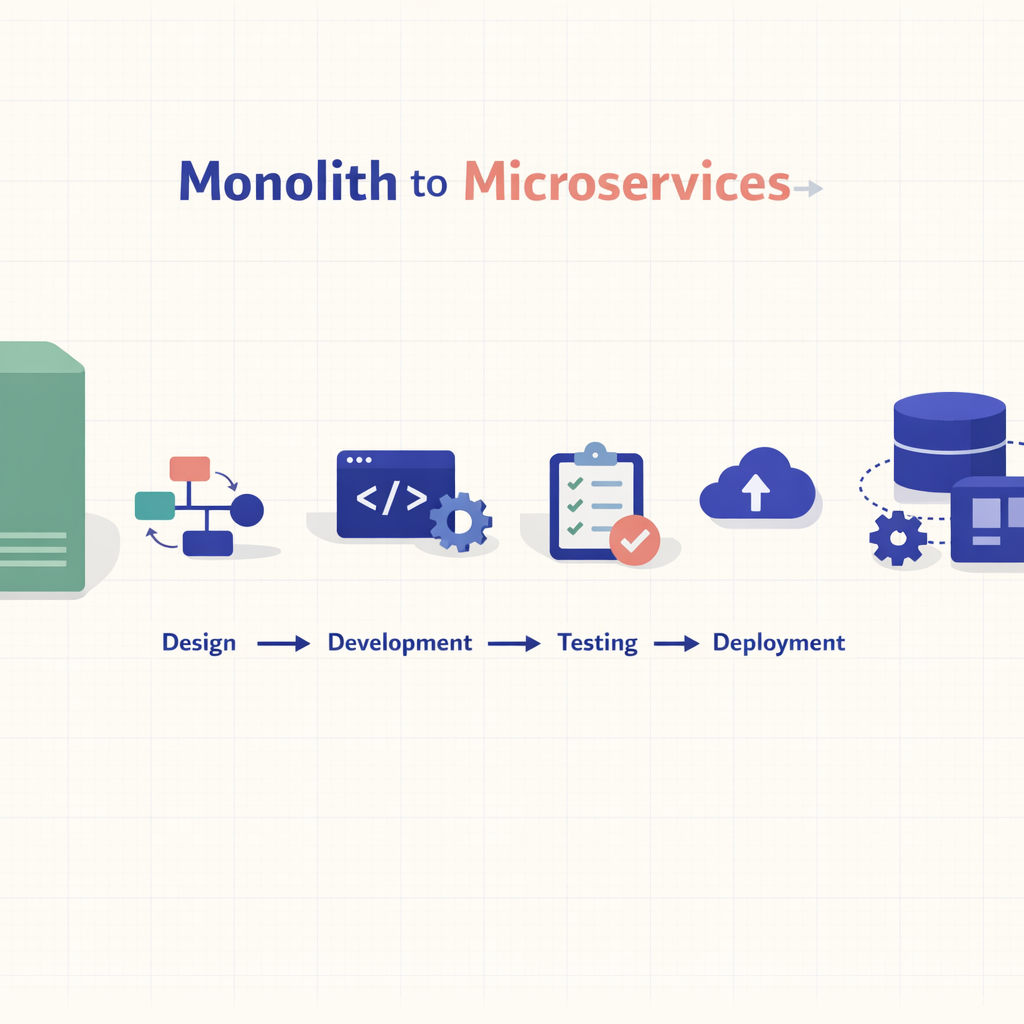 Technical diagram depicting the migration process from Monolithic architecture to Microservices architecture.
In summarizing the microservices vs monolith debate presented in this article, it's evident that the choice hinges on your specific project requirements and the dynamics of your team. Both architectural styles possess unique advantages and limitations.
On one hand, a monolithic design delivers a cohesive system where all components of the application integrate into a singular entity. This approach offers simplicity and is particularly advantageous for smaller, less complex systems. However, challenges arise when it comes to scaling or modifying specific aspects of the application independently.
Conversely, the microservices architecture adopts a more modular strategy, segmenting an application into smaller, autonomous units that communicate through APIs. This structure enhances scalability and enables parallel development, but it also introduces greater complexity and necessitates a more specialized skill set among team members.
Here is a summarized evaluation of key factors to consider:
| Factor | Microservices | Monolith |
|---|---|---|
| Scalability and Team Impact | Each service can be scaled independently, making it suitable for projects anticipating growth or frequent modifications. Teams can collaboratively work on different components, potentially using diverse technologies. This requires specialized 'deep dive' skills. | The entire system scales as a single entity, making it ideal for stable applications that do not require extensive scaling. This approach necessitates a thorough understanding of the entire system from team members, favoring 'generalist' skills. |
| Cost and Complexity | While this architecture entails greater DevOps overhead and higher upfront costs, it can lead to long-term savings through enhanced scalability and quicker feature deployment. | Monolithic systems generally involve lower initial development costs and simpler infrastructure. However, modifications can become costly and time-consuming over time, particularly in larger, growing applications. |
Migration Considerations
If you are contemplating transitioning from a monolithic structure to microservices due to scalability challenges or productivity concerns, it is crucial to assess your team's readiness, the associated DevOps costs, and the potential disruption to existing services.
Exploring the concept of the modular monolith may also be beneficial. This approach offers a compromise between monolithic and microservices architectures by maintaining a monolithic codebase while organizing it into modular sections that allow for independent development and deployment.
Ultimately, the decision between microservices and monolith should align closely with your project goals, team strengths, and available resources. As technology continues to evolve, so too will our understanding and application of these architectural styles. Stay attuned to ongoing discussions, conduct regular assessments of your architectural needs, and be prepared to adapt as necessary. In the ever-changing digital landscape of 2026, there is no one-size-fits-all solution; the most effective approach is the one that best meets your unique requirements.
Within the broad spectrum of software architecture, the debate between monolith and microservices persists. To navigate this complex domain, we address three key questions.
The decision between monolithic and microservices architectures depends on various factors. Monolithic designs are more suitable for smaller applications, where the development team can grasp the entire application, promoting simplicity and expedited build and deployment. For more extensive applications where scalability and team flexibility are critical, microservices become a relevant option.
Indeed, microservices architecture presents a more intricate framework. You may encounter challenges related to data consistency, network latency, and the orchestration of multiple services. Furthermore, the initial investment and maintenance for microservices can be higher due to the need for advanced deployment and monitoring tools. Nonetheless, the benefits of flexibility, scalability, and resilience often justify these costs for many organizations.
The Modular Monolith serves as a middle ground between monolithic and microservices architectures. It divides a monolithic application into several independent modules that operate within the same process. Each module fulfills a specific function, creating a system that is maintainable and retains the simplicity of a monolith while resembling a decoupled microservices architecture.