N
Naresh HRPublished on April 15, 2026
20 min read
Custom Software Development Timeline: How Long Does It Really Take?
Discover the phases and factors affecting custom software development duration.
Discover the phases and factors affecting custom software development duration.
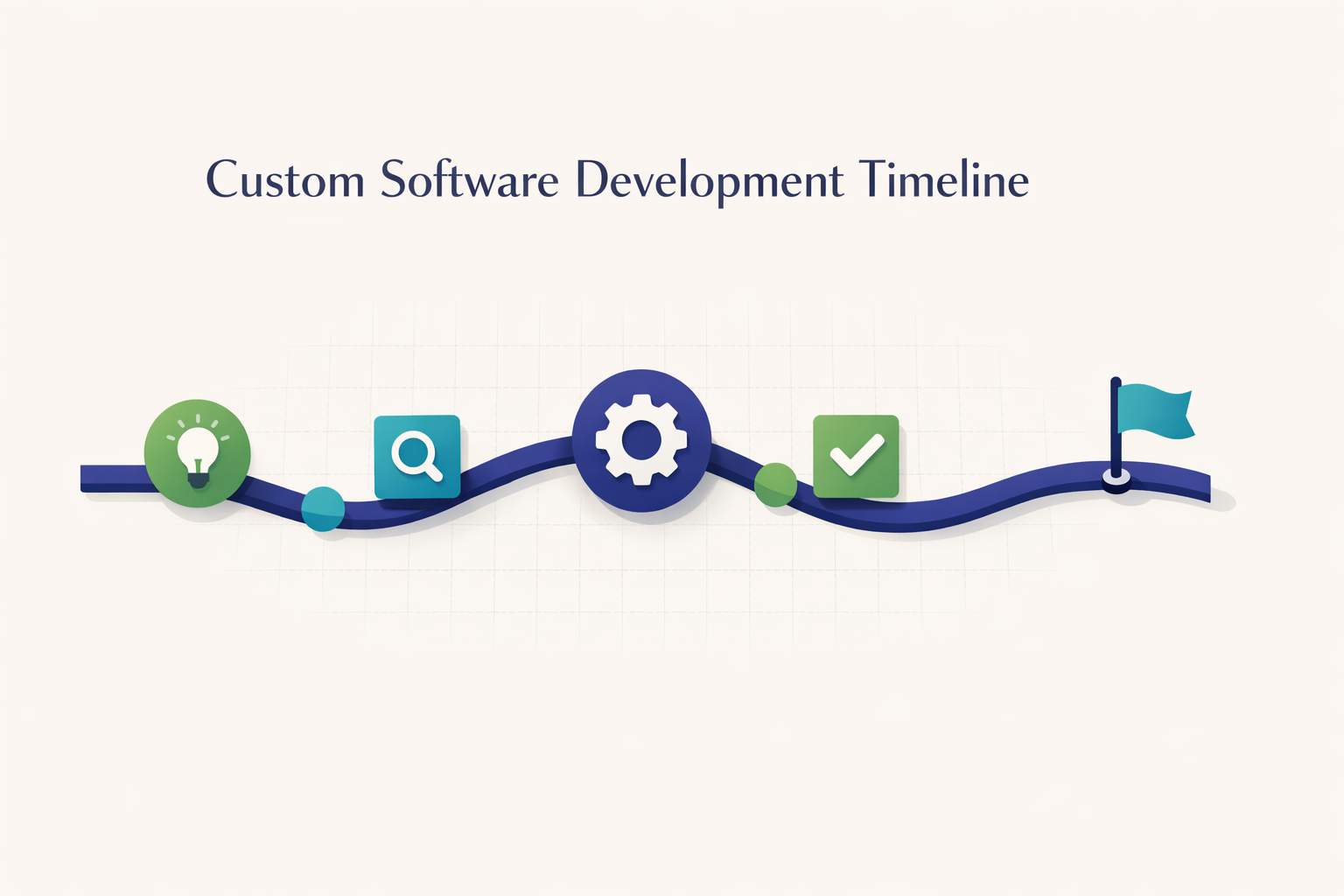
Hero banner depicting an abstract timeline illustration representing the concept of custom software development timeline.
Understanding the timeline for designing and implementing a custom software solution is crucial for effective strategic planning within businesses. However, grasping the nuances of a custom software development timeline can prove complex due to numerous influencing factors.
Creating an accurate estimate requires more than simply counting days or weeks; it involves carefully considering each unique phase of software development, which includes gathering requirements, designing the system, coding, testing, deployment, and subsequent software updates. Each phase has its own timeline, and together, they contribute to an overall estimate for the software development process.
Generally, smaller software projects may be completed in as little as 1-3 months, while medium-sized projects typically take between 3-6 months. More complex, larger-scale software projects can take significantly longer, often exceeding a year for full development, testing, and deployment. However, the answers to questions like "How long will it take to build an app?" or "What is the timeline for a custom software project?" heavily depend on the specifics of each individual project.
Several key variables determine the precise duration of software development, including:
Each of these factors can significantly influence the timeline for custom software development.
An important aspect to consider is the trade-off between speed and scope in custom software development. The quicker you wish to complete the development process, the higher the costs may rise, potentially requiring a reduction in the project's scope to stay within budget constraints. Conversely, a broader project scope might necessitate a longer development timeline.
In conclusion, understanding the timeline for software development provides businesses with essential insights for project planning and execution, ultimately enhancing the likelihood of project success.
Prepare to map out your custom software project timeline more effectively. Contact us here for a more detailed consultation.
 Abstract illustration of key variables that affect the software development time estimate.
How long does it take to build an app?
The timeline for app development varies based on the app's complexity, the proficiency of the development team, the chosen technology stack, and the targeted platforms.
How is the software development time estimate created?
The estimate is formulated by thoroughly evaluating each phase of the software development lifecycle, taking into account the relevant variables that could affect the timeline.
How can I speed up my custom software development process?
To accelerate development without sacrificing quality, it's essential to engage in careful planning, select the appropriate technology stack, and manage the project's scope effectively.
Custom software development is a complex, multi-faceted process with numerous stages, each possessing its unique timeline. Tailoring software to meet the specific needs and objectives of a business is anything but linear. Gaining a clear understanding of the various timelines involved can significantly enhance strategic planning.
When asking how long it takes to build an app or software, it’s crucial to comprehend the stages involved in the custom software development timeline and how each phase contributes to the overall duration.
The custom software development process primarily comprises the following stages:
The overall timeline of a custom software project can vary significantly based on its size:
| Project Size | Timeline |
|---|---|
| Small Projects | 1-3 months |
| Mid-sized Projects | 3-6 months |
| Large Projects | Exceeds 1 year |
However, it's important to remember that these are rough estimates; the actual timeline can be influenced by several key variables and potential delays.
Several critical factors play a vital role in determining the duration of a project:
In conclusion, understanding the typical phases of a custom software development timeline, along with the factors that influence overall duration, is essential for answering the question, "How long does it take to build an app or software?" Having a clear picture of what lies ahead can help enhance your strategic planning. For more expert insights or guidance on custom software development, visit our services page or contact us directly.
Custom software development unfolds in several key phases, each of which plays a crucial role in building a robust and scalable software solution tailored to meet strategic goals. Understanding these phases and their corresponding time estimates provides valuable insights into the overall timeline of custom software development.
The first phase of the software development timeline is requirements gathering, during which the project's specifics are outlined in detail. This phase typically takes anywhere from a few weeks to a month, depending on the complexity of the project.
Next, the system design phase begins. In this phase, technical experts architect the software's structure based on the requirements gathered earlier. This step usually takes about a month, according to software development time estimates.
Coding is undoubtedly one of the most time-consuming phases. Translating outlined requirements into functioning code involves extensive coding, collaboration, and numerous iterative improvements. Depending on the app's size and complexity, this phase can last anywhere from a few weeks to several months, or even up to a year for larger applications.
After the coding is complete, testing is conducted to identify and resolve any bugs or errors in the software. The duration of this phase can range from a few weeks to a couple of months, depending on the software's complexity.
The deployment phase entails transitioning the software from a development environment to a production environment. This process typically takes a few days to a week.
The timeline for custom software development does not conclude with deployment. Regular updates and maintenance are necessary to ensure the software remains operational and current. The duration of this phase can last as long as the software is in use.
The overall duration of custom software development is influenced by several key variables. Beyond project size, the complexity of functionalities and the technology stack utilized can significantly affect the timeline. Additionally, the skill level of the development team and the number of platforms for which the software is targeting will also impact the time required to build the application.
For instance, a healthcare application may take eight months from initial requirements gathering to deployment. In contrast, a more advanced predictive analytics algorithm for a large retail chain could take well over a year. Project timelines are highly customized and largely dependent on each of the factors mentioned above.
In conclusion, understanding the various stages involved in custom software development and their corresponding timelines is essential for setting realistic expectations for a software development project.
Do you have questions about custom software development timelines? Reach out to our team at /contact for further guidance or visit our service page: /services/custom-software-development. We're here to assist you in navigating every phase of your software development project.
Understanding the phases of custom software development allows for the formation of a preliminary software development timeline. However, these timelines can vary significantly based on project size.
In general, the timeline for a small project—such as a single-feature app or software with limited functionality—may range from 1 to 3 months.
For mid-sized projects, which typically involve dedicated applications with multiple features and increased complexity (e.g., an eCommerce platform, a CRM system, or a comprehensive business automation tool), the custom software development timeline can range from 3 to 6 months, depending on the specifics of the system's functionalities.
Large, intricate projects that require advanced solutions, multiple interlinking systems, or extensive data management can easily take more than 12 months to develop. Examples include creating a custom operating system, a complete ERP system, or a multi-platform solution, all of which demand extensive planning, a sizable development team, and rigorous testing prior to deployment.
Timelines can also be influenced by several factors:
Various factors can extend the duration of custom software development, including changes in project specifications, unforeseen technical challenges, iterative design processes, integration with existing systems, and the feedback loop from clients. The greater the number of variables in play, the more likely project timelines will shift.
To effectively manage these variables and ensure the delivery of a high-quality product, businesses are encouraged to collaborate with experienced software developers who can foresee potential challenges and streamline the development process.
For further insights on managing your custom software development timeline, please visit our services page on custom software development. If you seek professional guidance tailored to your project, don't hesitate to contact us for a detailed consultation.
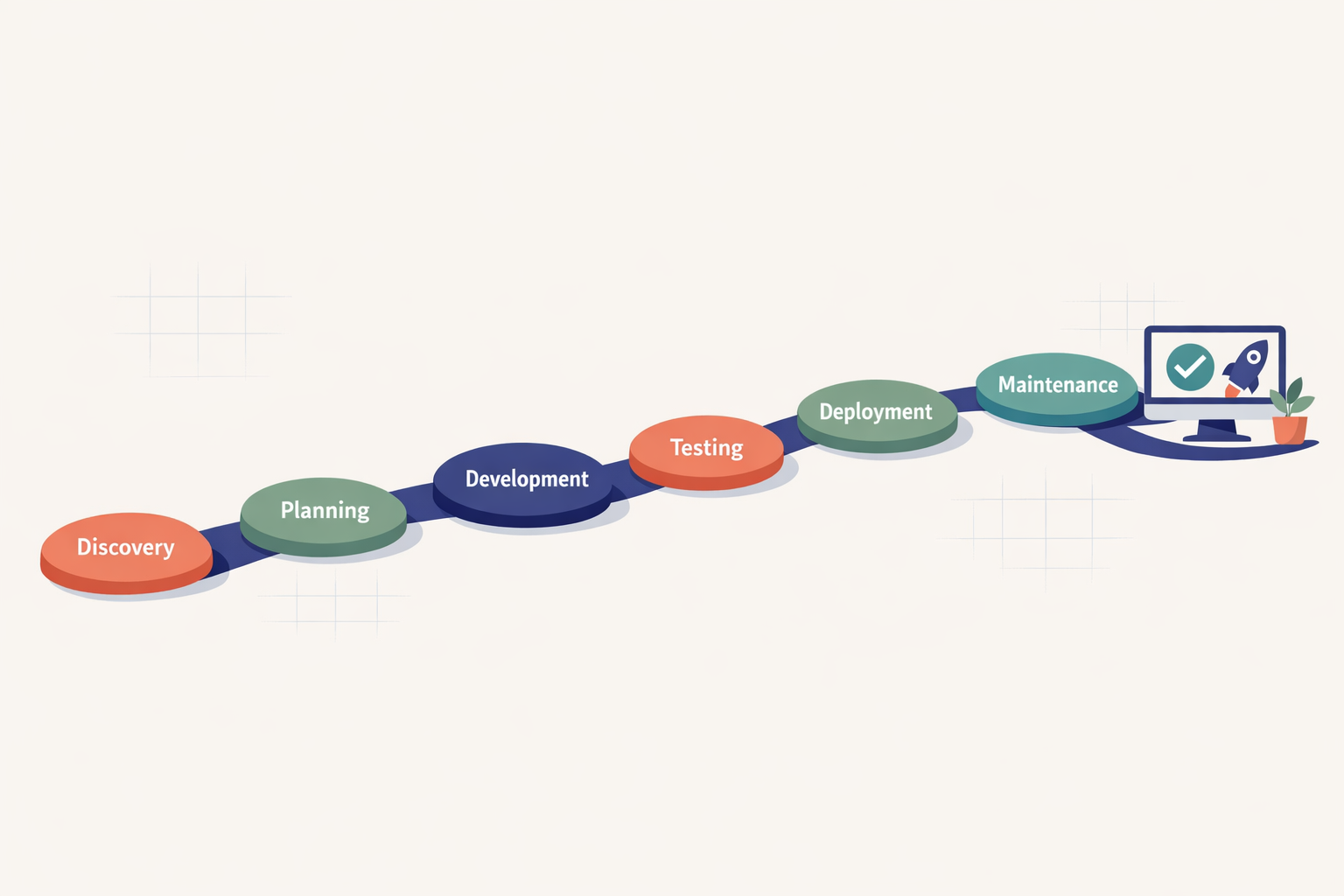
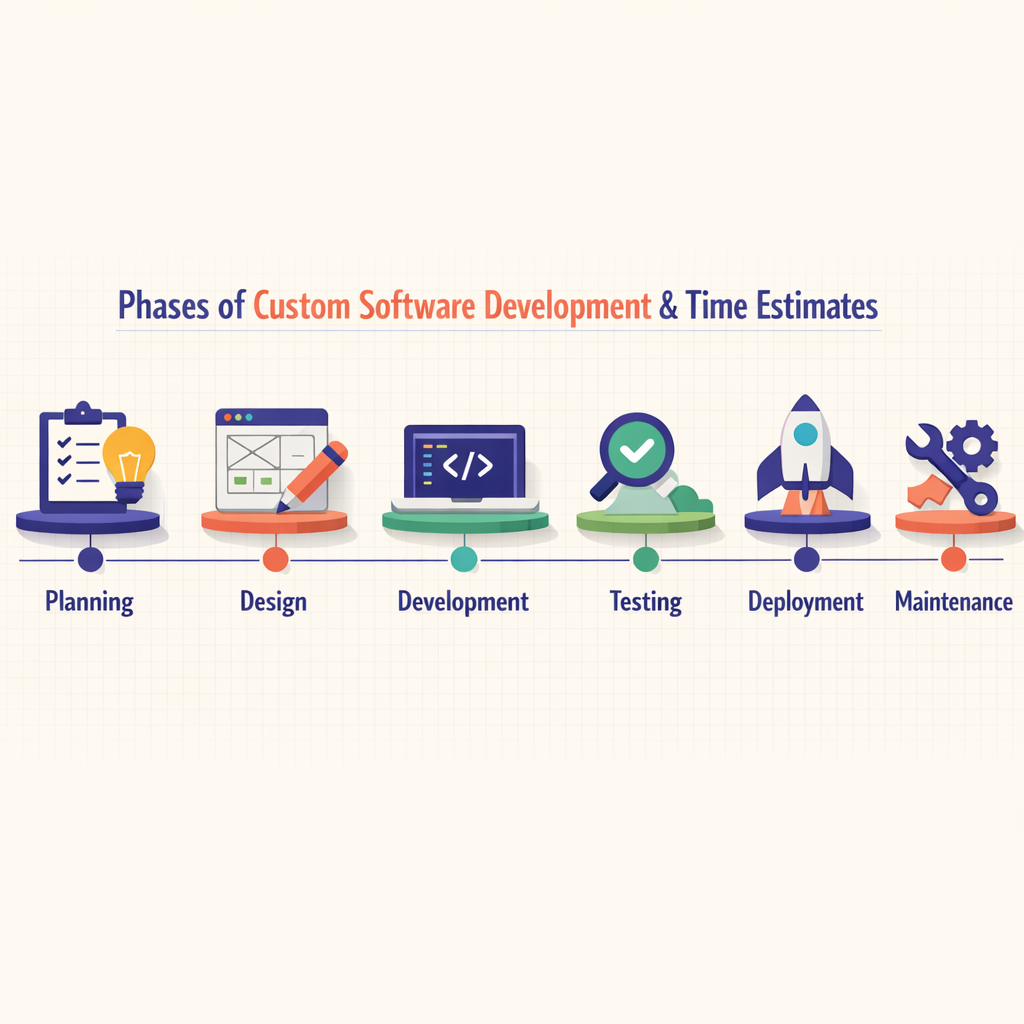 Diagram showing the different phases of custom software development with associated time estimates.
Question: How long does it take to build a single-feature app?
Answer: Typically, developing a single-feature app takes 1 to 3 months. However, this timeline can be significantly influenced by the complexity of the functionality and the technology employed.
Question: Can we speed up the custom software development process?
Answer: While certain measures can expedite the project, prioritizing speed may compromise thoroughness and quality. It is generally more beneficial to allocate sufficient time to ensure a well-balanced and effective product.
Question: What are some common causes of delays in custom software development?
Answer: Delays can occur due to:
When estimating the time required for software development, it is essential to consider a variety of variables that can either extend or reduce the duration of your custom software project. These factors can significantly influence how long it takes to build an application or develop a software product.
Evaluate the complexity of your project. More intricate projects, which may involve complicated architecture or numerous integrated features, generally require more time to develop than simpler ones. Key aspects to consider include:
The selection of your tech stack is another critical factor. Some technologies facilitate a faster development pace, while others might yield more powerful and refined results, albeit with a longer implementation timeline. Keep in mind that investing time upfront in choosing the right technology can ultimately save time during maintenance phases.
The size and expertise of your development team are also significant determinants of your software development time estimate. A larger team may deliver faster results, provided that they possess the necessary expertise and that the project is effectively managed to avoid communication issues or bottlenecks.
The number of platforms targeted for deployment will influence the overall development timeline. Developing for multiple platforms simultaneously can extend the duration, although utilizing cross-platform solutions may help expedite this process.
Regular and effective communication with stakeholders can expedite decision-making, providing clarity and accelerating the transition from ideation to development. On the other hand, infrequent or ineffective communication can hinder progress and delay the project.
In conclusion, the duration of custom software development is influenced by various parameters. It is crucial to account for all these factors when attempting an early software development time estimate. However, remember that each project is unique, and thus, the duration may vary accordingly.
Intrigued to find out more? Explore our Custom Software Development Services. Do you need assistance with your next project? Don't hesitate to reach out to us here.
When evaluating the custom software development timeline, it is essential to understand the various estimation methods that project managers and software developers utilize to provide accurate time estimates. These methods are tailored to accommodate different project types and their individual complexities.
| Method | Description | Advantages | Disadvantages |
|---|---|---|---|
| Expert Judgement | Leveraging the knowledge of seasoned professionals to estimate the timeline for building an app or custom software. | Utilizes experience; effective for familiar projects | Prone to bias; may lack accuracy with novel technology |
| Analogy-Based Estimation | Drawing on experiences from similar past projects to make informed guesses about project duration. | Based on comparable experiences; quick estimation | Every project is unique; inherent margin of error |
| Parametric Estimation | Applying standard formulas and historical data to calculate expected timeframes. | Highly effective when substantial historical data is available | Less applicable for innovative projects |
| Bottom-Up Estimation | Breaking down the project into smaller tasks, estimating each one, and summing the results. | Offers high accuracy | Time-consuming; can be overwhelming for complex projects |
| Top-Down Estimation | Starting with a broad overview and breaking it down into larger phases. | Provides a quick overview; easier management | May overlook critical smaller details |
Each of these methods presents a unique blend of advantages and challenges. The choice of the most suitable method ultimately depends on the project's nature, including its size, complexity, team familiarity with technology, and the project management methodology employed.
Investing time in creating realistic estimates is as important as the software development process itself. Accurate estimates help in managing expectations, planning budgets, and bridging the gap between client and developer perspectives.
Struggling with your custom software development timeline? Contact us for an expert consultation.
To better illustrate how a custom software development timeline can take shape, it’s helpful to examine real-life project examples. It's important to keep in mind that each project presents its own unique set of requirements and challenges, which can lead to variations in estimated development time.
A small business application designed for internal use involved:
Total Duration: Approximately 3 months.
The development of an e-commerce platform for a mid-sized company included:
Total Duration: Approximately 6 months.
A large-scale enterprise management system had a considerably longer timeline:
Total Duration: Nearly 1.5 years.
Be prepared to adapt and adjust timelines as necessary. Remember, responsiveness in adaptation can lead to software that not only meets your needs but also exceeds your expectations.
For expert assistance with your software development project, don't hesitate to get in touch with our experienced team, who can provide tailored solutions that align with your timeline.
FAQs
How long does it take to develop a simple app? Depending on the specific features and scope, developing a simple app could take anywhere from 1 to 3 months.
What is the standard timeline for developing a complex app? A complex, feature-rich app might take upwards of 6 months and could extend to over a year or more in certain cases.
Can fast-tracking the process compromise quality? Attempting to expedite non-negotiable stages may lead to quality issues or overlooked errors. Therefore, striking a balance between speed and scope is crucial in custom software development.
 Conceptual image of a balance scale representing the trade-offs in custom software development.
As we wrap up, navigating the landscape of custom software development need not feel like a daunting task. By understanding the various factors and methodologies involved, you can make informed decisions regarding your software development timeline.
Moreover, the size and scope of your project significantly impact the estimated duration of software development. Here’s a breakdown of typical timelines based on project size:
| Project Size | Estimated Duration |
|---|---|
| Small Projects | 1-3 months |
| Large Projects | Over 1 year |
However, these estimates should not be considered rigid rules. Delays can occur, variables may fluctuate, and the unique elements of your project can influence the overall timeline.
Leveraging insights from experienced professionals to estimate project timelines can be invaluable. Additionally, it's important to recognize that trade-offs are inevitable. You may need to negotiate between speed and scope based on your specific needs and constraints.
For a more practical understanding, refer back to the real-world examples discussed earlier. These provide tangible insights into timelines and serve as a reminder that project schedules are not fixed but are influenced by a variety of factors.
As you embark on your journey, keep these considerations in mind. While they may not provide an exact answer to 'how long it takes to build an app,' they will help you approach a more realistic estimate. If you seek expert assistance in estimating your project's duration, creating a roadmap, or navigating the nuances of custom software development, don't hesitate to contact us. We are here to guide you through your software development journey.
What factors contribute to the custom software duration?
Key aspects include the project's complexity, the chosen technology stack, the expertise of the development team, and the targeted platform.
How long does it usually take to build an app?
The timeline for app development can range from a few months to over a year, depending on its complexity, scope, and the methodologies employed.
Can the custom software development timeline be shorter?
While this is possible, it often requires sacrificing elements like scope or quality. Remember, quality should take precedence over speed.