S
Sagar HebbalePublished on April 21, 2026
16 min read
AI Automation for Ecommerce: Practical Applications in 2023
Discover how an ecommerce ai automation agency can optimize key processes.
Discover how an ecommerce ai automation agency can optimize key processes.
AI automation for ecommerce can automate repeatable workflows across merchandising, support, operations, pricing, marketing, and risk management right now. An ecommerce ai automation agency can do this on Shopify and Magento stacks while keeping humans involved for approvals, edge cases, and policy decisions.
I see this as a practical execution problem, not a futuristic one. If the workflow is repetitive, high-volume, and measurable, I can usually automate a meaningful part of it with AI for ecommerce operations. That includes product content, ticket routing, pricing recommendations, return decisions, forecasting, review analysis, personalized campaigns, and fraud scoring. At Imversion Technologies Pvt Ltd, I approach these systems as business infrastructure -- not experiments. Strong architecture defines product success. Execution matters more than ideas.
AI automation for ecommerce means I combine AI models with workflow logic so routine work moves faster, with fewer manual touches, and with clear business controls. That is different from basic automation and very different from handing everything to an autonomous system.
Rule-based automation follows fixed conditions. If payment clears, send confirmation. If stock drops below threshold, alert procurement. Useful. But narrow. AI automation online retail adds judgment-like capabilities on top of those flows -- classification, prediction, generation, recommendation, anomaly detection, and decision support. It can read a customer ticket, identify intent, estimate urgency, suggest a reply, and route it to the right queue. Or draft product descriptions from catalog attributes and brand guidelines.
But I do not treat AI as a replacement for operating teams.
I treat it as an accelerator wrapped in policy, business rules, and approvals. At Imversion Technologies Pvt Ltd, a common pattern I encounter is that teams first ask for “full automation,” then quickly realize the highest-performing systems are supervised systems. Humans still approve risky refunds, override pricing exceptions, review suspicious fraud cases, and tune campaign strategy. That is how ai for ecommerce operations becomes dependable.
Sagar Hebbale here -- and my view is simple. Technology should solve real problems. If the process is ambiguous, politically sensitive, or poorly documented, AI will expose that weakness fast. If the process is structured and the inputs are strong, AI can compress cycle time dramatically. So the real work is designing the workflow around the model: triggers, context retrieval, rule enforcement, confidence thresholds, fallback logic, and auditability. That is where reliable ecommerce process automation actually happens.
An ecommerce automation agency usually starts with workflows that are repetitive, high-volume, and measurable. That is the right place to begin because the ROI is visible and the operational risk stays manageable.
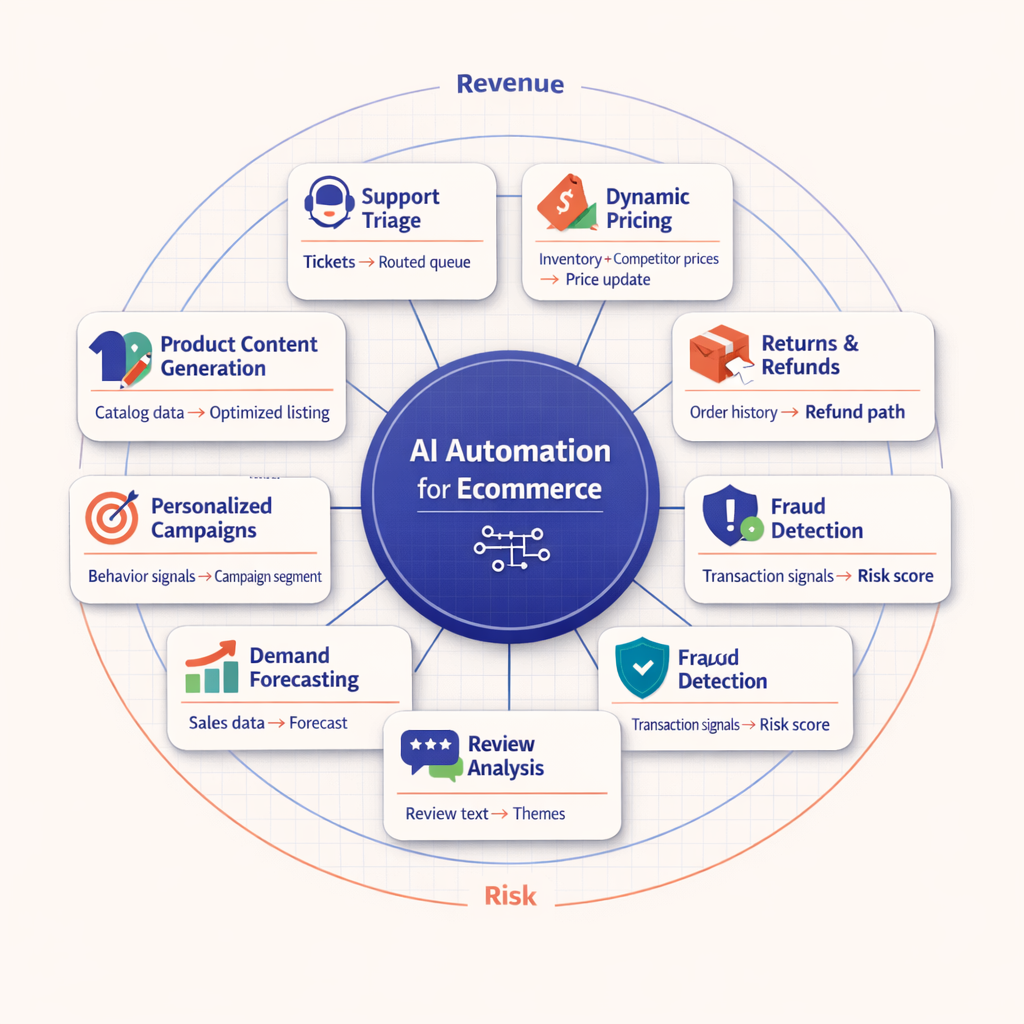
Central AI automation for ecommerce hub linked to eight process cards labeled product content, support triage, dynamic pricing, returns, demand forecasting, review analysis, personalized campaigns, and fraud detection
I can automate title drafts, descriptions, bullet points, metadata, alt text, attribute tagging, and category suggestions using catalog data, brand voice rules, and SEO templates. Human review should stay in place for premium lines, regulated products, and final publishing approvals.
For Shopify and Magento merchants, I often see content bottlenecks slow down launches. AI can pull from product attributes, supplier feeds, PIM records, and image context to create first drafts at scale. Guardrails matter: brand lexicon, banned claims, formatting templates, and validation against actual attributes. Inputs need to be clean. If color, material, dimensions, or fit data are inconsistent, the output degrades fast. The business outcome is faster merchandising velocity, better catalog consistency, and stronger discoverability.
I can automate ticket classification, sentiment tagging, priority scoring, routing, reply suggestions, and self-service resolution for common questions. In Shopify stacks, this often connects order data, shipping updates, customer profiles, and helpdesk tools. In Magento environments, the pattern is similar -- just with more custom integration work.
What matters is confidence handling. I want the system to fully resolve simple requests like order status or return policy questions, while escalating exceptions such as damaged goods, payment disputes, or VIP complaints. Inputs usually include order history, shipping status, prior conversations, macros, and policy documents. KPIs are straightforward: average handling time, first-response time, ticket deflection, and CSAT. At Imversion Technologies Pvt Ltd, I often see support triage become the fastest path to visible ROI because the workflow is repetitive and the metrics are obvious.
I can automate price recommendations or rule-bounded price changes using competitor signals, inventory position, sell-through rates, demand patterns, margin floors, and campaign calendars. Humans should approve changes for strategic SKUs, premium products, and brand-sensitive categories.
This is where ai automation online retail gets powerful -- and dangerous if implemented badly. Pricing cannot be left unconstrained. I always use guardrails like minimum margin thresholds, MAP compliance logic where relevant, promotion exclusions, and approval flows for large changes. Shopify merchants may use app-based pricing layers plus middleware; Magento merchants often need deeper catalog and pricing engine orchestration. The outcome is margin protection, conversion improvement, and better inventory movement. But only if the architecture is disciplined.
I can automate return eligibility checks, label generation, policy validation, reason-code capture, low-risk refund approval, and exception routing. That reduces manual workload in a part of ecommerce operations that is often messy, expensive, and emotionally charged.
Inputs include order details, shipment status, payment confirmation, return windows, product category rules, customer history, and fraud signals. Guardrails should be strict: policy exceptions, high-value orders, suspicious return behavior, and damaged-item claims need human review. For Shopify, this often means connecting storefront orders, WMS or OMS data, payment systems, and helpdesk actions. For Magento, I often see more custom return logic already present, which AI can augment rather than replace. The business outcome is faster resolution, lower refund leakage, and cleaner return analytics.
I can automate SKU-level demand forecasts using sales history, seasonality, promotions, stockout patterns, channel mix, lead times, and sometimes external signals. This is one of the highest-value use cases because inventory mistakes are expensive.
Forecasting is not just about models. It depends on data hygiene, calendar context, and operational definitions. Are preorders included? How are stockouts handled? What about bundles? I use AI to generate forecasts and exception alerts, then keep planners in control of final purchasing decisions. This improves replenishment timing, inventory allocation, and stockout prevention. In my experience at Imversion Technologies Pvt Ltd, teams often underestimate how much master data discipline matters here. Plan for scalability early. Otherwise the model works in a pilot and then collapses under real catalog complexity.
I can automate the analysis of product reviews, support conversations, survey comments, and social feedback to extract recurring themes, defects, feature requests, fit issues, and sentiment trends. This is one of the cleanest applications of AI for ecommerce operations because the output supports multiple teams at once.
Merchandising gets insight into conversion blockers. Product teams see quality issues. Support identifies recurring friction. Marketing learns what language customers actually use. Inputs are usually review text, ratings, SKU metadata, and return reasons. Guardrails are lighter here because the system is mostly analytical, though topic taxonomies still need curation. The outcome is faster insight generation and better decisions across catalog, messaging, and operations.
I can automate segmentation, churn prediction, replenishment reminders, cart recovery, upsell recommendations, win-back timing, and content variation for email and SMS campaigns. This is where ecommerce process automation meets revenue generation directly.
The inputs are behavioral events, order history, product affinities, lifecycle stage, campaign engagement, and inventory availability. Human control still matters around offer strategy, frequency caps, and brand voice. On Shopify, I usually see tighter native integrations with marketing tools; on Magento, customer data may be more fragmented, so CDP or middleware support becomes more valuable. Business outcomes include higher conversion rate, improved revenue per send, stronger retention, and better average order value.
I can automate transaction risk scoring using device signals, geolocation, velocity patterns, order behavior, address mismatches, payment anomalies, and historical fraud labels. High-risk orders should route to manual review. Low-risk orders should pass quickly.
This is not only about catching fraud. It is also about reducing false positives that block good customers. That balance matters. The best setup combines machine learning scores with hard business rules, payment provider signals, and analyst review queues. For Shopify and Magento merchants, integration with payment gateways, fraud tools, OMS, and customer data is key. The outcome is lower chargeback exposure, fewer manual checks, and better approval rates on legitimate orders.
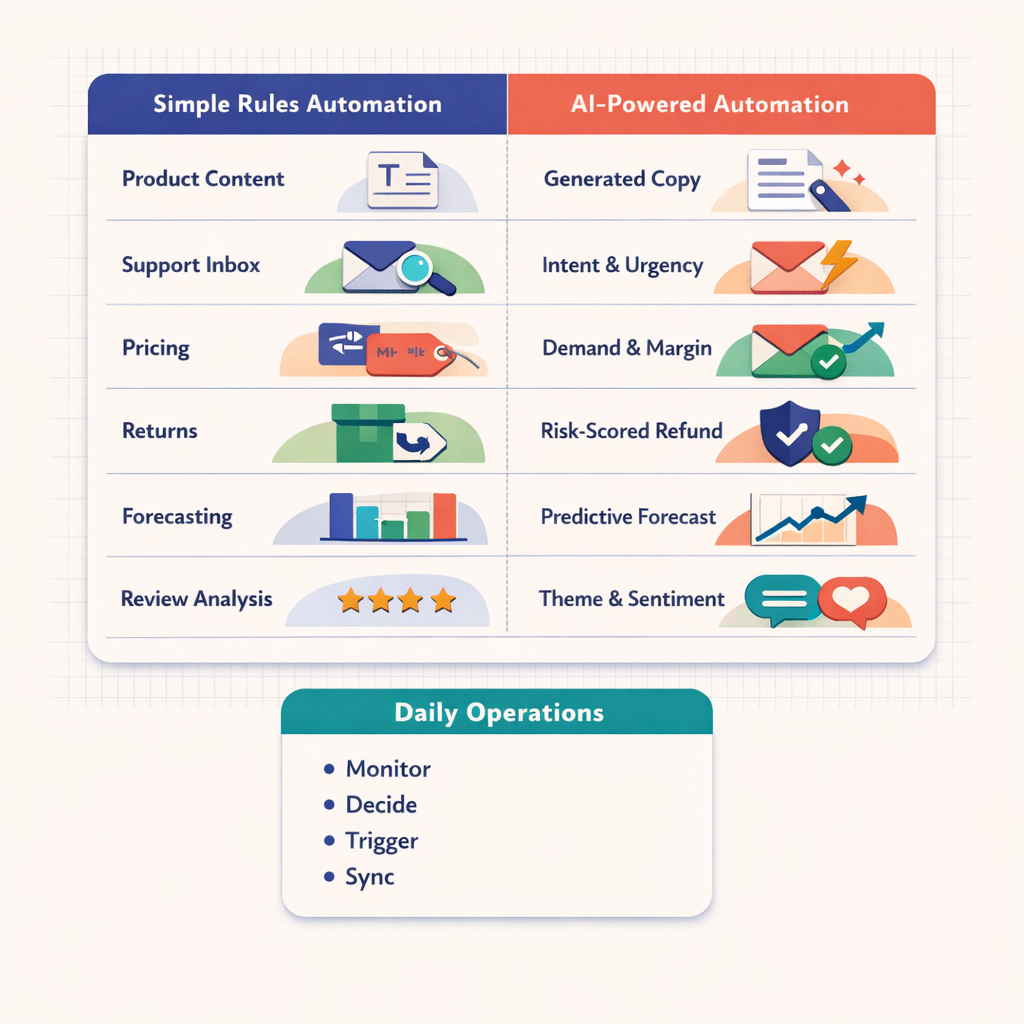 Two-column comparison table showing rules-based automation versus AI-powered automation for product content, support inbox, pricing, returns, forecasting, and review analysis with operational notes
I do not greenlight ai automation for ecommerce based on excitement. I look for baseline metrics, target outcomes, and delivery complexity. If a team cannot define success, the automation should not start yet.
For support triage, I track average handling time, first-response time, deflection rate, and escalation accuracy. For product content, I look at time to publish, throughput, error rate, and organic performance indicators. For returns, I care about cycle time, refund leakage, policy compliance, and customer resolution speed. For pricing, margin protection and conversion both matter. For forecasting, forecast accuracy and stockout reduction matter. For campaigns, revenue per send and retention lift matter. For fraud, chargeback rate and false-positive rate matter.
Complexity comes from six places:
Here is the lens I use:
| Use case | ROI speed | Data readiness need | Implementation complexity | Governance risk |
|---|---|---|---|---|
| Product content generation | Fast | Medium | Low-Medium | Low |
| Support triage | Fast | Medium | Medium | Medium |
| Personalized campaigns | Fast-Medium | High | Medium | Medium |
| Review analysis | Medium | Low-Medium | Low | Low |
| Returns and refunds | Medium | High | Medium-High | High |
| Dynamic pricing | Medium | High | High | High |
| Demand forecasting | Medium-Slower | High | High | Medium |
| Fraud detection | Medium | High | High | High |
Because complexity is uneven, I usually recommend starting with low-governance workflows that still have visible impact. That sequencing is what turns ecommerce process automation into a compounding program instead of a stalled pilot.
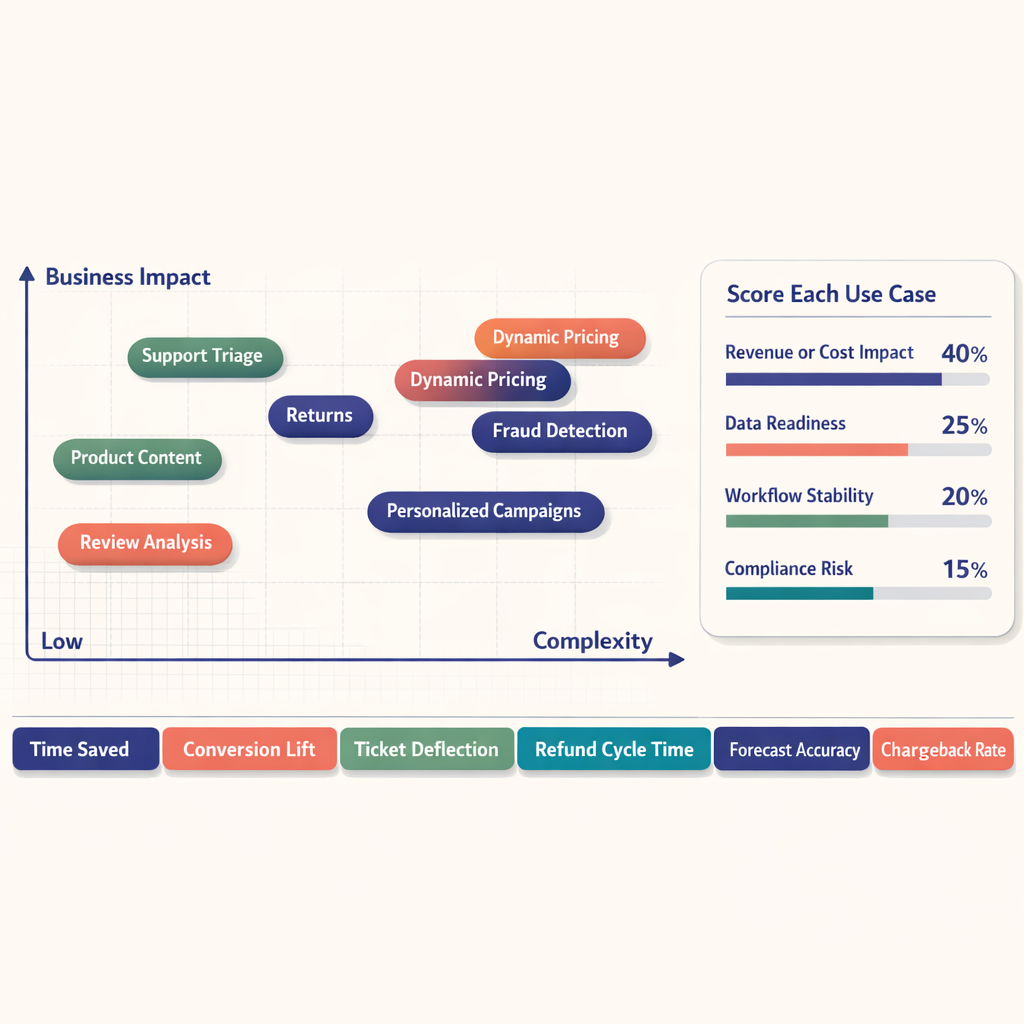 Impact-versus-complexity matrix plotting eight ecommerce automation use cases with a weighted scorecard for revenue impact, data readiness, workflow stability, compliance risk, and KPI labels
The architecture for ai automation for ecommerce is not mysterious. It is a connected operating layer around the commerce platform. I map the core systems first: Shopify or Magento as the storefront and transaction source, PIM for product truth, ERP for finance and inventory, CRM or CDP for customer context, helpdesk for support, WMS or OMS for fulfillment, marketing tools for outbound campaigns, analytics for measurement, and payments or fraud systems for risk signals.
Then I design orchestration.
An ecommerce ai automation agency should use APIs and webhooks for event triggers, queues for resilience, workflow engines for process logic, and human-in-the-loop dashboards for approvals and exception handling. If the use case needs retrieval over policy docs, catalog notes, or support knowledge, I may add vector search. But only where it improves reliability. Not everywhere.
Batch and real-time patterns should stay separate. Forecasting, review analysis, and large-scale content generation often run in batch jobs on schedules. Support routing, fraud scoring, and pricing decisions may need real-time or near-real-time execution. That changes infrastructure choices, timeout handling, and fallback design. If a model call fails during checkout risk scoring, I want deterministic fallback rules. Fast. No drama.
At Imversion Technologies Pvt Ltd, a pattern I see often is that teams focus on the model prompt before they fix system boundaries. That is backwards. I want logging, monitoring, prompt and version control, confidence thresholds, retry policies, and audit trails from day one. I also want role-based access, PII handling controls, secret management, and environment separation across staging and production. Because ai for ecommerce operations touches revenue, customer trust, and policy enforcement. One weak integration can break the whole chain.
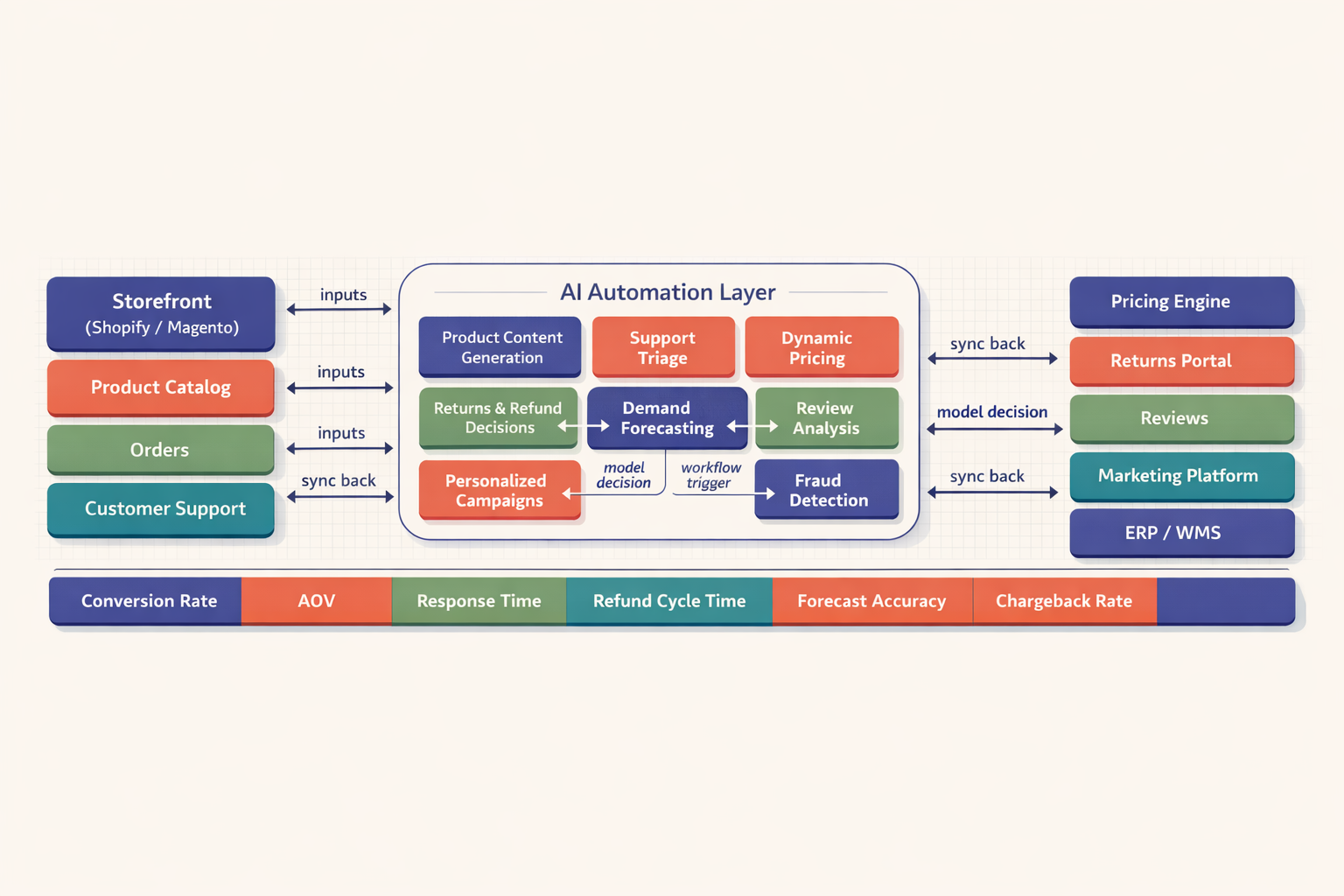 Architecture diagram showing Shopify and Magento storefronts connected to an AI automation layer with modules for pricing, support triage, returns, forecasting, reviews, campaigns, and fraud detection, plus ERP, CRM, helpdesk, OMS, and analytics systems
Strong architecture defines product success.
I use a simple scoring model before I recommend any build. Every candidate workflow gets scored from 1 to 5 across business value, workflow volume, data readiness, integration effort, exception rate, compliance risk, and time to pilot. Then I rank for fast, measurable wins.
What should most brands automate first? Repetitive workflows with strong inputs and clear success metrics. Support triage. Product content generation. Review analysis. Personalized campaign triggers. These are usually the best entry points for ai automation online retail because they create visible value without forcing the organization into high-risk decisions too early.
My phased rollout is straightforward:
That is the lens I use as an ecommerce automation agency leader, and it is how I advise teams at Imversion Technologies Pvt Ltd. Start where execution is clean. Then scale. Ideas are cheap. Operating systems are not. If the goal is durable ecommerce process automation, I want the first deployment to prove business value, architectural fit, and governance discipline all at once. That is how I build AI systems that hold up in production.
AI automation for ecommerce combines models, business rules, and system integrations to make decisions or generate outputs based on context. Standard apps usually follow fixed logic and predefined triggers. The difference is that AI can classify, predict, summarize, recommend, and adapt within guardrails, while conventional automation mostly executes static workflows.
AI automation for ecommerce can show ROI within weeks when applied to narrow, high-volume workflows such as support triage, product content drafting, or review analysis. Broader use cases like pricing, forecasting, and fraud scoring usually take longer because they require stronger data quality, tighter controls, and more stakeholder alignment before measurable gains appear.
An ecommerce ai automation agency reduces time lost to architecture mistakes, weak integrations, and poor workflow selection. Agencies bring implementation patterns, governance frameworks, and cross-platform experience that most internal teams develop only after costly trial and error. The strongest agency value is not the model itself; it is designing a system that works reliably in production.
AI should not make high-risk decisions alone in edge cases. A well-designed system uses confidence thresholds, rule checks, and approval queues so uncertain or sensitive cases move to human reviewers. This approach protects margin, compliance, and customer trust while still automating the high-volume routine decisions that create most of the operational efficiency.
The first data to clean is product catalog structure, order history, customer identifiers, policy rules, and event tracking. These datasets drive most ecommerce automations and determine whether outputs are usable. If attributes are inconsistent, statuses are unreliable, or policies are undocumented, the automation layer will amplify those problems rather than solve them.