A
Ankit Kumar BaralPublished on April 19, 2026
16 min read
RPA vs AI Automation: Why Agencies Are Shifting in 2023
Explore the critical differences between RPA and AI automation and why companies are switching their automation strategies.
Explore the critical differences between RPA and AI automation and why companies are switching their automation strategies.
The short answer in the rpa vs ai automation debate is simple: companies are switching because RPA solved repetitive clicks, while AI automation solves interpretation, variation, and decision-heavy work. The shift from an rpa vs ai automation agency choice happens when leaders realize bots alone cannot handle unstructured data, changing rules, and constant maintenance.
RPA was the first wave of automation. It mattered. It still matters in the right conditions. But business processes did not stay clean, structured, and stable. Inputs started arriving as emails, PDFs, chats, screenshots, and mixed-format documents. Policies changed. Interfaces changed. Exceptions multiplied.
That is where the old automation model starts to strain.
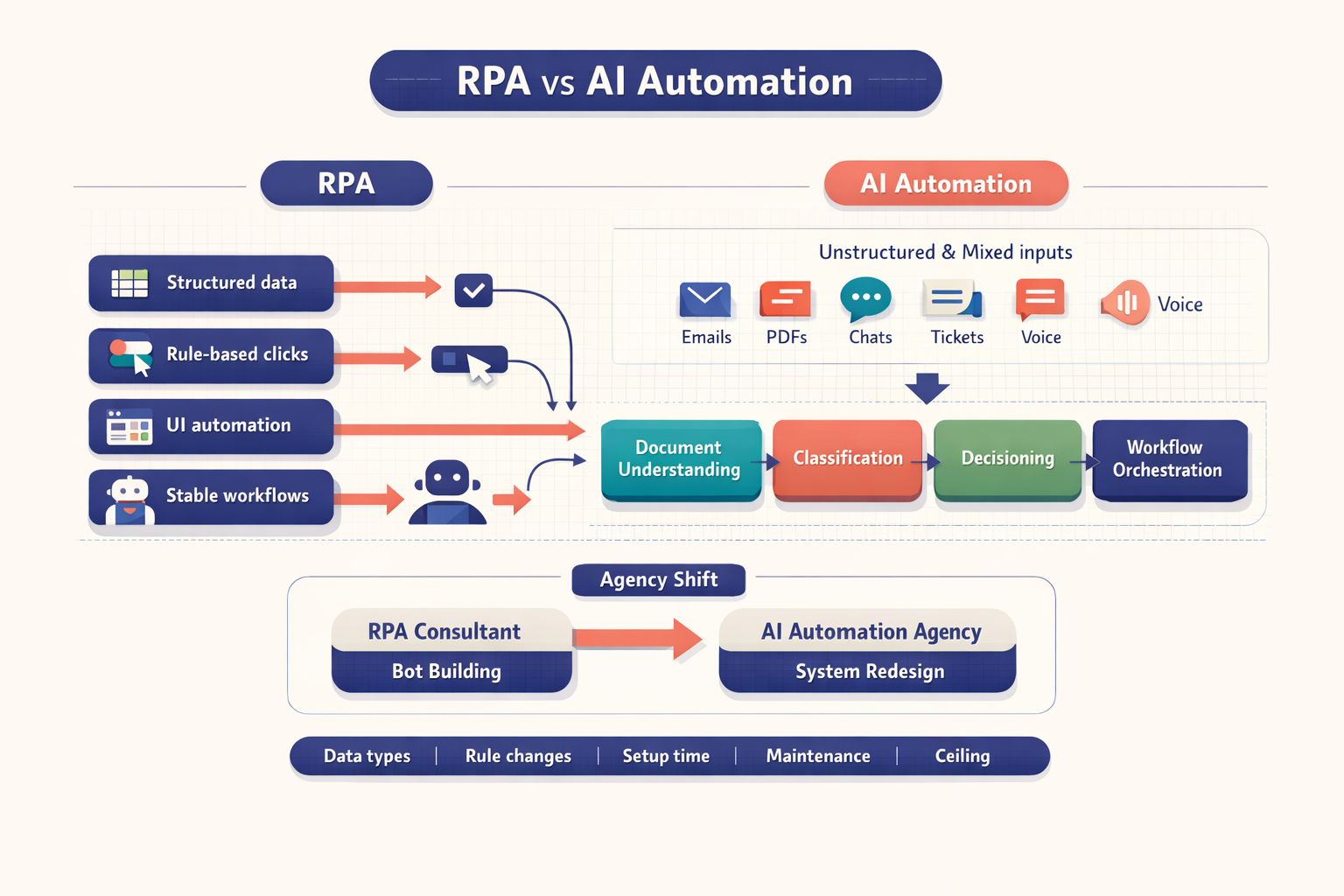
Side-by-side workflow diagram comparing RPA and AI automation, with spreadsheets and web forms feeding a rules-based bot on the left and emails, PDFs, chats, and documents flowing into an AI-driven process with document understanding and decision steps on the right
Ankit Kumar Baral, Full-Stack Developer at Imversion Technologies Pvt Ltd, approaches this topic from a systems perspective: automation should not be judged by whether it works once, but by whether it stays reliable under change. That distinction is driving agency switching. At Imversion Technologies Pvt Ltd, a common pattern teams encounter is that companies first buy bot capacity, then later discover they actually need workflow intelligence, data pipelines, API integrations, and governance around AI outputs. Different problem. Different partner.
RPA earned adoption because it solved a painful business problem with relatively low disruption. Instead of replacing legacy systems or waiting for major ERP upgrades, companies could deploy software bots to mimic user actions across existing applications. Click here. Copy that. Paste there. Log the result. Move to the next case.
That was powerful.
For finance teams, this meant automating reconciliations, invoice entry from standard templates, and report distribution. In HR, it meant onboarding workflows, payroll data updates, and system synchronization. In operations and support, it often meant order status checks, ticket creation, and repetitive data transfer between disconnected tools.
The attraction was practical, not theoretical. RPA often delivered time-to-value faster than large transformation programs because it sat on top of existing interfaces. No major backend rebuild. No long replacement cycle. Just process mapping, bot scripting, testing, and rollout.
This is one reason the rpa vs ai automation conversation should be framed historically, not emotionally. RPA was not a mistake. It was the right first answer for a large class of repetitive work.
In our experience at Imversion Technologies Pvt Ltd, teams that adopt automation usually begin with the most visible manual burden, not the most strategically complex process. That is exactly where RPA performs well. It gives organizations a way to reduce repetitive effort before they are ready for deeper systems redesign.
But the method had a built-in assumption: the process should remain predictable enough for scripts to hold.
As enterprises pushed automation into more realistic workflows -- vendor emails, claim documents, customer messages, contract reviews, multi-system approvals -- they hit the boundary. The issue was no longer task execution alone. It was interpretation. Context. Variability. That pressure is why the buyer conversation has moved from simple bot deployment to the broader rpa vs ai automation agency decision.
RPA is strongest where work is repetitive, rule-based, and built on structured data. If a process has fixed fields, known formats, a stable user interface, and clear business rules, bots can be efficient and reliable.
Examples include:
In these cases, the value is obvious. Setup can be relatively fast. Audit trails are clear. Compliance teams often like the determinism because the bot follows explicit steps every time. If a buyer wants a workflow with low exception rates and measurable labor reduction, RPA can still be the right tool.
And this matters. Too much commentary treats automation as if only the newest option counts. It does not. Reliable systems matter most.
A well-designed RPA bot can reduce manual handling time, standardize execution, and avoid expensive platform replacement. For a stable workflow, that is enough.
The pressure point appears once process reality gets messy. This is where rpa limitations ai discussions become commercially relevant, not academic.
RPA struggles with:
Unstructured inputs
Emails, contracts, scanned PDFs, handwritten notes, support chats, and mixed-layout documents do not fit neat field mapping. OCR can help, but extraction alone is not understanding.
Frequent interface changes
UI bots depend on selectors, layouts, and screen positions. A vendor portal update can break a script overnight. Small changes. Big maintenance.
Exception-heavy workflows
If 20 percent of cases need judgment, escalation, or context, bots hit the edge fast. Hard-coded branches multiply. Maintenance follows.
Limited decision-making
RPA can apply rules. It does not reason through ambiguity. It cannot read the tone of a complaint, compare clauses across contracts, or infer intent from an email thread without AI support.
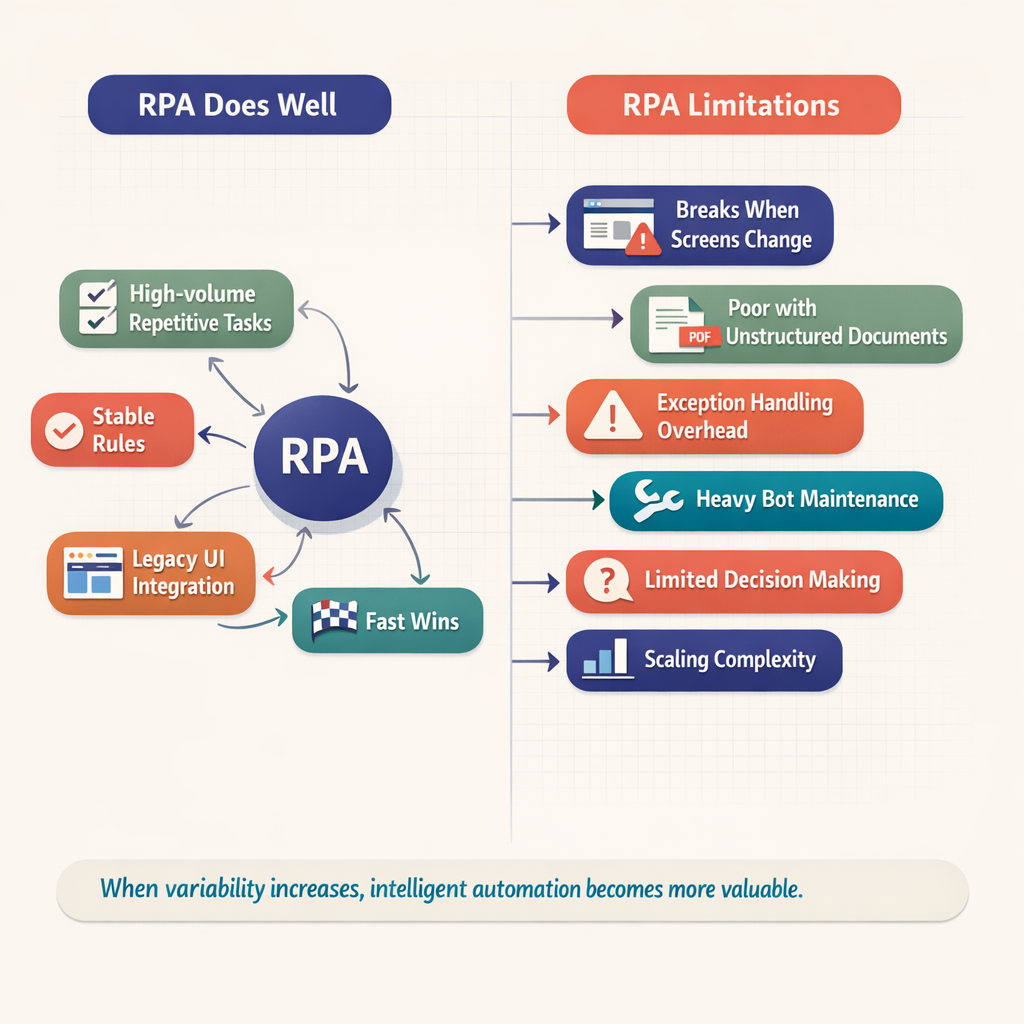 Two-column concept map showing RPA strengths such as structured data, stable rules, and repeatable steps alongside RPA limitations including screen changes, unstructured documents, exception handling overhead, and brittle maintenance
Consider the difference between two workflows. A bot entering invoice fields from a fixed supplier template is a classic RPA case. But an inbox receiving invoices, credit notes, attachments, and vendor questions in inconsistent formats is different. The second workflow needs classification, extraction, validation, and routing based on context. That is not just clicking. It is interpretation.
At Imversion Technologies Pvt Ltd, a pattern often seen is that companies blame the tool when the bigger issue is scope drift. They started with deterministic steps, then kept adding document variety, approval logic, and exception handling until the bot became fragile. Because the process changed, the automation model had to change too.
That is the real pivot in rpa vs ai automation.
AI automation goes beyond replaying steps. It can read language, classify intent, extract entities, summarize content, detect anomalies, and support decisions inside a workflow. With OCR, IDP, LLMs, retrieval systems, and backend APIs, automation becomes less dependent on static screens and more aligned with business meaning.
This is the real distinction in intelligent automation vs rpa. RPA executes predefined actions. AI helps the system understand what action should happen next.
That changes workflow design.
Instead of building dozens of hard-coded branches, teams can use AI to interpret incoming content, score confidence, route low-confidence cases for human review, and pass approved outputs into downstream systems through APIs. Cleaner architecture. Better control.
A classic RPA bot can download a contract, rename the file, upload it into a repository, and notify a reviewer. Useful, yes. But limited.
AI automation can:
The task is no longer document movement alone. It becomes document understanding.
Support inboxes are rarely structured. Customers write in different tones, ask multiple questions, attach screenshots, and reference previous cases. An RPA bot can create tickets from emails based on fixed fields. But if the workflow requires intent detection, urgency scoring, response drafting, or routing by context, AI is the better fit.
A practical stack might include:
So the workflow becomes orchestrated, not scripted.
The intelligent automation vs rpa comparison should not be framed as replacement in every case. Some of the best systems combine both. AI interprets the incoming content. Rules engines apply policy logic. APIs write data to systems of record. RPA handles the few steps where no API exists and UI interaction is still required.
This hybrid model works well in claims handling, support ticket routing, procurement intake, and onboarding review. In our experience at Imversion Technologies Pvt Ltd, the strongest automation outcomes come from reducing brittle dependencies first, then deciding where bots still make economic sense. Clarity beats complexity. Always.
The most useful rpa vs ai automation comparison is operational. Buyers should evaluate how each approach behaves after deployment, not only during demos.
| Dimension | RPA | AI Automation |
|---|---|---|
| Data types handled | Best with structured fields, fixed templates, stable forms | Handles structured and unstructured data such as emails, PDFs, contracts, chats, and images |
| Response to rule changes | Requires script updates and retesting when UI or steps change | Can adapt better to variability, especially with model-driven classification and configurable workflows |
| Setup time | Fast for simple, repetitive tasks with clear rules | Often longer upfront due to model evaluation, prompt design, data preparation, and governance |
| Maintenance load | High when selectors break, exceptions rise, or workflows drift | Lower UI brittleness if built around APIs and document understanding, though models need monitoring |
| Exception handling | Weak for ambiguous or novel cases | Stronger through confidence scoring, routing, summarization, and human-in-the-loop review |
| Automation ceiling | Task automation | Task automation plus interpretation and decision support |
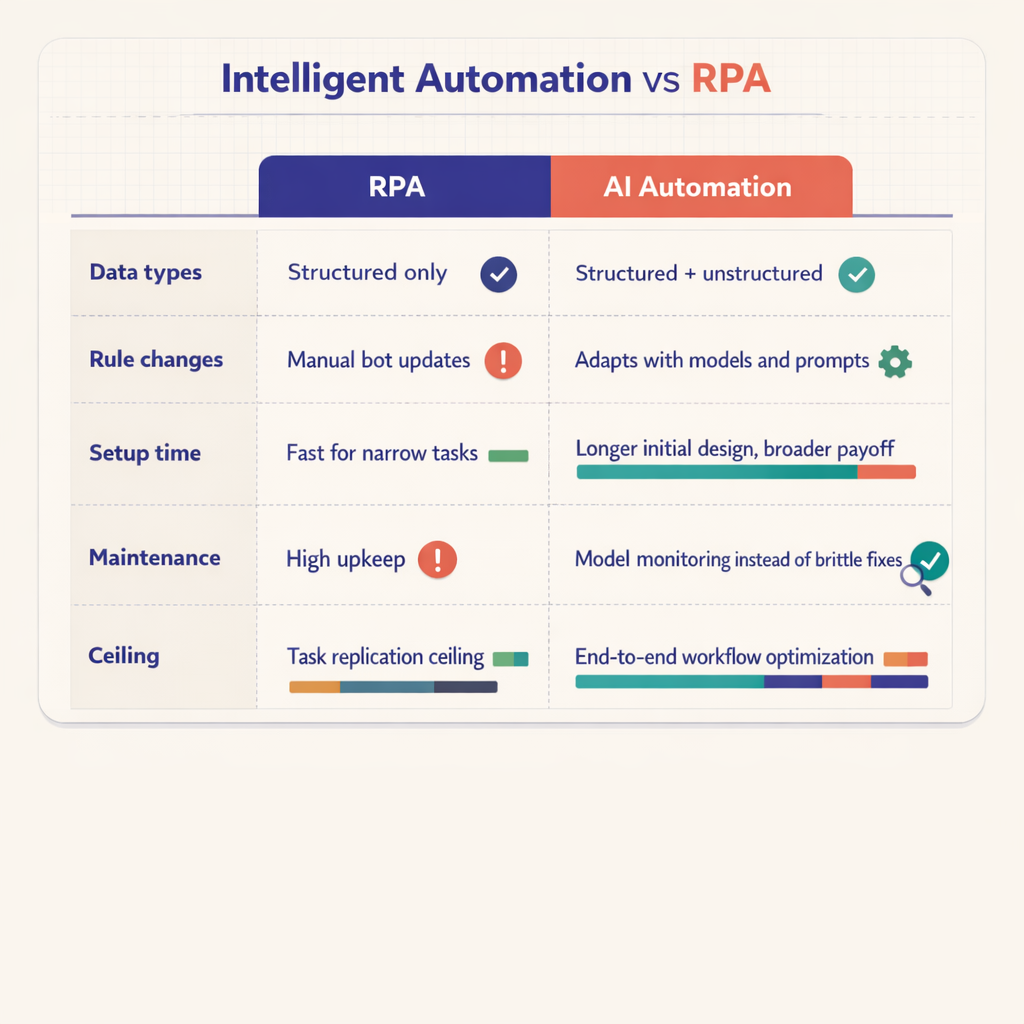 Comparison table showing RPA versus AI automation across data types, rule changes, setup time, maintenance, and automation ceiling, with notes like structured only, high upkeep, and end-to-end workflow capability
The table matters because buyers do not purchase “automation” in the abstract. They buy reduced handling time, lower maintenance hours, higher straight-through processing, and better reliability under change.
And this is where rpa limitations ai becomes a budgeting issue. If a process takes three weeks to automate but then needs constant fixes, the original win shrinks. A slightly slower AI-led implementation can produce better long-term ROI if the workflow includes document variance, language interpretation, or frequent exceptions.
Hybrid models still make sense. For example, AI can classify inbound claims documents and extract fields, while RPA handles a legacy portal with no API. That is often the most practical form of intelligent automation vs rpa -- not either-or, but architecture by fit.
The delivery model has changed. That is why the ai automation agency vs rpa consultant comparison now matters so much.
A traditional RPA consultant is usually optimized for process discovery, task mapping, bot design, UI automation, test scripts, and bot support. Those are useful services. But AI automation requires a broader technical base and a different operating mindset.
An rpa vs ai automation agency decision often comes down to whether the partner can handle:
That stack is not an extension of bot scripting. It is a different discipline.
At Imversion Technologies Pvt Ltd, a common observation is that buyers who outgrow RPA are not just looking for more developers. They are looking for better system design. They want discovery workshops that separate structured from unstructured work. They want process maps that include exception paths, not only happy paths. They want governance models for AI outputs. They want migration roadmaps, not just bot backlogs.
Because the risk profile changes.
A bot failure usually means a broken step. An AI failure can mean a wrong classification, weak extraction, or low-confidence output that still needs oversight. So the partner must know how to design guardrails, thresholds, fallback logic, and review queues.
That is why many legacy RPA agencies struggle. Their delivery engine was built for deterministic automation. AI work demands experimentation, evaluation, and backend engineering discipline. Different team shape. Different playbook. Different expectations from the client.
A smart rpa migration to ai automation plan should be phased, not ideological.
Start here:
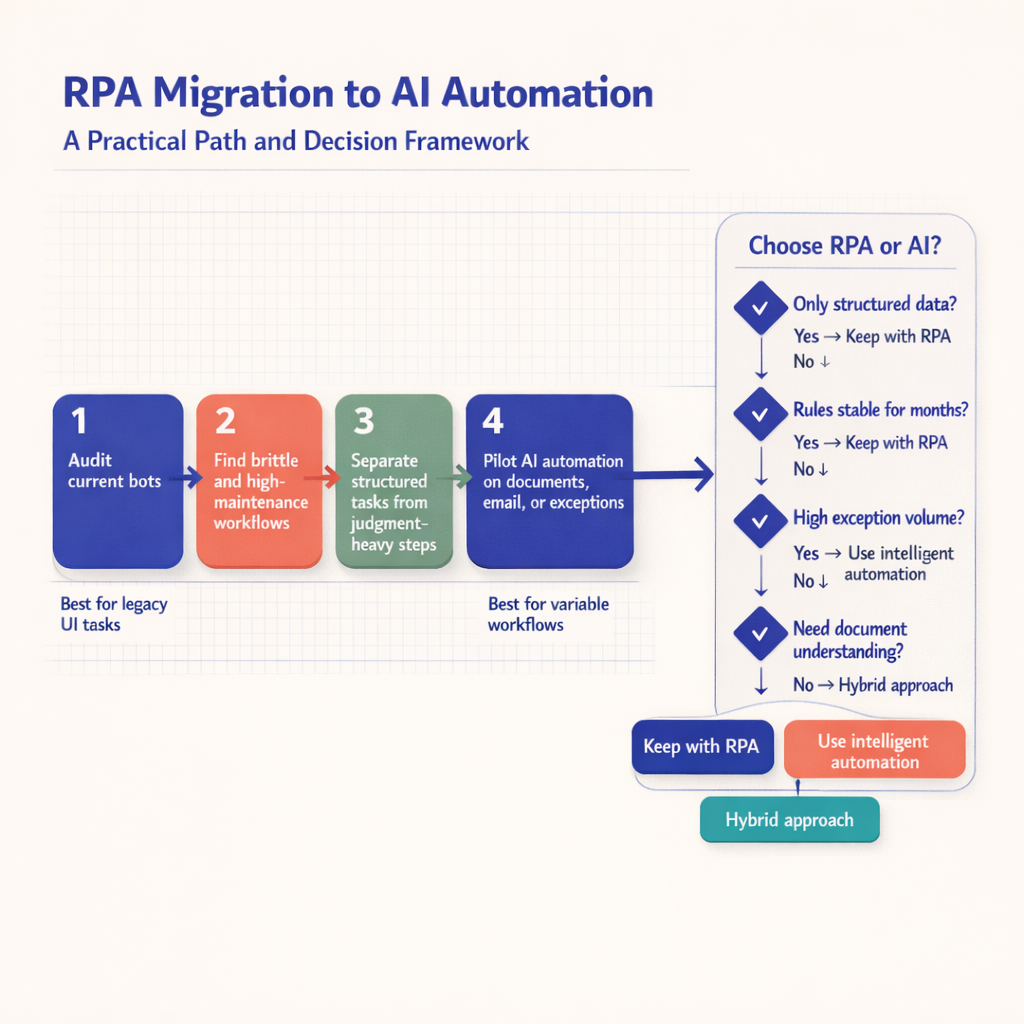 Five-step migration flowchart from existing RPA bots to AI automation, with decision points for structured data, stable rules, exception volume, and document understanding leading to outcomes like keep with RPA, hybrid approach, or AI-led redesign
This sequence works because it respects what already functions while exposing where the next gains actually are.
A simple decision framework helps:
That is the practical answer to rpa vs ai automation. The right choice depends less on trend and more on workflow variability, maintenance burden, and partner capability. And for buyers comparing ai automation agency vs rpa consultant, the strongest question is simple: who can build a reliable system that still works after the process changes? At Imversion Technologies Pvt Ltd, that is the standard worth using.
The biggest practical difference is that RPA follows predefined steps, while AI automation interprets content and helps decide the next step. RPA is ideal for repetitive actions in stable systems, but AI automation is better when workflows involve language, documents, exceptions, or changing business context.
You should evaluate the process by looking at input type, exception rate, rule volatility, and maintenance history. If the work uses structured data and rarely changes, RPA is usually sufficient. If it relies on emails, PDFs, customer language, or judgment-heavy routing, AI automation is the stronger fit.
A company should choose an AI automation agency when the problem involves document understanding, model evaluation, API orchestration, or governance of AI outputs. An RPA consultant is usually strongest at deterministic bot delivery, while an AI automation agency is better equipped for adaptive workflows and system-level redesign.
No. Intelligent automation is a broader operating model that can include RPA, AI, OCR, workflow rules, APIs, and human review. RPA may be one component inside it, but intelligent automation is designed to handle interpretation, exceptions, and end-to-end process orchestration rather than scripted task execution alone.
RPA limitations become expensive when maintenance hours, bot failures, and exception handling consume more value than the automation creates. Migration is usually justified when teams repeatedly patch screen changes, manually review too many edge cases, or fail to scale because the process depends on documents, language, or variable inputs.