S
Sagar HebbalePublished on April 15, 2026
17 min read
Staff Augmentation vs Outsourcing: Choosing the Right Model for Succes
Understand the key differences and benefits of staff augmentation and outsourcing.

Understand the key differences and benefits of staff augmentation and outsourcing.
Hero image of scales balancing the concepts of Staff Augmentation and Outsourcing
In today's fast-paced business environment, effective resource allocation strategies are crucial for gaining a competitive edge. Two prominent strategies, Staff Augmentation and Outsourcing, have emerged as viable options for organizations across various sectors. A key question that arises in this context is, "Which approach is more effective: Staff Augmentation or Outsourcing?" A closer examination reveals an intriguing comparison that warrants exploration.
To clarify any misunderstandings, it is essential to first understand the basics of these two strategies.
Staff Augmentation (also known as "Staff Aug") enables companies to enhance their existing teams by integrating specialized external talent on a contractual basis. Professionals with specific skills become part of the organization’s workforce and operate under its direct supervision. This approach is particularly advantageous during peak workload periods, when addressing specific skill gaps, or when the organization desires to maintain stringent control over its processes.
Outsourcing (commonly referred to as 'Project Outsourcing') involves delegating entire tasks, projects, or functions to an external specialized entity. Whether it involves IT operations, administrative tasks, or other specific projects, the outsourced organization operates independently under established guidelines.
A critical aspect of the decision-making process involves comparing these models against various key factors, as illustrated in the table below:
| Factor | Staff Augmentation | Outsourcing |
|---|---|---|
| Cost | Generally cost-effective, influenced by various factors | Potential for cost savings based on project requirements and market conditions |
| Control | Offers a higher level of control through direct management of hired professionals | Provides lower control, as the outsourced entity operates independently |
| Speed | Can yield faster outputs due to immediate team integration | Varies with project complexity |
These factors will be explored in greater detail in the subsequent sections.
It is important for businesses to recognize that the decision between Staff Augmentation and Outsourcing is not a one-size-fits-all solution. The appropriateness of each model depends significantly on specific business needs, available resources, and strategic objectives. However, a thorough comparison of these models can greatly assist in informed decision-making. In the following sections, we will examine real case scenarios, potential risks, and a structured decision-making framework.
In the realm of IT Resource Management, two methodologies stand out: Staff Augmentation and Outsourcing. To select the appropriate approach for a specific business need, it is essential to understand these concepts. Let's begin by elucidating each one.
Staff Augmentation (commonly abbreviated as Staff Aug) is a strategy that enables a business to supplement its existing workforce with specialized or temporary workers hired on a contractual basis. These augmented staff members are typically experts in their respective fields and integrate seamlessly into the company's ongoing teams and projects, operating under the direct supervision of company management.
Importantly, staff augmentation is not about replacing the traditional workforce; rather, it is about enhancing it for specific tasks, projects, or periods. This strategy is particularly beneficial when an organization needs to address skill gaps or manage increased workloads while retaining exclusive control over processes and personnel.
In contrast, Outsourcing involves delegating entire projects, tasks, or even operations to an external agency, ideally a specialist in the industry. The outsourcing partner is responsible for executing its assigned tasks or projects autonomously, following the company's predefined objectives.
Outsourcing encompasses the transfer of responsibility for an entire process or service to a third party. This service model can be advantageous when a company seeks to delegate non-core or complex tasks to external experts or when it aims to concentrate more on its core business competencies.
In summary, while Staff Augmentation focuses on empowering your own teams with additional expert resources, Outsourcing involves transferring the entire responsibility to an external entity. The decision between Staff Aug vs Outsourcing, or in specific cases, Augmentation vs Project Outsourcing, essentially compares the engagement of an external resource to perform tasks within your internal framework against the complete delegation of responsibilities to an external agency.
This comparison is not about categorizing one approach as better than the other; rather, it is about assessing which option aligns more effectively with a particular need, considering factors such as cost, control, speed, risks, use cases, and ultimately, overall efficiency. This evaluation provides a clear decision-making framework to choose between the two approaches based on the real situations faced by businesses in today's dynamic environment.
In an ever-evolving business environment, selecting the right engagement model—Staff Augmentation or Outsourcing—is crucial. The most effective approach depends largely on specific company requirements such as cost, control, speed, and flexibility. This comparative analysis offers a comprehensive overview of both methodologies and serves as a foundation for making informed decisions.
The table below highlights the primary differentiating factors between Staff Augmentation and Outsourcing.
| Criteria | Staff Augmentation | Outsourcing |
|---|---|---|
| Control | High level of control; companies direct the augmented staff | Less control; most management is performed by the service provider |
| Cost | Can be cost-effective based on short-term needs | Generally more cost-effective for long-term, entire project handling |
| Speed | Rapid deployment of specialists to address immediate needs | May take time to transition tasks to the service provider |
| Flexibility | High; easy to scale up or down in response to changing business needs | Moderate; changes may require contract modification |
| Expertise | Relies on the expertise of in-house resources and augmented staff | Provides access to a broad spectrum of expertise from the service provider |
| Transparency | High; direct visibility into project progress and performance | Depends on contract terms and the service provider's communication policies |
When evaluating Staff Augmentation vs Outsourcing, financial factors play a significant role. Cost is a key consideration for any organization, regardless of its size or industry. Staff Augmentation typically incurs lower startup costs and can be cost-effective for organizations needing to ramp up quickly for a short-term project. Conversely, Outsourcing may prove more economical in the long run due to economies of scale and resource management by external providers.
Control and Speed are vital factors to consider. With Staff Augmentation, companies maintain significant control over their projects, allowing them to manage their resources directly. This model also enables quick deployment of specific expertise to meet immediate business requirements. In contrast, the speed of mobilization may be slower with Outsourcing, as it often involves preparatory and transitional time.
In the next section, we will explore real-life scenarios and use cases to further assist in the decision-making process. Stay tuned!
When selecting between staff augmentation and outsourcing, companies must consider three critical parameters: cost, control, and speed. The effectiveness of the chosen engagement model will vary depending on the specifics of each company's situation.
Let’s begin by examining the cost implications of both models:
| Aspect | Staff Augmentation | Outsourcing |
|---|---|---|
| Cost Implications | Overhead costs are typically higher due to recruitment, onboarding, and benefits. However, a key advantage is the ability to access project-specific expertise. | While outsourcing may initially appear cost-effective by reducing recruitment and training expenses, it is essential to consider potential hidden costs and those arising from mistakes or rework. |
The next parameter to assess is the level of control a company desires:
| Aspect | Staff Augmentation | Outsourcing |
|---|---|---|
| Control Extent | Companies maintain direct control over the augmented workforce, allowing them to dictate work and monitor progress. However, this model also places project management responsibilities on the company. | In an outsourcing arrangement, control is transferred to external providers, which can alleviate management burdens but may lead to misaligned expectations. |
Lastly, let’s consider the speed of project execution:
| Aspect | Staff Augmentation | Outsourcing |
|---|---|---|
| Project Execution Speed | Faster results are achievable when the augmented staff possess the necessary skills and require minimal onboarding. This model is particularly well-suited for rapid scaling and urgent expert assistance. | The speed of outsourcing is contingent upon the service provider's experience, expertise, and resource availability. If these elements align, outsourcing can significantly accelerate project completion. |
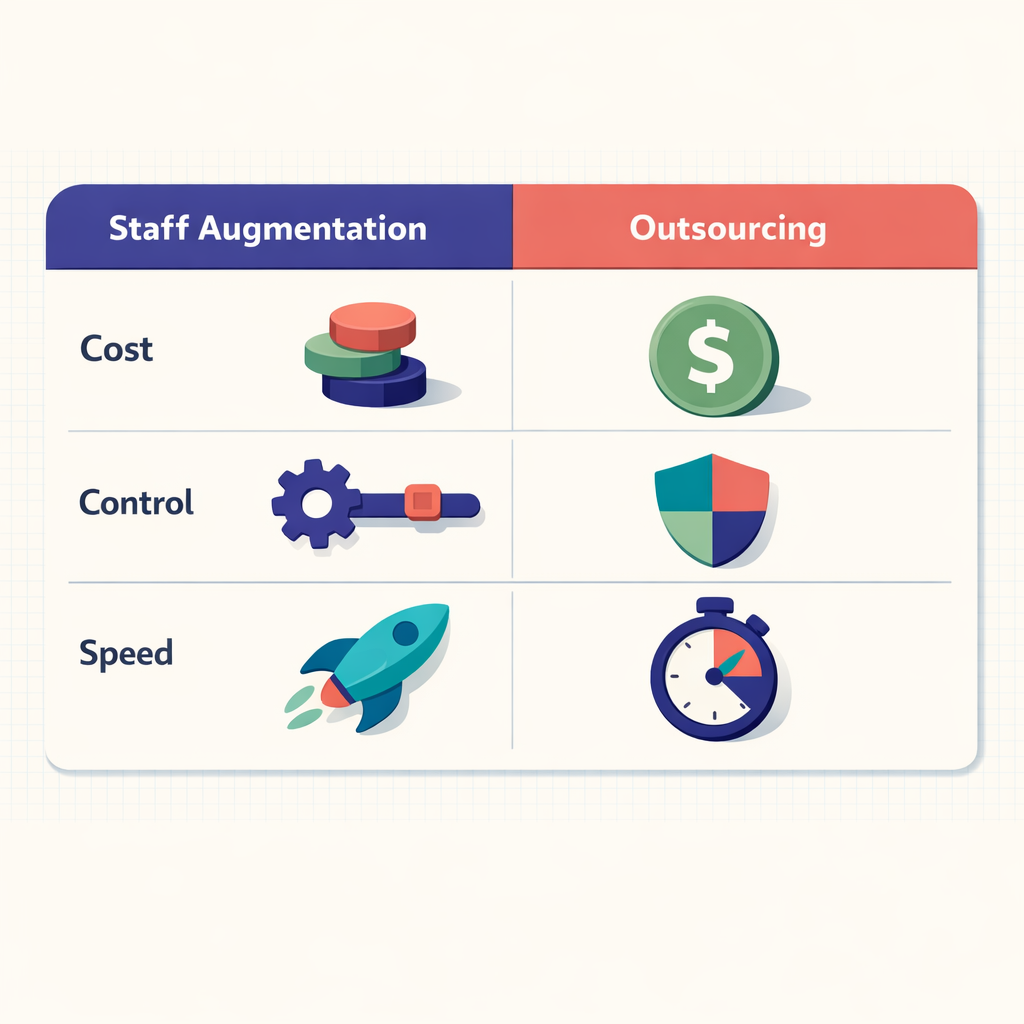 Comparative table diagram showing differences between Staff Augmentation and Outsourcing
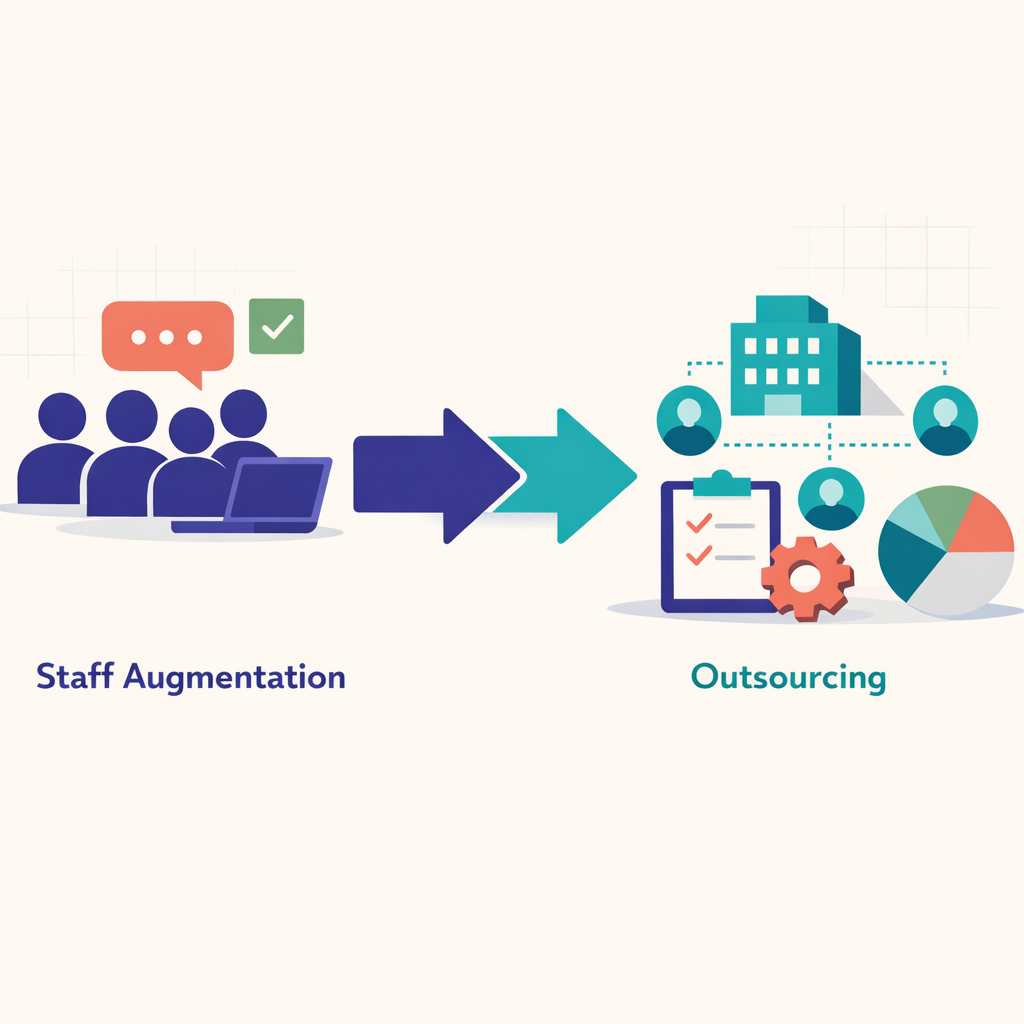 Illustration of real scenarios using either Staff Augmentation or Outsourcing
The comparison of Cost, Control, and Speed between Staff Augmentation and Outsourcing demonstrates that there is no one-size-fits-all solution. Each model has its own advantages and disadvantages, and the optimal choice depends on the nature of the work, the project scope, timeline, and available resources. Companies must conduct a thorough analysis of their unique circumstances and ensure that their selection aligns with their strategic business objectives.
Understanding when to utilize Staff Augmentation and Outsourcing can be clarified through practical use cases. These real-world scenarios offer insights into the distinct conditions that render one model more advantageous than the other. Key factors influencing such decisions include project size, timeline, required expertise, and overall business strategy.
| Use Case | Description | Recommended Approach |
|---|---|---|
| Urgent Need for Specialized Skill | For example, a company developing an innovative software application requires expertise in a specific technology, such as blockchain. However, they lack this expertise in-house. A viable solution is to hire a blockchain expert through Staff Augmentation. This approach allows the specialized professional to work collaboratively with the existing team while the company maintains direct control over the process. | Staff Augmentation |
| Scalability and Large Projects | An e-commerce platform planning to expand its services globally may need a significant software upgrade. Given the project's complexity and size, which exceeds the existing team's capabilities, Outsourcing becomes necessary. By outsourcing the project to a reliable and experienced technology provider, the task can be completed within the specified timeline, enabling the existing team to concentrate on their daily operations. | Outsourcing |
| Short-term Projects | A financial firm aims to develop a mobile application for precise financial forecasting. Given the time-sensitive nature of the project, employing a rapid application development model is essential. In this scenario, Staff Augmentation is ideal, as it allows for the quick onboarding of experienced developers who can ensure timely project delivery. | Staff Augmentation |
| Recurring Non-core Operations | Consider a healthcare institute that processes thousands of bills daily. The repetitive tasks of bill processing and data entry can be effectively Outsourced. This allows the in-house team to focus on core healthcare operations while a service provider efficiently handles routine, non-strategic tasks. | Outsourcing |
Organizations considering Staff Augmentation or Outsourcing models should deliberate the risks associated with each engagement approach, as these are as critical as the potential benefits. Certain pitfalls linked to Staff Augmentation and Outsourcing could negate their advantages if not properly managed.
While Staff Augmentation provides greater control, several risks merit your consideration:
| Risk | Description |
|---|---|
| Lower Off-Site Productivity | Even with thorough screening and contracting of top-tier remote professionals, productivity may fall short of that of the in-house team, particularly in a remote or hybrid working model. |
| Higher Expenses | Although accessing high-end niche capabilities is advantageous, costs can significantly exceed those of permanent staff or outsourced services. |
| Management Resource Drain | Engaging external talent for complex projects requires additional resources for effective management, potentially leading to unforeseen management burdens. |
These risks can be mitigated through the implementation of clear working agreements, setting measurable performance metrics, and providing adequate resources for effective management.
Outsourcing, while appealing, presents its own distinct set of risks:
| Risk | Description |
|---|---|
| Less Control | Delegating an entire project or operation to an external provider means relinquishing direct control, which can lead to quality issues if the provider fails to meet the established standards. |
| Vendor Dependence | When you delegate a critical function or project, you may become overly reliant on the third-party provider, creating potential challenges if the vendor relationship deteriorates. |
| Data Security Concerns | Sharing sensitive information with an external vendor necessitates stringent data security measures to prevent breaches. |
To mitigate these risks, conduct thorough vendor qualifications, establish clear expectations regarding deliverables, and implement robust data security measures with your provider.
To minimize risks associated with both Staff Augmentation and Outsourcing, achieving a balance is essential. Assess your business requirements, analyze your company’s risk profile, and weigh the pros and cons of each model. Ultimately, your strategic goals should guide your decision.
By incorporating potential risks into your decision-making process, you will facilitate effective and successful engagement with either a Staff Augmentation or Outsourcing strategy.
Choosing between Staff Augmentation and Outsourcing requires a strategic evaluation based on a company's specific objectives, resources, and growth projections. This Decision Framework serves as an effective guide to help you navigate this critical business decision.
The first step is to gain a comprehensive understanding of your organization's needs:
Next, evaluate the benefits and risks associated with each engagement model:
| Engagement Model | Pros | Cons |
|---|---|---|
| Staff Augmentation | High control and seamless integration with your team | May require more intensive management; costs could rise with an increase in overall headcount |
| Outsourcing | Potentially lower cost structure; autonomous operation | Relational risks; lower control over processes to consider |
Examine your available resources and constraints—both financial and operational:
All decisions should align with your organization's broader objectives:
Consider real-world scenarios where either model has proven advantageous.
For instance, a tech development company facing a tight timeline for a client project that requires expertise not currently covered by their in-house team may opt for Staff Augmentation. Conversely, an IT company aiming to streamline operations and concentrate on core competencies may find that Outsourcing their customer support function to a specialized vendor is the most effective decision.
Ultimately, as every business is unique, it is essential to tailor this Decision Framework according to your specific situation and objectives. Balancing immediate needs with long-term goals is key in deciding between Staff Augmentation and Outsourcing.
 Conceptual image of a decision-making framework in business
As we explore the intricacies of various business strategies, it becomes clear that organizations may derive distinct value from either Staff Augmentation or Outsourcing. Framing this evaluation as Staff Augmentation vs Outsourcing is less about identifying a definitive winner and more about discerning the best fit for your specific business requirements, goals, and objectives.
The decision between augmenting staff (Staff Aug) and outsourcing involves several critical factors:
| Factor | Staff Augmentation | Outsourcing |
|---|---|---|
| Definitions | Adding temporary team members to enhance capacity or expertise | Transferring entire projects or tasks to an external party |
| Comparison | Evaluates cost-effectiveness, level of control, speed, and existing capabilities | Assesses essential factors influencing the decision |
| Cost | Considers both direct and hidden costs, such as overhead and recruitment | Analyzes management and training expenses associated with outsourcing |
| Control | Offers closer management and oversight over the process | Frees up internal resources, resulting in less direct involvement |
| Speed | May require extended time for onboarding | Allows for potentially swift project execution |
From recognizing an immediate need to hire developers to considering the strategic choice between augmentation and project outsourcing, the significance of conducting a comprehensive internal analysis cannot be overstated. Grasping both your immediate and long-term objectives is crucial for making an informed decision.
While both models carry inherent risks that may pose challenges, a thorough understanding of these risks empowers you to navigate them effectively, ensuring your organization maximizes its return on either investment.
When weighing the decision between Staff Augmentation and Outsourcing, keep in mind that this is not a binary choice but rather a flexible spectrum. Elements from both models can be combined to address your unique application requirements.
Ultimately, the ideal decision should be strategically aligned with your business’s mission, vision, and objectives. Different scenarios may necessitate varying blends of these strategies. Therefore, comprehending these tools is essential in today's global, complex, and fast-paced business environment, providing the flexibility, scalability, and competitive advantage required to thrive.