S
Sagar HebbalePublished on April 15, 2026
18 min read
Staff Augmentation vs Full-Time Hire: Unlocking Cost-Effective Develop
Discover the true costs and benefits of hiring full-time developers versus staff augmentation.

Discover the true costs and benefits of hiring full-time developers versus staff augmentation.
Hero image of a scale balancing full-time hires and staff augmentation
In today’s digital landscape, the decision between staff augmentation and full-time hiring has become increasingly critical for business success. This choice, particularly relevant in a technology-driven age, revolves around immediate business needs as well as considerations of cost, flexibility, potential risks, and projected return on investment (ROI).
| Aspect | Full-Time Hiring | Staff Augmentation |
|---|---|---|
| Base Salary | Extends beyond just salary. | Flat hourly or monthly rate. |
| Recruitment Costs | Includes fees for hiring and onboarding. | Typically minimal. |
| Benefits | Health insurance, retirement schemes, etc. | Usually included in the flat rate. |
| Workspace and Equipment | Additional costs for physical workspace and equipment. | Generally covered by the provider. |
| Learning and Upskilling | Continuous investment required. | Not typically applicable. |
The costs associated with hiring a full-time developer extend well beyond the base salary. This includes recruitment costs, employee benefits such as health insurance and retirement plans, expenses related to workspace and equipment, and the ongoing investment in learning and upskilling.
In contrast, the cost structure for staff augmentation appears more straightforward. However, this streamlined model should not lead to overlooking potential hidden costs tied to both hiring models.
The staff augmentation model provides a significant advantage in flexibility, enabling businesses to scale their teams up or down based on evolving project demands. It allows for a swift response to skill gaps, alleviates administrative burdens linked to permanent hires, and, superficially, presents a cost-effective solution.
However, when weighing the decision to hire versus augment a developer, it is vital to analyze various cost comparison scenarios. The most effective choice will depend heavily on specific business conditions, objectives, and both short-term and long-term needs.
As you contemplate your options, it is equally important to assess the inherent risks associated with each scenario and to consider ROI in terms of the total value delivered by both options, rather than focusing solely on apparent upfront costs.
In the following sections, we will explore the true costs of these hiring models, present a coherent decision framework tailored to specific business needs, outline risk mitigation strategies, and provide further insights into maximizing ROI.
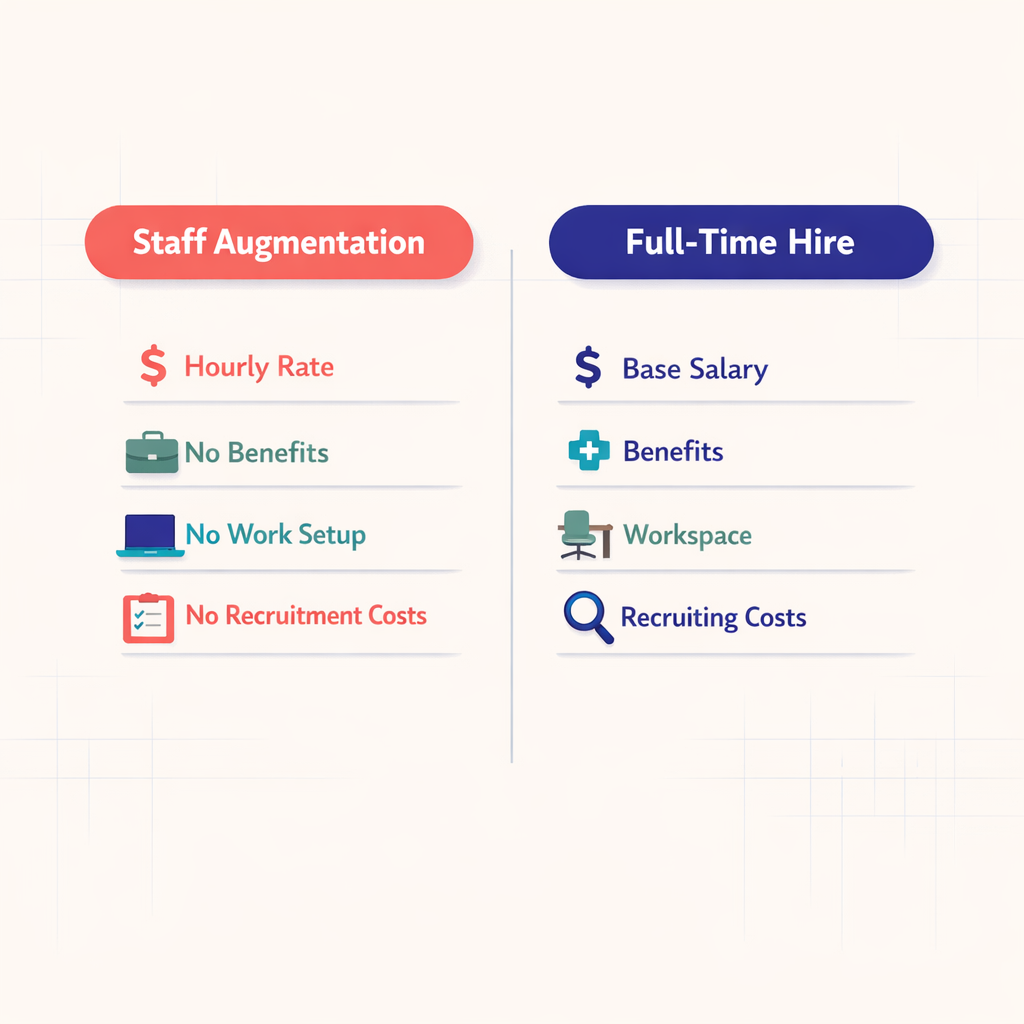 Diagram comparing the cost components of staff augmentation and full-time hiring
In today’s competitive landscape, businesses—particularly in the tech sector—are increasingly aware of the cost of hiring a developer. This expense extends beyond the base salary, encompassing various factors that warrant thorough consideration. A clear understanding of these components is essential for decision-makers evaluating whether to hire a full-time developer or pursue staff augmentation.
When you choose to hire a full-time developer, several cost components significantly affect the total expenditure. These include:
| Cost Component | Description |
|---|---|
| Base Salary | This fundamental cost varies based on the developer's skill level, geographic location, and market demand. |
| Benefits | Companies typically provide benefits packages that may include health insurance, retirement plans, and paid time off. The financial impact of these benefits can be substantial and should be taken into account. |
| Workspace and Equipment | Each new employee requires a designated workspace, whether physical or virtual, along with essential tools such as computers and software subscriptions. |
| Recruitment Costs | These encompass expenses related to advertising job openings, conducting interviews and assessments, and managing other administrative tasks involved in the hiring process. |
| Learning & Development | To ensure developers remain skilled and competitive, ongoing training and professional development initiatives are often necessary, which entail additional costs. |
By considering all these factors, the overall cost of hiring a developer becomes a composite of various elements, far exceeding mere salary considerations.
In contrast to hiring a full-time developer, the pricing model for staff augmentation typically involves a straightforward hourly or monthly rate. This rate encompasses the developer's salary, benefits, and additional operational expenses.
Nevertheless, businesses should be aware of other potential costs, such as:
Given its inherent flexibility, the staff augmentation model may be ideal for projects with variable requirements or those needing specialized skills not currently available within the existing team. A cost comparison between this model and hiring full-time developers presents a compelling case for businesses.
Evaluating costs is only one aspect of the decision-making process. Businesses must also consider other factors, such as flexibility, risks, and anticipated ROI. The goal is to find a balance that best aligns with the specific needs and circumstances of the organization.
When making the critical decision of whether to hire a full-time developer or adopt a staff augmentation strategy, it is important to consider undercover expenditures. Beyond the surface costs lie hidden expenses that can significantly impact your bottom line. In the debate of 'hire vs augment developer,' these clandestine fees play a substantial role.
The expense of hiring a developer does not end with the signing of an employment contract. Additional costs may include:
The irony is that these costs can escalate dramatically if the new developer is not a perfect fit for your team, necessitating more time for effective onboarding and integration.
In many cases, hiring agencies are engaged to source potential developers, which introduces additional costs. These may include:
In contrast, staff augmentation services typically incorporate their fees into their hourly or monthly rates, simplifying the overall cost structure.
While the flexibility of a staff augmentation model is appealing, it can be diminished by the hidden costs associated with managing remote workers. These costs may include:
If a staff augmentation service needs to be terminated for any reason, there may be exit fees or penalties involved. While the flexibility of staff augmentation is attractive, potential termination charges could pose a hidden obstacle.
To illustrate this concept, consider two similar tech projects with a one-year timeline:
At first glance, the second scenario may appear more economical; however, only a thorough examination of the hidden expenditures will reveal the true cost implications.
In conclusion, understanding the various hidden costs associated with both hiring models is essential. This knowledge will provide clarity in the 'hire vs augment developer' debate and support informed decision-making. An objective analysis of costs, taking into account the nature and needs of your business, specific hiring scenarios, potential risks, and projected ROI, will lead you to an effective hiring strategy.
When evaluating the cost of hiring a developer, business owners and project managers must assess the value proposition of each staffing model. A practical approach to compare alternatives—such as hiring a full-time developer versus the staff augmentation model—involves a clear understanding and careful management of the associated costs.
Staff augmentation plays a vital role by offering significant benefits that directly affect the costs associated with developing and managing a project. These advantages include:
| Benefit | Description |
|---|---|
| Flexible Scalability | Staff augmentation allows you to upsize or downsize your team, adapting to your project's specific needs while mitigating unnecessary costs. |
| Swiftly Address Skill Gaps | It provides access to a broader talent pool, ensuring you can find experts with the necessary skills to execute your project effectively. |
| Reduced Administrative Burdens | This model alleviates many burdens tied to full-time hires, such as taxation, employee benefits, and HR management. |
| Transparent Cost Structure | Staff augmentation features a simplified cost structure, typically based on hourly or project-based rates. This method eliminates the need to account for workspace, insurance, and other underlying costs. |
The key distinction between 'hiring' and 'augmenting' a developer lies in the cost composition and associated risk factors.
| Aspect | Hiring a Full-Time Developer | Staff Augmentation |
|---|---|---|
| Cost Structure | Fixed costs irrespective of work volume | Variable costs based on work completed |
| Risk Factor | Risk of unforeseen expenses, such as turnover | Risk is minimized, as the service provider assumes it |
The measurable ROI of staff augmentation often surpasses that of full-time hires, attributable to factors like operational efficiency, reduced recruitment costs, and access to a global talent pool.
Decision Framework: Staff Augmentation or Full-Time Developer?
Ultimately, the decision hinges on the unique needs and circumstances of your organization. Taking the aforementioned factors into account can provide a solid foundation for your choice.
In conclusion, staff augmentation presents a compelling option, particularly when cost-effectiveness, flexibility, reduced risk, and ROI are critical considerations in the decision-making process. A thorough analysis and understanding of your business needs will be essential in outlining a more accurate cost comparison for your organization.
 Illustration showing the flexibility characteristic of the staff augmentation model
It is crucial for businesses to conduct a cost comparison between staff augmentation and hiring full-time developers to ensure financial efficacy. Herein, we examine two contrasting scenarios to illuminate the distinct cost differences associated with each staffing model.
An enterprise with a rapidly evolving project may favor flexibility. In such cases, hiring a full-time developer may not be the most cost-effective choice. There may be a need to frequently scale the team size up or down according to changing project requirements.
| Staffing Model | Cost Considerations |
|---|---|
| Full-Time Hire | The company would incur recruitment, onboarding, and offboarding costs repeatedly, which could quickly inflate the total cost of hiring a developer. |
| Staff Augmentation | In contrast, the augmentation model may exert less financial impact. The ability to dynamically mobilize or reduce resources as needed can enhance cost efficiency. |
For organizations engaged in a long-term project with foreseeable technical challenges and consistent personnel needs, hiring a full-time developer might be a logical choice.
| Staffing Model | Cost Considerations |
|---|---|
| Full-Time Hire | Despite the significant upfront costs associated with recruitment, the long-term return from a dedicated full-time developer can outweigh these initial expenses. |
| Staff Augmentation | Although the augmentation model boasts short-term cost savings, these may be offset by unforeseen expenses such as termination costs. Additionally, maintaining consistent output quality over a longer term may be challenging with varying resources. |
Ultimately, the decision should not merely hinge on whether to hire or augment a developer. Rather, it should be informed by a pragmatic assessment of project needs, cost components, potential hidden charges, and desired flexibility. Both models carry unique risks, and considerations regarding return on investment (ROI) should influence the final decision-making process.
As it stands, there is no one-size-fits-all answer. Investing time in developing a comprehensive decision framework tailored to an organization’s specific requirements can lead to a smart, sustainable solution. Regardless of the chosen path, careful cost comparison and financial planning will play a pivotal role in successful project delivery and organizational fiscal health.
In today's fast-paced business environment, the decision between hiring and augmenting developer groups can significantly influence an organization's flexibility while exposing it to various risks.
Staff augmentation offers a compelling advantage in terms of flexibility. It enables organizations to scale their technical teams up or down in response to shifting project requirements or evolving business environments. Additionally, this model allows organizations to integrate specialized skill sets into their teams on an as-needed basis. When compared to the expense of hiring a developer full-time to fill these gaps, the staff augmentation model can result in substantial cost savings.
However, both hiring models come with their own set of risks that can impact project implementation costs.
| Model | Risks |
|---|---|
| Full-time hiring | Recruitment risks, such as the selection of sub-optimal candidates, and financial risks that encompass unforeseen costs related to onboarding, training, benefits, and resource maintenance. Prolonged vacancies while searching for the right fit can also lead to project delays. |
| Staff Augmentation | Risks associated with onboarding augmented staff, successfully integrating them into existing teams, and ensuring consistent quality and performance standards among augmented personnel. |
In both scenarios, the potential for talent attrition exacerbates these risks and adds to the overall cost of hiring a developer.
Effective strategies can be employed in both scenarios to minimize potential risks.
When considering a staff augmentation cost comparison, evaluating Return on Investment (ROI) is crucial. The flexibility and reduced overhead costs associated with staff augmentation can often yield a better ROI, particularly when resources are required for a limited timeframe or for specialized projects.
Conversely, for long-term, stable roles, hiring a developer full-time may provide a higher return, given the stronger alignment with organizational culture and long-term business objectives.
When considering "Staff Augmentation vs. Full-Time Hire," ROI is a critical factor that extends beyond the mere cost of hiring a developer. This section will explore the long-term gains, sustainability, and overall impact on business growth associated with both models.
While the ROI for a full-time developer may appear less attractive initially due to higher upfront costs, this investment can yield significant returns over time. A full-time developer will become more integrated within your business and accumulate domain-specific knowledge.
Conversely, the staff augmentation model offers immediate ROI since you only pay for the hours or services utilized. This transparency simplifies cost assessment and enhances budget control. However, it is essential to acknowledge that contractors may require additional time to grasp the intricacies of your business—time for which you are also compensating them.
Sustainability involves adopting a model that can adapt to your evolving business needs. Full-time employees typically provide greater stability and commitment, which fosters a culture of innovation and continuous improvement. However, this stability may come at the cost of flexibility; downsizing your team can lead to layoffs and reputational risks.
In contrast, staff augmentation allows for easy scaling of your team, enabling you to add or reduce personnel as needed. However, the high turnover of staff may disrupt team dynamics, potentially affecting productivity and cohesion.
Full-time developers often enhance knowledge transfer within the team, which can significantly contribute to business growth. Their emotional investment in the organization can drive high-quality outcomes. Nevertheless, the time required to hire and onboard a new full-time developer may slow project momentum, affecting timelines.
With staff augmentation, businesses can quickly onboard skilled resources and facilitate seamless collaboration with the existing team. However, the potential lack of continuity or loyalty from contractors may influence the quality of the output.
Conclusion:
Both models—staff augmentation and full-time hires—offer distinct advantages and disadvantages. By weighing the ROI considerations outlined above, businesses can make more informed decisions. Ultimately, the choice between a full-time hire or staff augmentation will depend heavily on the unique needs, culture, and growth aspirations of your organization.
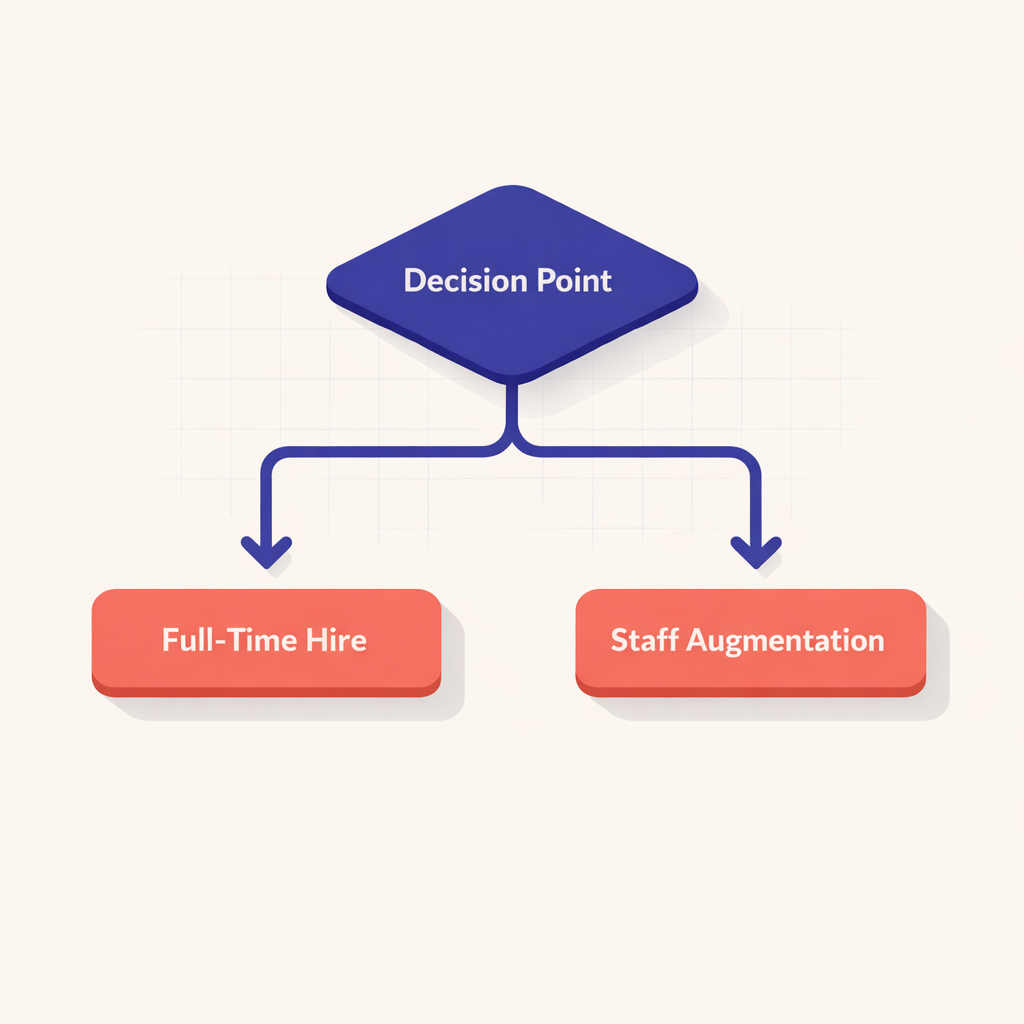 Conceptual image of a decision framework leading to either 'Full-Time Hire' or 'Staff Augmentation'
Choosing between staff augmentation and hiring a full-time developer can be a daunting task. Your decision hinges on various factors, each of which has the potential to significantly impact your business. Here, we present a practical decision-making framework to guide you through the critical considerations in the Staff Augmentation vs. Full-Time Hire dilemma.
Ultimately, your staffing decision should align with your business objectives and operational needs. Ask yourself:
A variable demand typically favors staff augmentation due to its inherent flexibility. However, full-time developers may be better suited for businesses with a steady demand for technical skills, particularly when considering long-term strategies.
A thorough analysis of the cost of hiring a developer under both models is essential. Be sure to include:
When comparing costs for staff augmentation, evaluate the hourly or monthly fees along with any additional indirect charges. Keep in mind that what seems less expensive initially may not be the most cost-effective option in the long run.
In terms of flexibility, staff augmentation offers a clear advantage, especially in fast-paced environments, fluctuating markets, or projects with variable workloads.
It is important to revisit the risks associated with each model. While staff augmentation can reduce administrative burdens, managing and engaging remote teams may present challenges. In contrast, full-time developers can introduce risks related to onboarding and integration.
Return on investment (ROI) encompasses more than just financial returns; it also includes:
Thus, while the initial ROI for a full-time developer might be less compelling, the depth of commitment and potential for skill enhancement can make it a smart long-term investment.
Taking the time to make a well-informed staffing decision can significantly influence your project's success and contribute to business growth. Aim for a solution that balances cost-effectiveness, flexibility, risk mitigation, and optimal ROI. With this framework at your disposal, you are empowered to make the best workforce decision for your business, leading to a thriving, agile, and future-proof organization.