N
Naresh HRPublished on April 15, 2026
16 min read
Nearshore vs Offshore Development: Which is Right for Your Project?
Explore cost, quality, and timezone differences to make informed outsourcing decisions.
Explore cost, quality, and timezone differences to make informed outsourcing decisions.
Hero Image representing the concept of nearshore vs offshore in a boxing ring
In today's dynamic digital landscape, outsourcing software development has become essential for successful businesses, enabling them to tap into global talent while optimizing costs. A crucial decision within this framework involves choosing between nearshore and offshore development. This introduction offers a brief comparison of these two approaches, examining factors such as cost, quality, and timezone overlap.
Nearshore software development entails outsourcing tasks to a neighboring country or within your geographical region. For instance, an American company might collaborate with service providers in Mexico or Canada. In contrast, offshore development involves assigning work to firms located thousands of miles away—such as a U.S. enterprise leveraging talent from India or the Philippines.
| Factor | Nearshore Development | Offshore Development |
|---|---|---|
| Cost | May seem more expensive, yet it can reduce communication barriers and inefficiencies. | Typically occurs in regions with lower salary expectations, offering significant financial advantages. |
| Quality | Closer cultural similarities may enhance service quality. | Broad talent pools in offshore locations can also ensure high-quality service. |
| Timezone Overlap | Offers better alignment with working hours, facilitating real-time collaboration. | May encounter challenges due to timezone differences, but can maintain efficiency with effective communication. |
Ultimately, the decision hinges on leveraging the strengths of each approach based on the unique requirements of your project. This blog will explore each criterion in greater depth, providing insights on use cases, real scenarios, and a decision framework to facilitate an informed choice. For now, it's crucial to recognize that both nearshore and offshore development offer distinct advantages and should be assessed not solely on cost but also in alignment with your business requirements and goals.
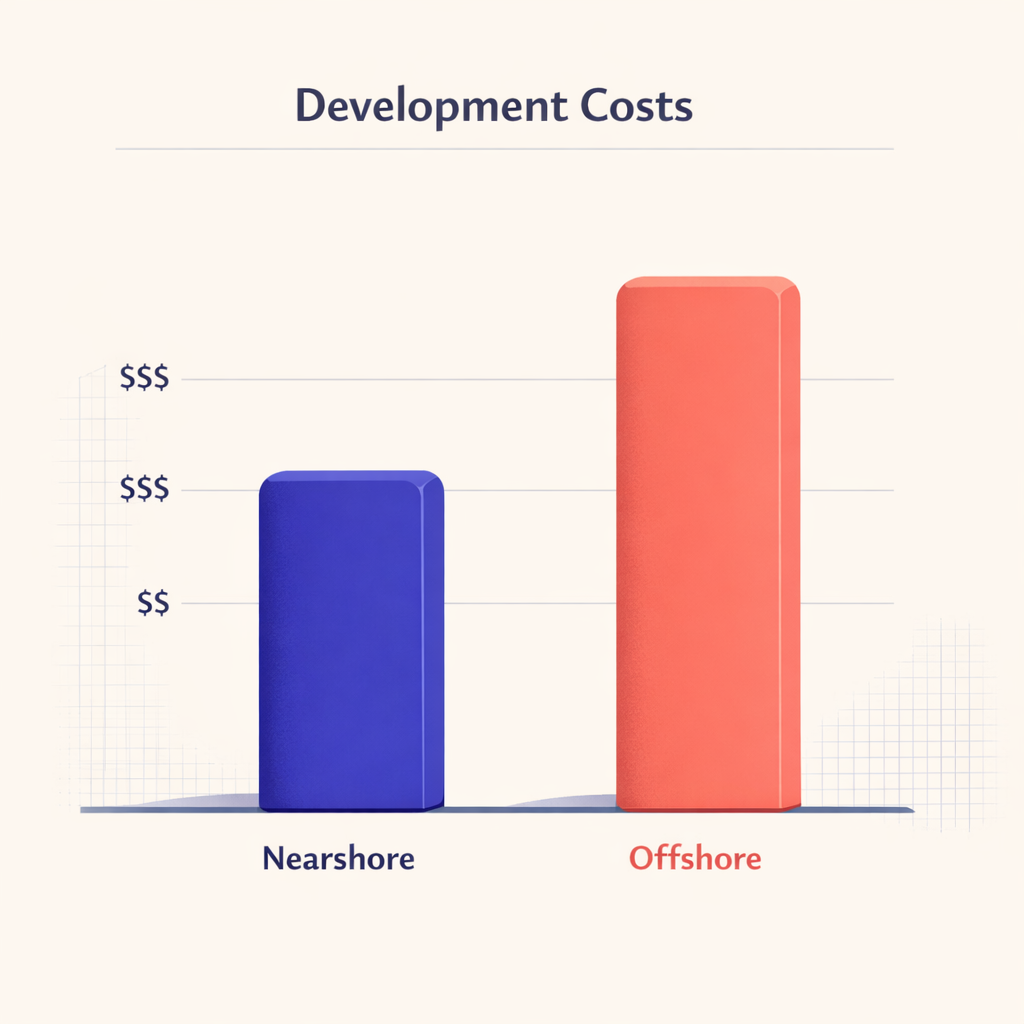 Bar chart comparing the costs of nearshore and offshore development
Let’s unravel the concepts of nearshore and offshore development by exploring practical examples and weighing their pros and cons.
Nearshore development refers to the practice of outsourcing software-related tasks to a company located in a nearby country, typically within the same geographic region or a bordering nation. For instance, an American organization collaborating with a software development firm in Canada or Mexico exemplifies the nearshore model. This approach aims to enhance effective communication, foster synergy, and reduce cultural differences—all critical elements for project success.
Advantages of this model include:
In contrast, offshore development involves outsourcing tasks to a company situated in a markedly different geographic region, often thousands of miles away. A clear example of offshore development is a U.S. company hiring a software development team based in India or the Philippines.
This model is primarily recognized for its cost-effectiveness, driven by significantly lower average salary scales in offshore countries.
| Pros | Cons |
|---|---|
| Access to a vast talent pool, which can lead to high-quality results | Timezone misalignments may pose communication challenges |
| Cost efficiency due to lower labor costs in offshore regions | Potential cultural differences and language barriers |
| Opportunity to leverage specific strengths and capabilities unique to certain regions | Management and oversight can be difficult due to considerable distance |
When it comes to choosing between offshore and nearshore software development, the decision should align with your company's specific needs, goals, and resources. The discussion of additional factors—such as cost-effectiveness, quality control, and timezone considerations—will be explored in subsequent sections.
In the realm of software development, cost is a critical factor in the decision-making process when weighing nearshore versus offshore development. Each approach has its own characteristics, leading to distinct economic implications. Understanding these elements can help companies make cost-effective choices while ensuring quality outcomes.
Offshore development typically offers greater cost-effectiveness. This is largely due to the strong correlation between software developers' wages and the living standards and average incomes within a country. In regions with lower average earnings, such as India and the Philippines, a U.S. company can hire engineers and developers at reduced rates compared to local or nearshore options, such as Mexico or Canada. Consequently, offshore development leverages lower wages, significantly reducing the overall cost of software development.
That said, nearshore software development can also be economically viable. While upfront costs, like wages, may be higher compared to offshore rates, nearshore development often results in fewer communication barriers. This enhances collaboration and, in turn, minimizes the project's total time and costs.
Though offshore development may appear less expensive at first glance, it often comes with hidden costs. Among the pros and cons of offshore development, key hidden expenses include:
These factors can lead to inefficiencies or project delays.
Conversely, a nearshore approach may offer more predictability. For a U.S. company, for instance, outsourcing to a nearby location like Mexico or Canada can mitigate unexpected costs associated with time zone differences and cultural misalignments. However, initial budgeting must account for higher wages compared to offshore options.
Ultimately, the choice will hinge on a company's unique needs, resources, and business strategy. When managed effectively, both nearshore and offshore development can prove to be equally cost-effective and advantageous in the field of software development.
When comparing nearshore and offshore development, the quality of the final product is a crucial factor that must not be overlooked. This section highlights software quality considerations, emphasizing the differences between these two outsourcing strategies and their implications for your business.
Clear and effective communication with your development team has a significant impact on software quality. In offshore development, the vast and diverse talent pool can be an advantage; however, it may also introduce language barriers that complicate clear communication.
In contrast, nearshore software development typically involves teams that are geographically closer, often sharing a common language and similar cultural nuances. This proximity fosters smooth communication and mutual understanding, which can enhance collaboration and ultimately improve the quality of the project.
While the location of software development influences cost and time zone alignment, the skill level of developers should not be underestimated. Offshore development provides access to an extensive talent pool from countries such as India, the Philippines, and Ukraine. This globalization of talent allows businesses to acquire specialized skill sets that may not be readily available domestically, thereby potentially enhancing software quality.
Nearshore developers, although they may offer a more limited selection, often demonstrate strong commitment and expertise in specific technology areas, ensuring competitive quality in their deliverables.
Culture plays a subtle yet significant role in software quality. Nearshore developers, due to their geographical proximity and often shared cultural background with the client, may possess a deeper understanding of user requirements and business context. This cultural empathy can lead to improved software usability and quality, allowing businesses to better meet user needs and market expectations.
Conversely, offshore development teams bring diverse cultural perspectives and innovative approaches to project execution. However, success in this area depends on effectively managing cultural diversity and leveraging these global insights.
 Illustration of a globe indicating time zones
When evaluating nearshore versus offshore development, an often underestimated factor is the influence of time zone differences. Time zones can significantly affect collaboration efficiency, communication, and the overall software development process.
Let’s begin by defining "timezone overlap development." This concept refers to the overlapping working hours between different teams collaborating across various geographical regions. The greater the overlap, the more opportunities there are for live interaction, which is vital in agile development methodologies. This interplay between nearshore and offshore development is fundamentally rooted in the timezone challenge.
For nearshore software development, it is likely that your development team will be in the same time zone, or only a few hours ahead or behind. This overlap enables immediate feedback, rapid decision-making, and seamless communication—elements that are critical to the agile development process.
In contrast, offshore development presents a different set of advantages and drawbacks. The considerable time zone differences may limit overlap, potentially hindering real-time communication. However, this disparity can also serve as an advantage, facilitating a "follow-the-sun" model where one team continues work as another wraps up, thereby allowing for round-the-clock productivity.
As discussed, time zone differences bring both benefits and challenges. Here are some key points:
| Nearshore Development | Offshore Development |
|---|---|
| Fosters enhanced real-time collaboration, leading to more efficient problem-solving and a shared understanding. | May experience communication delays, but enables continuous work cycles and potential reductions in project duration. |
| Offers immediate feedback and rapid iterations due to timezone overlap. | Communication hurdles can result in delays and risks of misinterpretations, which may negatively impact project timelines and increase costs. |
Interestingly, time zones may not always be a critical factor. In certain scenarios, the significance of timezone overlap diminishes:
When choosing between nearshore and offshore software development, conducting a comprehensive risk assessment is essential. It's crucial to understand the potential pitfalls and drawbacks inherent to each approach, going beyond mere cost, quality, and timezone considerations. This section will outline the primary risks associated with both nearshore and offshore development models, along with effective strategies to mitigate these risks.
Regardless of whether you choose nearshore or offshore development, contractual issues can emerge. In offshore development contracts, challenges may arise from language barriers, misunderstandings regarding requirements and deliverables, and misinterpretations of legal terms. On the other hand, nearshore software development contracts often benefit from shared legal frameworks and business practices, which may help reduce ambiguities. However, discrepancies can still occur. To mitigate these potential risks:
Data security concerns are prevalent in both nearshore and offshore development models. Offshore development may expose sensitive data to increased risks due to varying and potentially inadequate cybersecurity frameworks in remote regions. In contrast, nearshore software development can help reduce these risks, given the closer alignment with regulatory standards. To ensure data security:
Offshore development may present project management challenges stemming from timezone differences. Technical issues, delays, and miscommunication can arise due to the time gap and language barriers. Nearshore software development, with its higher likelihood of timezone overlap, alleviates the need for late-night calls or emails that may be lost in translation. Nonetheless, even nearshore projects can encounter management challenges. Strategies to mitigate these include:
Overall, risk assessment in outsourcing models is a complex process that involves numerous variables. However, thorough planning, due diligence, and effective risk mitigation strategies can transform these challenges into manageable tasks, irrespective of the pros and cons of offshore development. In the next sections, we will explore potential use cases, decision frameworks, and real scenarios to further assist you in making your choice.
In the discussion of nearshore versus offshore development, examining successful projects can help identify the approach best suited to your needs. Here are some illustrative examples:
A leading U.S. bank collaborated with Technisys, an Argentine digital banking technology provider, in an exemplary nearshore software development initiative. This partnership benefited from overlapping time zones, which facilitated efficient collaboration. However, it was not without challenges. Language barriers and cultural differences needed to be addressed early on, underscoring the importance of thorough preparation in nearshore development projects.
The journey of Slack, the renowned messaging platform, and Tiny Speck (now Slack Technologies) serves as a prime example of successful offshore development. The Canadian company Tiny Speck outsourced work to a firm in Ukraine, accelerating product development. Throughout this process, the pros and cons of offshore development became evident; while they enjoyed lower costs and access to a broad talent pool, the significant time zone difference presented communication challenges.
These examples offer valuable takeaways:
The U.S. Bank-Technisys collaboration highlights the advantages of nearshore development, particularly the benefits of overlapping time zones that enhance collaboration. However, it also illustrates the necessity for preparation in mitigating potential cultural and language differences.
The Slack-Tiny Speck experience exemplifies successful offshore development, leveraging lower development costs and global talent access. Nonetheless, it serves as a reminder of the communication issues that can arise due to time zone discrepancies.
Real-world scenarios such as these emphasize a decision framework that incorporates practical considerations. One must consider the critical impact of time zone differences, cultural proximity, language proficiency, and cost-effectiveness. Therefore, when evaluating nearshore versus offshore development, it is essential to understand specific requirements, assess potential risks, and prepare for unforeseen challenges.
While offshore development may offer lower costs and access to a global talent pool, it's important to remember that time zone differences can complicate collaboration. Conversely, nearshore development, though potentially more expensive, can enhance communication and collaboration due to overlapping time zones and cultural proximity.
In conclusion, there is no 'one-size-fits-all' approach when it comes to nearshore versus offshore development; the decision primarily hinges on specific project requirements, potential risks, and the willingness to address unexpected challenges.
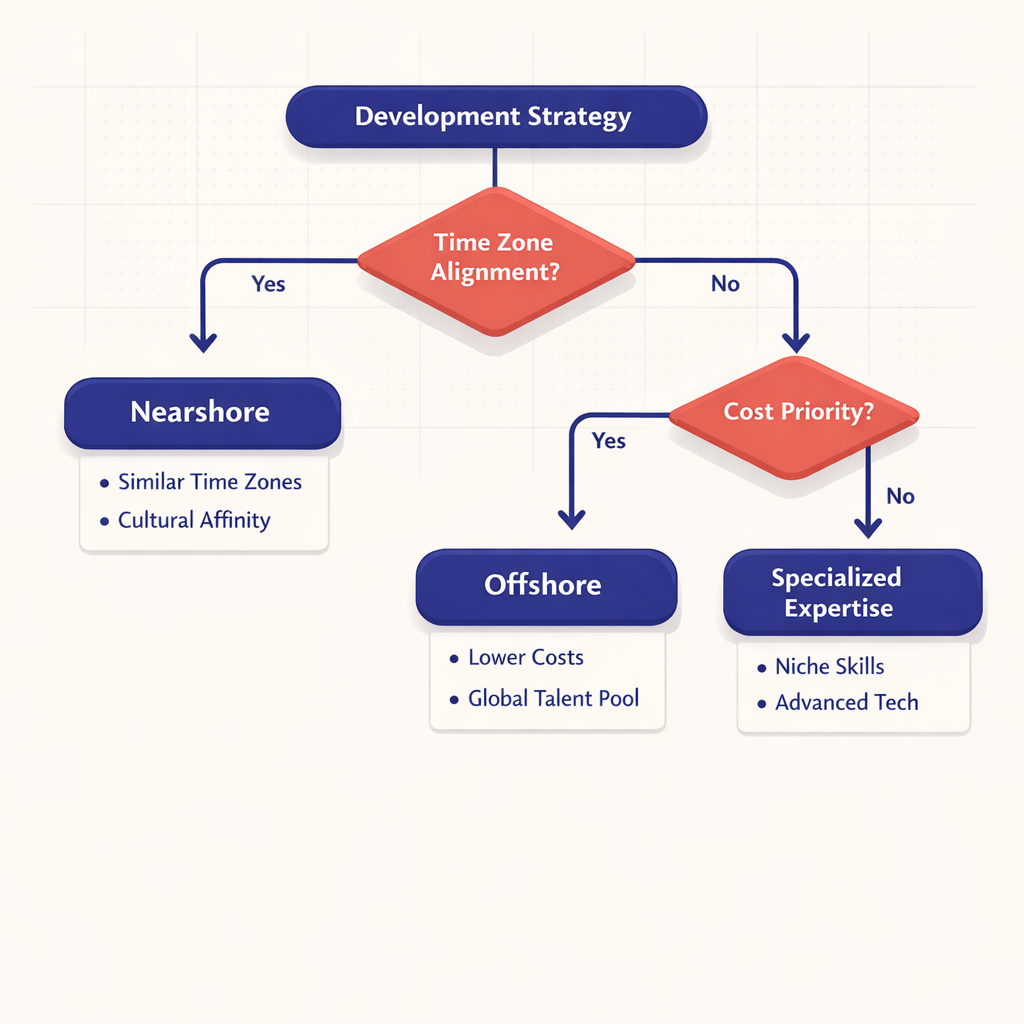 Flowchart for decision-making framework between nearshore and offshore development
Choosing between nearshore and offshore development can be a daunting task, given the complexities related to cost, quality, time zones, and operational logistics. However, implementing a solid decision-making framework can help business leaders make informed choices. Here is a straightforward, clear decision-making framework:
Clarify the Objective:
Begin by defining clear goals for the outsourced project. Are you primarily focused on cost efficiency, seeking exceptional quality, or attempting to address timezone discrepancies?
Assess the Costs:
Next, evaluate the software development costs associated with both models. Consider that costs encompass not only development expenses, but also potential communication challenges, language barriers, and the time required to align with the business culture.
Inspect the Quality:
Investigate the quality of work provided by potential partners by examining their previous projects, client testimonials, and quality assurance processes. While both nearshore and offshore providers can deliver high-quality services, the closer cultural alignment often found in nearshore development can sometimes yield superior service quality.
Review Timezone Overlap:
For projects requiring frequent, real-time interactions and iterations, a nearshore software development partner may be more advantageous due to reduced timezone differences. Conversely, if your business model accommodates asynchronous communication or the project's nature allows more flexible working hours, offshore development might be suitable.
Consider Communication and Collaboration:
Assess factors such as language proficiency, cultural compatibility, and ease of communication and collaboration. These elements can significantly influence your decision between nearshore and offshore options.
Evaluate Risks:
Identify and evaluate the potential risks associated with both setups. Offshore development may involve factors like unanticipated holiday calendars, political instability, or extended communication hours. On the other hand, nearshore development may present risks related to market demand leading to increased costs.
Analyze Personal Requirements and Constraints:
Finally, take your business-specific needs and constraints into account. Consider customer expectations, timelines, budget, team size, and the nature of the project—these factors will illuminate your unique requirements.
Reflecting on real-life scenarios, weighing the pros and cons of offshore development, exploring the benefits of nearshore software development, and considering your unique requirements will provide a comprehensive perspective, enabling you to make an informed and balanced decision.