S
Sagar HebbalePublished on April 15, 2026
26 min read
Custom Ecommerce Platform Development: Build vs Buy in 2026
Explore the advantages of custom ecommerce solutions over pre-packaged ones in an evolving market.
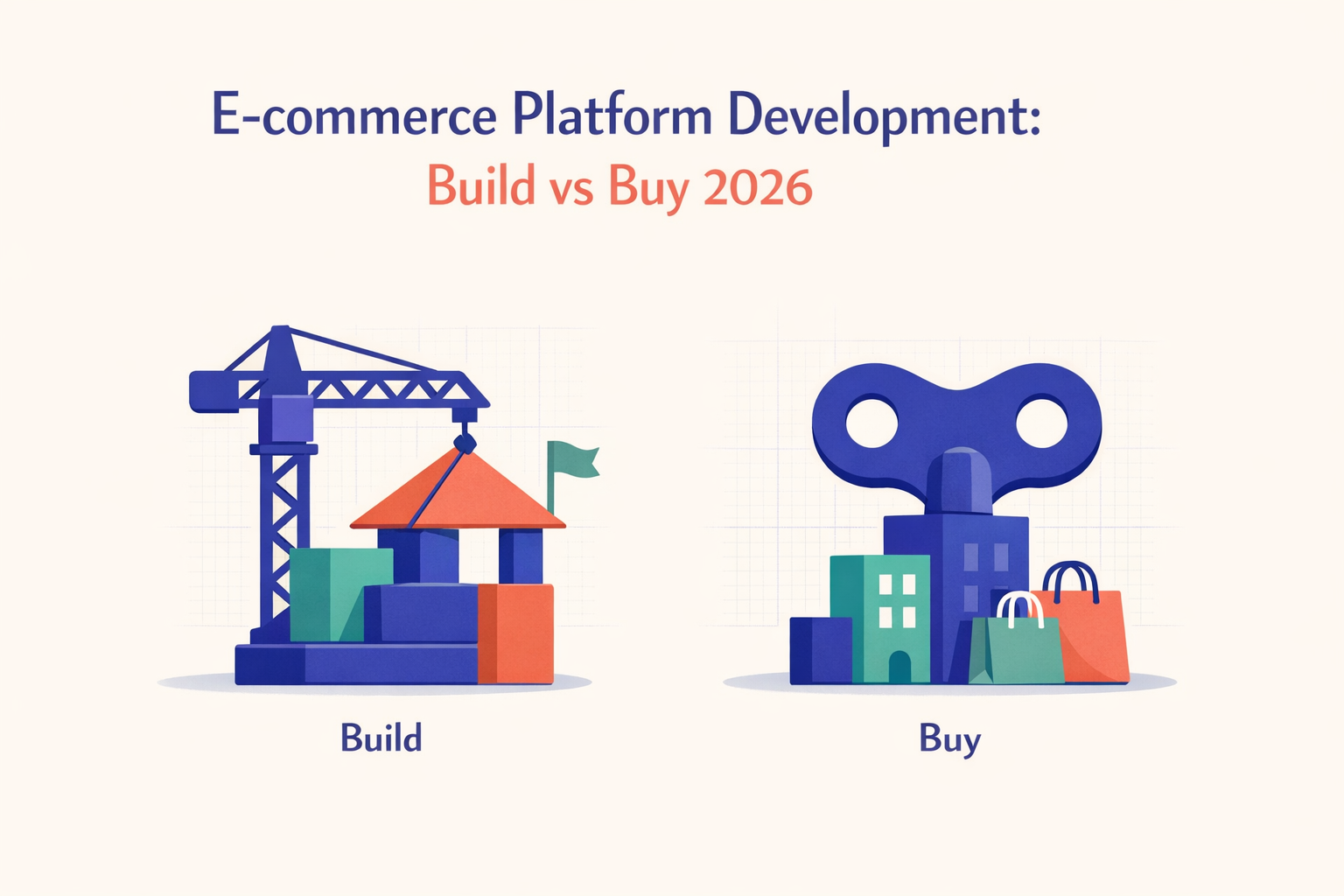
Explore the advantages of custom ecommerce solutions over pre-packaged ones in an evolving market.
Hero Image: Custom vs Shopify E-commerce Platform Development
As we approach 2026, the ever-evolving realm of ecommerce has become increasingly influential and steadfast. At the heart of this transformation lies the burgeoning trend of custom ecommerce platform development—a multifaceted approach that is redefining how businesses engage in online retail.
Ecommerce has evolved from a mere trend to a fundamental component of business strategy, a shift underscored by forecasts predicting that global e-retail revenues will surge to an astonishing $6.54 trillion by 2026. This essential change has prompted a pivotal decision that businesses must confront: should they invest in developing a custom ecommerce platform or opt for a pre-packaged solution like Shopify? This represents a classic dilemma of ecommerce—build vs. buy.
As we navigate through 2026, the inclination appears to be favoring custom development. This shift is propelled by emerging trends, including an increasing demand for personalized shopping experiences, growing cybersecurity concerns, and evolving regulatory frameworks. Although initially, outsourcing ecommerce operations to a commercial platform like Shopify may seem more cost-effective, the projections for ecommerce in 2026 suggest that a custom platform investment—despite its higher upfront costs and extended development timeline—could yield substantial long-term returns.
Custom ecommerce platform development offers unparalleled flexibility and exclusivity, enabling seamless integration with existing business operations. Among the foremost advantages are the scalability and customization tailored specifically to your business model. A custom-built platform distinguishes your business by not being confined by the limitations of a generic, outsourced framework.
Moreover, crafting a custom platform allows you to prioritize functionalities that are vital to your business objectives, avoiding the extraneous features often included with off-the-shelf solutions that can drain valuable resources.
The rise of ecommerce platform development in 2026 has fundamentally transformed the business landscape. As industries adapt to navigate the new dynamics of the sector, the decision to either build or buy an ecommerce platform is more critical than ever. By evaluating key factors such as cost, scalability, integrations, customization, and associated risks, your organization can make a well-informed choice for the future of ecommerce in 2026.
Interested in exploring ecommerce platform development for your business? Contact us here for a detailed consultation.
FAQs
Is custom ecommerce platform development better than buying an off-the-shelf solution like Shopify?
The best choice depends on the unique requirements of your business. Both strategies have their advantages and disadvantages, so your decision should align with your business model and strategic goals.
What are the potential risks associated with custom ecommerce platform development?
While custom development allows for increased flexibility and scalability, it comes with challenges such as higher initial costs, longer development timelines, and the necessity for ongoing maintenance and updates.
How does the anticipated growth of ecommerce in 2026 influence the decision to build or buy?
The expected growth in ecommerce emphasizes the need for an efficient and effective platform. As standardized solutions may lack the necessary flexibility and scalability to accommodate this expansion, many businesses are considering the benefits of building a custom ecommerce platform.
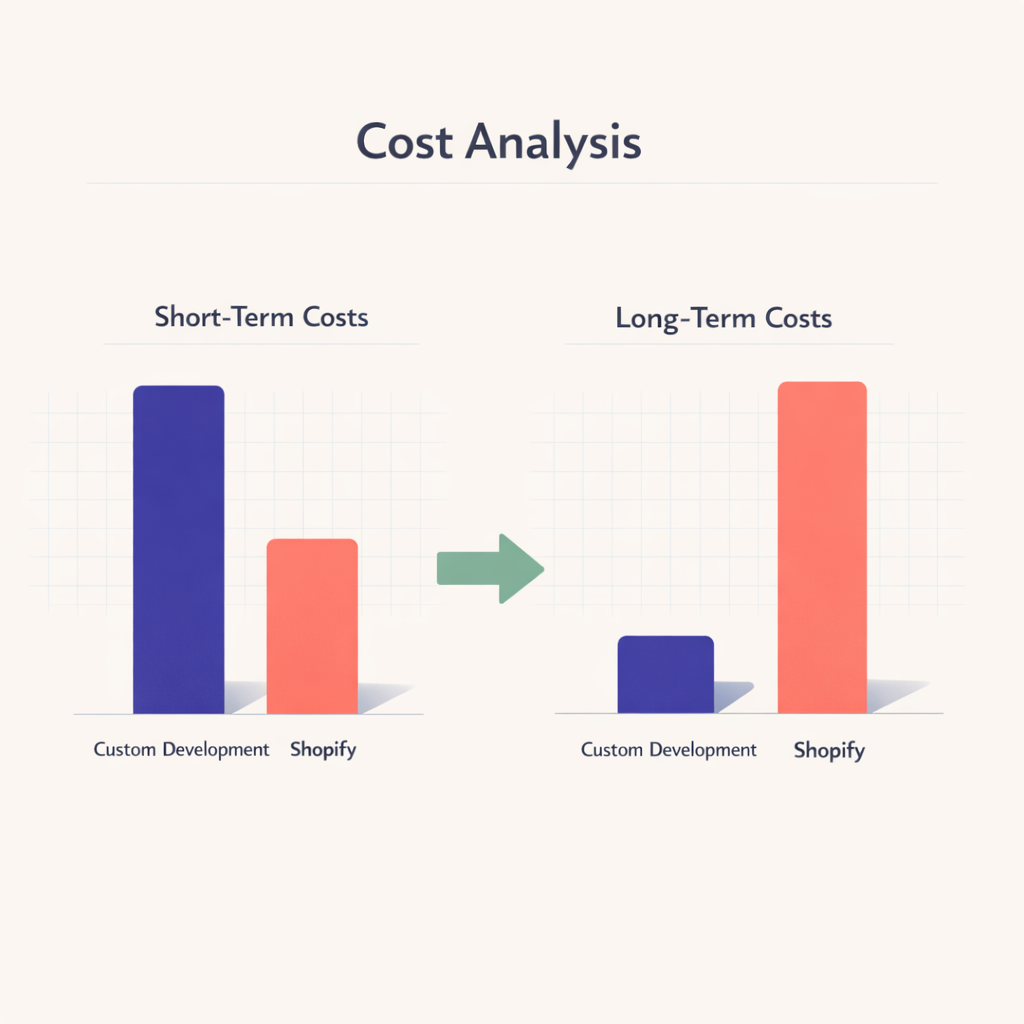 Diagram of Cost Analysis for custom and Shopify Ecommerce Platforms
As we look ahead to the near future of the digital commerce landscape, a compelling scenario unfolds. Driven by innovative technologies and evolving consumer expectations, e-commerce in 2026 will be strikingly different from what we know today. In this context, the strategic question of "build vs. buy" in e-commerce becomes increasingly important.
Projected to surpass an impressive $6.54 trillion in e-retail revenues, 2026 represents a technological battleground. Intense competition, market saturation, and changing trends make the decision between a custom e-commerce platform and a ready-made solution like Shopify more critical than ever.
On one side is Shopify, the Canadian e-commerce powerhouse, which levels the playing field. With various pricing tiers, an intuitive interface, and a comprehensive marketplace of plugins and themes, Shopify is designed for businesses of all sizes. By streamlining the setup and maintenance processes, Shopify creates a cost-effective and user-friendly environment.
However, Shopify's greatest asset could also be a drawback. Its customization capabilities are somewhat constrained, potentially leading businesses to incur high costs for custom development.
Conversely, custom e-commerce platform development empowers businesses with personalized functionalities and distinctive customer experiences. Choosing a custom solution enables:
But does this mean a custom e-commerce platform always outperforms Shopify? Not necessarily. The predictions for e-commerce in 2026 suggest a nuanced landscape. While the demand for customization grows, the limited timelines and project complexities often make Shopify a more practical choice.
| Feature | Shopify | Custom E-commerce |
|---|---|---|
| Up-front Cost | Cost-effective | Requires a larger investment |
| Time to Market | Quicker go-to-market | Longer development time |
| Scalability | Potential limitations | Promises scalable growth |
| Customization | Limited | Extensive customization |
While Shopify offers initial cost-effectiveness and a faster go-to-market strategy, it comes with certain limitations. As businesses scale, they may encounter obstacles related to growing traffic, unique features, and specialized plugins.
On the other hand, custom e-commerce development requires a more significant upfront investment but guarantees scalable growth and extensive customization. This approach provides businesses the freedom to experiment, innovate, and operate without restrictions.
As we move toward 2026, the risk landscape for Shopify and custom e-commerce platforms evolves. Shopify’s susceptibility to security breaches contrasts with potential time and cost overruns in custom development. It is essential to evaluate both options through a risk-appetite lens.
In conclusion, the debate between "custom vs. Shopify" is not a straightforward dichotomy. It requires careful consideration of your company's growth trajectory, budget, desired level of customization, and risk tolerance.
So, where should your e-commerce platform development strategy lead you?
If your e-commerce goals align with innovation, significant growth, and customer-centric solutions, custom e-commerce platform development may be the path forward. Otherwise, Shopify's simplicity and cost efficiency might better serve your business needs.
If you have specific questions regarding e-commerce predictions for 2026, don't hesitate to reach out to us here!
: Source needed.
: Source needed.
: Source needed.
As the landscape of e-commerce continues to expand and diversify, the decision between building a custom e-commerce platform and buying an existing solution emerges as a pivotal issue in 2026. This strategic choice has the potential to fundamentally impact a business's success in the digital marketplace.
When evaluating the costs associated with building a custom e-commerce platform versus purchasing an existing one, businesses must conduct a thorough financial analysis.
| Criteria | Building a Custom Platform | Buying an Existing Platform |
|---|---|---|
| Investment | Offers unmatched flexibility and exclusivity compared to off-the-shelf solutions, though it requires a higher initial investment. | Appears cost-effective, especially for smaller businesses, with pre-built features and immediate setup. |
| Long-term Returns | Has the potential for significant long-term returns, particularly when scalability and customization are integral to the business strategy. | May incur hidden costs; features that initially seem unnecessary can become essential, leading to additional expenses. |
The ability to scale is crucial in any e-commerce strategy.
When businesses choose to build a custom e-commerce platform, they can ensure the platform evolves alongside their needs. Predictions for e-commerce in 2026 emphasize a future heavily focused on scalability, making the development of custom platforms a strategic choice.
In contrast, opting for a pre-built solution like Shopify may raise scalability concerns over time. While such platforms can efficiently support initial operations, they may struggle to adapt to growing business demands.
The ease of integrating with existing operations varies depending on the decision to build or buy an e-commerce platform.
This level of integration may not be feasible with purchased platforms, as their existing frameworks can limit integration capabilities.
The increasing demand for personalization highlights the importance of a custom e-commerce platform, which allows for substantial control over the customer experience.
However, building such a platform also entails potential risks, including heightened cyber threats and regulatory compliance challenges.
Ultimately, the decision hinges on a business's specific needs and resources. An assessment should focus on alignment with the business model, future growth projections, budget considerations, and the ability to manage potential risks.
What are the key benefits of building a custom ecommerce platform?
Is buying an off-the-shelf ecommerce solution like Shopify more cost-effective?
How do cybersecurity and regulatory compliance influence the decision between building or buying an ecommerce platform?
Reach out to us for personalized guidance on choosing the right ecommerce platform.
As we transition into an era marked by explosive growth in ecommerce, understanding the financial implications of choosing between custom ecommerce platform development and utilizing an off-the-shelf solution like Shopify is essential for businesses. Ultimately, cost considerations can significantly influence your decision in the "ecommerce build vs. buy" debate. Let's explore the details.
At first glance, Shopify appears appealing with its low upfront cost. A flat monthly fee starting at $29 for the Basic plan and reaching up to $299 for the Advanced plan covers hosting, security, and regular platform updates. However, additional features such as themes, applications, payment gateways, and transaction fees can accumulate quickly, effectively increasing the total investment.
In contrast, the costs associated with custom ecommerce platform development may initially seem daunting. Businesses must account for expenses related to software development services, hosting, security, and maintenance, which can range from several thousand to hundreds of thousands of dollars. Nevertheless, this substantial initial investment is justified by the platform's distinctiveness and tailor-made functionalities.
When considering ecommerce development costs in the long run, the dynamics shift. Shopify, with its ongoing monthly payments, may require increasingly significant financial resources as your business expands. Costs for additional storage, bandwidth, and features may escalate unnecessarily.
Conversely, the costs of a custom-built platform are primarily incurred upfront, with occasional expenses for updates or enhancements. Its scalability allows you to amplify operations or integrate new systems without incurring significant additional costs.
Looking forward to ecommerce predictions for 2026, global e-retail revenues are projected to reach $6.54 trillion. Given this anticipated growth, the custom-built approach appears promising. This option provides businesses with unrestricted customization capabilities, eliminating the potential risks associated with a one-size-fits-all model like Shopify. Despite the initial price tag, the long-term financial benefits could propel your business into a new era of digital retail.
The decision of "build vs. buy" hinges on your company's specific needs and budget. Evaluate both direct and hidden costs and consider future scalability and customization requirements before making your ecommerce investment.
Still have questions about the costs of ecommerce platform development? We've addressed some FAQs below.
Intrigued? To discuss your ecommerce platform development, get in touch.
: Post 17, Pricing Plans, Shopify. : /services/custom-software-development, Pricing Guide, Custom Software Development. : /software-development-ecommerce, Ecommerce Predictions 2026, Software Development Ecommerce.
 Conceptual Image of Platform Integrations and Customizations
Scalability has become a critical factor for businesses evaluating whether to pursue custom ecommerce platform development or utilize ready-to-use platforms like Shopify. With predictions estimating significant growth in ecommerce by 2026, the choice between building or buying a platform can significantly impact not only your immediate success but also your long-term scalability and growth trajectory.
Although custom ecommerce platform development often requires a higher initial investment, it offers substantial advantages in terms of scalability. Custom-built platforms are specifically designed to be scalable, allowing your ecommerce store to grow and adapt alongside your business needs.
Key scalability benefits include:
| Benefit | Description |
|---|---|
| Perfect fit | Unlike one-size-fits-all platforms, custom applications are tailored to align with your unique business model, maximizing operational efficiency. |
| Resource management | Custom platforms provide greater control over server resources, enabling you to increase capacity as needed without compromising performance. |
| Seamless integration | Custom-built platforms can integrate smoothly with your existing business operations, avoiding limitations imposed by preset features. |
Conversely, Shopify boasts remarkable ease of use and low initial costs, which makes it an appealing choice for startups and small businesses. However, scalability may pose challenges. While Shopify is designed to support businesses of varying sizes, scaling your ecommerce operations on this platform could result in increased ongoing costs and limited customization options.
Key scalability concerns with Shopify include:
| Concern | Description |
|---|---|
| Slow page load times | As your store expands, you may experience slower page speeds. This can negatively affect user experience and potentially lead to lost sales. |
| Limited customization | While Shopify provides numerous integrations and features, as your business evolves, you may reach a point where further customization to meet your unique needs becomes limited. |
In conclusion, both options come with their respective advantages and disadvantages, and your decision should align with your business goals and growth vision. If maximizing scalability along with robust integration and customization is a priority, a custom ecommerce platform is likely the best route. However, if you are operating under budget constraints and seek immediate solutions, Shopify presents a viable option. For expert advice, feel free to contact us (/contact?industry=ecommerce) to discuss the ideal solution for your ecommerce needs.
: E-retail revenues are projected to grow to $6.54 trillion in 2026.
: Custom-built platforms offer optimized scalability to match your business trajectory.
: Shopify's scalability limitations may make it less suitable for larger businesses.
: Slower page speeds can affect user experience and overall sales.
In today's rapidly evolving ecommerce landscape, the ability to integrate seamlessly with various services and customize your platform to meet your clients' needs is a game-changing factor. In the debate between building a custom ecommerce solution and using Shopify, these two aspects add another layer of complexity to an already intricate decision-making process. So, how does one navigate the question of integrations and customizations in ecommerce as we approach 2026 and beyond?
As the ecommerce market is projected to reach a value of $6.54 trillion by 2026, effective integrations can play a crucial role in engaging customers and streamlining operations. Shopify offers a robust array of applications that can be seamlessly integrated into the platform.
Conversely, custom platforms allow you the flexibility to create integrations tailored to your unique business model. However, it is essential to consider the associated development costs and technical complexities.
| Feature | Shopify | Custom Ecommerce |
|---|---|---|
| Integrations | Offers a comprehensive set of proven integrations with leading payment gateways, CRMs, and digital marketing tools. | Virtually no restrictions on integrating third-party applications or developing your own. |
| Limitations | May face challenges in meeting specific business requirements for customization. | High costs and extended timelines associated with custom development can be significant concerns. |
Looking ahead to the ecommerce predictions for 2026, the demand for personalized shopping experiences is only expected to increase.
| Feature | Shopify | Custom Ecommerce |
|---|---|---|
| Customization | Provides a diverse library of themes and add-ons to enhance User Experience (UX). | Offers almost limitless possibilities for customization, allowing for a distinctive brand identity. |
| Constraints | You may encounter limitations when modifying the platform's core functionality. | Extensive customization can come with a significant cost. |
In the debate between building a custom ecommerce platform and buying a standardized solution like Shopify, it is crucial to evaluate the associated risks.
In conclusion, the decision between developing a custom ecommerce platform and adopting a solution like Shopify largely hinges on your business needs and resource allocation. Both approaches offer distinct advantages and potential pitfalls when it comes to integrations and customizations.
Questions to Guide Your Decision-Making:
Navigating these complex decisions becomes more manageable with the right support. Reach out to us today at /contact?industry=ecommerce and let’s explore the best ecommerce strategy for your organization.
In the pursuit of developing an ecommerce platform that effectively addresses your business needs, both custom ecommerce platform development and pre-built solutions like Shopify present distinct opportunities and challenges. Understanding the potential risks linked to each option is crucial for making an informed decision between building or buying an ecommerce platform, enabling you to successfully navigate the evolving ecommerce landscape projected in the 2026 predictions.
Custom ecommerce platform development offers businesses complete control. However, this option comes with inherent risks:
Higher Development Costs and Time: Creating a custom platform can be costly and time-consuming. It is essential to evaluate these challenges in the context of life-cycle costs and how well the platform aligns with your strategic business objectives.
Reliance on Developers: Since a custom platform is proprietary, businesses may depend on the original development team for maintenance, troubleshooting, and updates. This reliance can pose significant risks.
Potential for Technical Flaws: As with any custom-built solution, there may be bugs and vulnerabilities initially, which will require thorough testing and refinement to resolve.
Choosing pre-built platforms like Shopify also carries potential risks:
Limited Customization: While Shopify provides some customization options, businesses may encounter restrictions in terms of advanced features and unique functionalities.
Ownership and Control: Utilizing off-the-shelf solutions like Shopify means that businesses do not have complete control over the platform, which can influence strategic decisions.
Ongoing Costs: Platforms like Shopify often come with recurring subscription fees. Depending on the size and needs of the business, these costs can accumulate, potentially making this option more expensive in the long term.
Anticipating and lessening these risks hinges on thorough planning and strategic foresight. Modeling potential scenarios and responses, regularly reviewing and updating project and budget plans, and fostering diverse developer relationships can all contribute to mitigating these risks. Staying informed about ecommerce predictions for 2026 and beyond will further clarify your path forward.
Seeking additional guidance on which path to take? Our ecommerce experts are here to assist you. Contact us at [^/contact?industry=ecommerce].
Choosing the right ecommerce platform for your business can be a daunting task. However, by establishing a decision framework tailored to your business needs, you can simplify the ecommerce build vs. buy choice. Here are key questions to consider as you weigh custom ecommerce platform development against Shopify in 2026:
| Question | Custom Ecommerce Platform Development | Shopify |
|---|---|---|
| What's your budget? | Offers long-term returns due to scalability and customization potential. | More cost-effective initially, making it ideal for small businesses. |
| What customization do you need? | Provides greater flexibility to tailor a platform according to specific operations. | Offers various plugins/themes, but with less overall customization. |
| How important is scalability? | More scalable as your business evolves and grows. | May impose limitations on both customization and scalability. |
| What are the potential risks? | Requires ongoing maintenance and presents cybersecurity risks, though these can be managed. | Simplifies updates and security but may create dependency risks. |
Ready to take the next step in your ecommerce platform development? Reach out to us, and let’s discuss the right solution for your business at /contact?industry=ecommerce.
As we navigate the evolving e-commerce landscape in 2026, one question frequently arises among businesses: Should we invest in custom e-commerce platform development or opt for a ready-to-use service like Shopify? Each option offers distinct strengths and weaknesses depending on your unique business needs, financial resources, and long-term growth plans. Let's explore three of the most frequently asked questions regarding custom versus Shopify e-commerce platforms.
| Platform Type | Scalability |
|---|---|
| Custom E-commerce Platforms: | Custom e-commerce platforms excel in scalability, providing an unparalleled level of flexibility and potential for expansion tailored to your business requirements. This platform type is particularly well-suited for business models that require adaptability as both customer bases and product inventories grow. |
| Shopify: | While Shopify is easy to set up, it may impose restrictions on growth after a certain point due to its predefined structure and possible limitations on features and design elements. Nevertheless, it can serve as an excellent starting point for small businesses or those entering the e-commerce space for the first time. |
| Platform Type | Cost Implications |
|---|---|
| Custom E-commerce Platforms: | The initial development cost may be relatively high, as the platform is built from scratch to precisely meet the business's specific needs. However, over the long term, custom e-commerce platforms can yield significant returns through unique user experiences, improved conversion rates, and enhanced customer retention. |
| Shopify: | Shopify has a small startup fee and monthly subscription costs. While it offers a more cost-efficient option upfront, be mindful of recurring costs and the potential for higher transaction fees as your business expands. |
| Platform Type | Integrations and Customization |
|---|---|
| Custom E-commerce Platforms: | Custom platforms outpace others in terms of integrations and customization. They can seamlessly integrate with your existing systems and can be tailored in every aspect—from user interface design to personalized user experiences. |
| Shopify: | In contrast, Shopify provides integrations with a myriad of apps and services. However, the extent of customization can be more limited compared to a custom platform, potentially resulting in additional costs for certain premium features. |
With projected global e-retail revenues expected to reach $6.54 trillion in 2026, the decision to build or buy an e-commerce platform is more critical than ever. Your choice can significantly affect your market position, customer satisfaction, and overall business growth. Do you need further advice? Contact us for a more in-depth discussion on custom e-commerce platform development, e-commerce predictions for 2026, and how we can help turn your vision into reality. [/contact?industry=ecommerce].
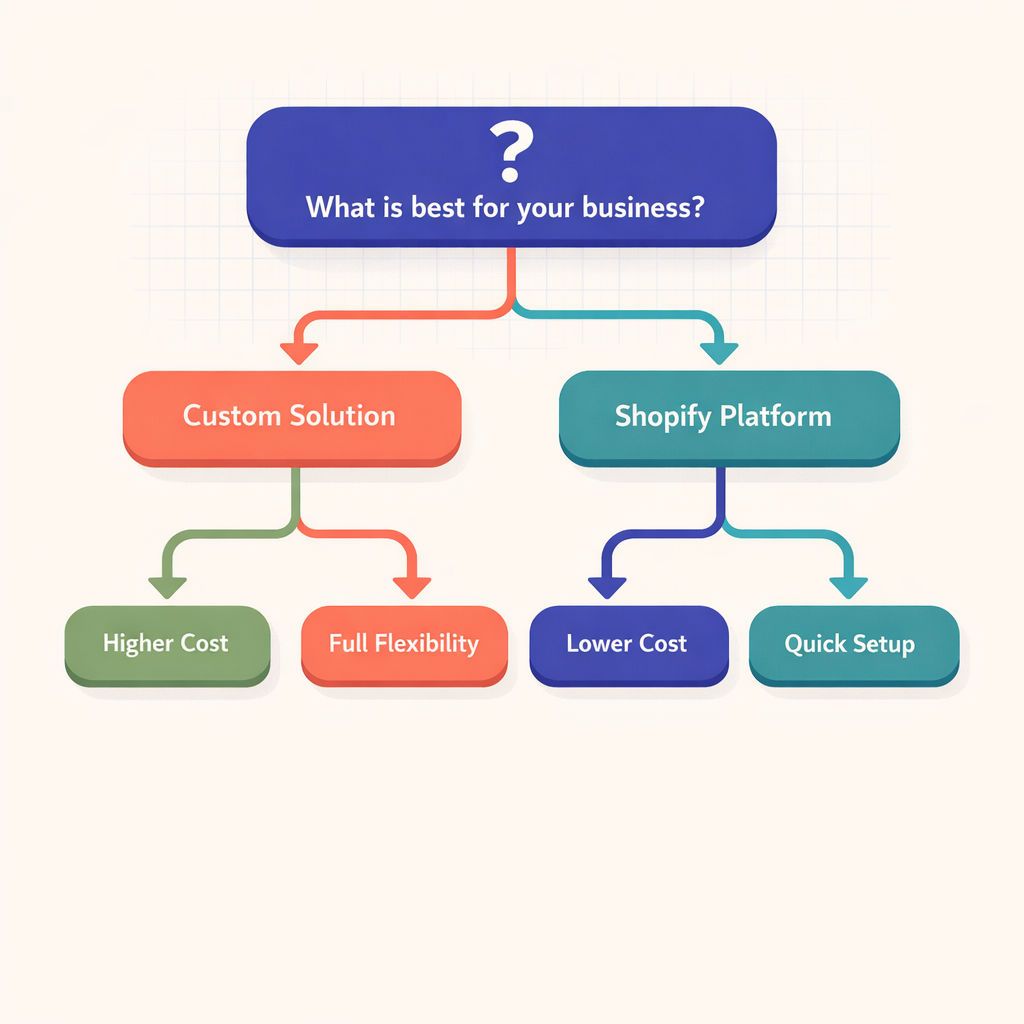 Illustration of the Decision-Making Framework for E-commerce Platform
The unprecedented evolution of e-commerce, transitioning from a trend to a necessity, has compelled businesses to adopt innovative strategies for sustained growth and relevance in the dynamic e-commerce landscape. A pivotal decision in this evolution is the "Shopify vs Custom E-commerce" dilemma. In our analysis of the e-commerce context in 2026, we have examined the build versus buy theory in e-commerce platform development, highlighting key considerations such as:
These factors may significantly influence your decision.
Opting for a custom e-commerce platform (the 'build strategy') offers a unique level of exclusivity and extensive customization options. This approach allows businesses to engineer a platform that aligns closely with their unique business models and facilitates seamless integration with existing systems. The value of this investment lies in its long-term benefits, which can outweigh the initial higher costs and time commitments associated with developing a custom solution as opposed to using Shopify.
Conversely, purchasing an off-the-shelf solution like Shopify (the 'buy strategy') is a more cost-effective route, particularly if you are working with a limited budget or a tight timeline. While this option provides the convenience of a ready-to-use platform, companies may encounter limitations in terms of customization and flexibility regarding integrations.
Reflecting on these considerations reveals the distinct differences inherent in the build versus buy decision for e-commerce platforms. To make the most informed choice, it is essential to establish a decision framework grounded in your business needs, financial resources, and long-term growth objectives.
For your convenience, we have provided answers to three frequently asked questions regarding this topic, examining the pros and cons of each option. However, the complexity of e-commerce platform development underscores the need for personal, in-depth consultations with e-commerce experts. Leveraging their insights can help you navigate the intricacies of this critical decision, ensuring your business is well-positioned for success in the e-commerce landscape of 2026 and beyond.
In conclusion, the predictions for e-commerce in 2026 indicate a rapidly evolving environment—shaped by heightened customer expectations and continuous technological advancements. Succeeding in this competitive terrain will require businesses to make informed, strategic decisions about their e-commerce platform development approach. To assist you with this, reach out to our team of experts at our contact page; we are always ready to address your inquiries and guide you on your e-commerce journey.