N
Naresh HRPublished on April 15, 2026
19 min read
AI Workflow Automation: 10 Essential Processes to Automate by 2026
Unlock efficiency and insights with AI workflow automation for your business in 2026.
Unlock efficiency and insights with AI workflow automation for your business in 2026.
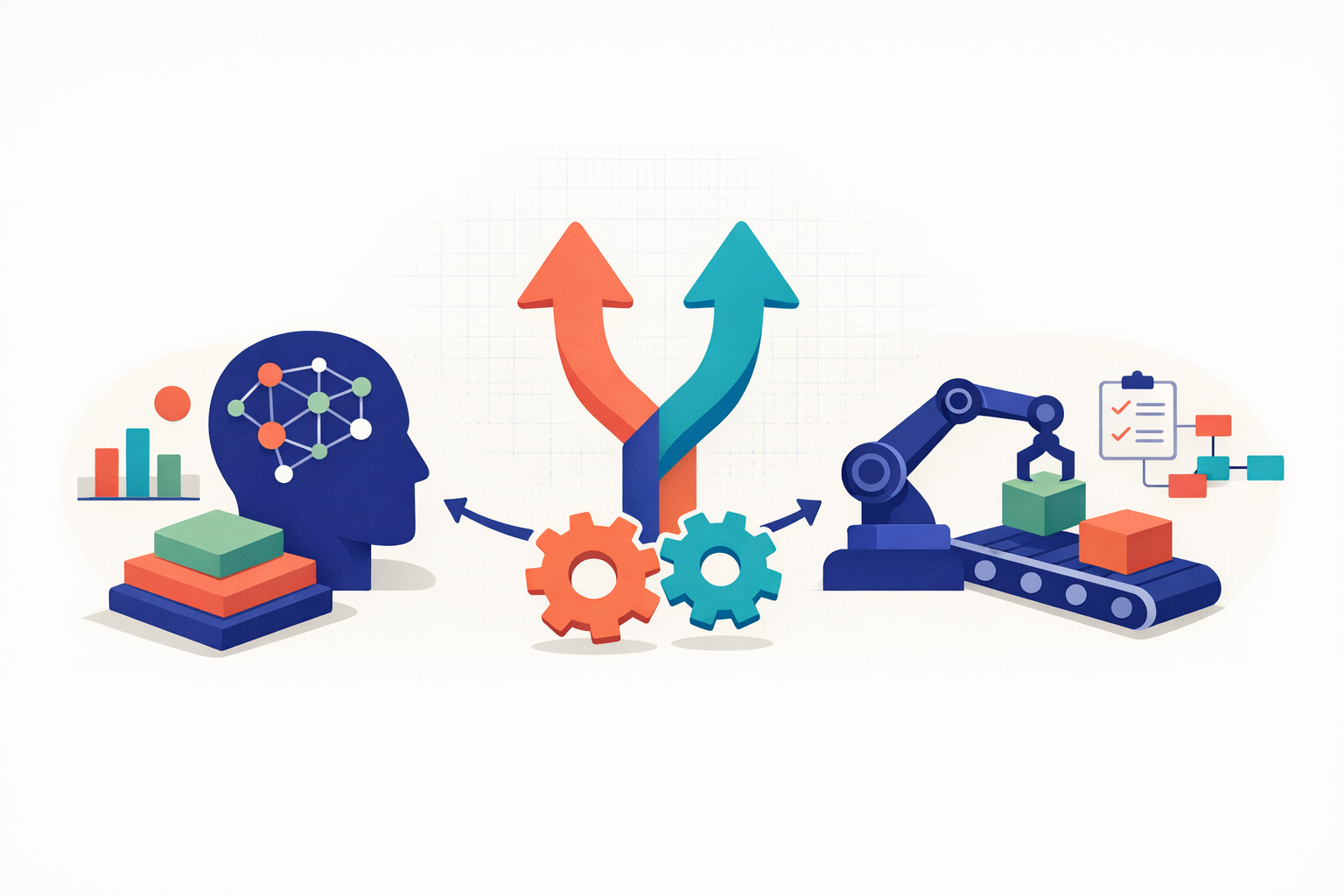
Hero image depicting the evolution of AI and RPA in the landscape of automation.
In today's digital landscape, AI Workflow Automation is rapidly evolving from a luxury into a necessity for businesses. This transformative technology is poised to redefine the business environment by 2026, with projections suggesting unprecedented levels of efficiency and accuracy. Its primary objective is to fundamentally change the execution of business tasks and processes.
Moving beyond traditional Robotic Process Automation (RPA), Artificial Intelligence (AI) integrates cognitive capabilities with automation. While RPA focuses primarily on automating routine tasks, AI enhances this by incorporating learning, decision-making capabilities, and predictive features based on historical data. This potent combination ushers in the next chapter of Intelligent Process Automation (IPA), where AI-driven insights significantly improve conventional RPA.
As we look toward the future of AI Automation in 2026, it is essential to consider which key business processes are most suitable for automation. Below are ten essential processes that are ideal candidates for AI Process Automation:
Customer Support: Implement AI chatbots to handle routine inquiries around the clock, allowing your team to focus on more complex issues.
Invoicing: Utilize AI applications to verify, match invoices with purchase orders, and automate payment processing, minimizing manual errors and accelerating payment cycles.
Onboarding: Introduce an AI-guided system for a streamlined and consistent onboarding experience that ensures regulatory compliance and enhances overall satisfaction.
Content Moderation: Leverage AI to automatically review content on social media platforms and forums, ensuring the removal of inappropriate content and maintaining a positive environment for your audience.
In conclusion, AI Process Automation offers a promising future for companies willing to adopt it. By minimizing the time and costs associated with manual operations, AI ensures greater precision, heralding a new era of business efficiency.
: AI Workflow Automation: 10 Processes to Automate in 2026.
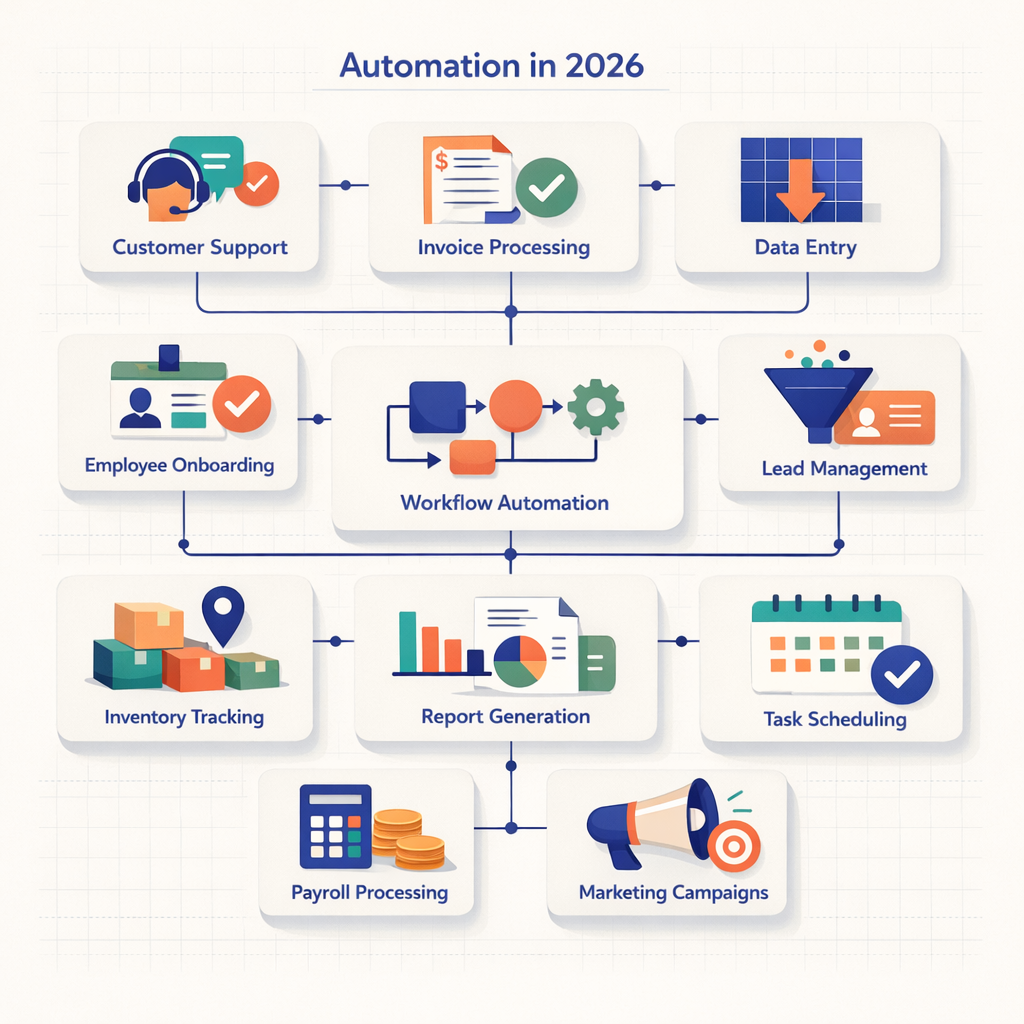 Illustration of 10 business processes for AI automation.
In discussing automated processes, it is crucial to understand the distinction and relationship between AI and RPA (AI vs RPA). To best illustrate this, we will delve into AI process automation, which many anticipate will be the driving force behind business operations with AI by the year 2026.
RPA primarily focuses on automating routine tasks. Initially, RPA was essential for replacing repetitive, human-performed tasks with bots, encompassing functions such as customer service responses, data entry, and invoice processing. While RPA can undoubtedly increase efficiency, it has its limitations; RPA lacks the cognitive ability to learn from or respond to the data it processes. Instead, it strictly adheres to programmed rules and instructions.
In contrast, business processes utilizing AI elevate automation to a new level. Rather than merely executing tasks, AI introduces cognitive capabilities such as:
This ability to learn and predict enables AI to be adaptable to changing conditions, a feature that RPA lacks. By 2026, it is anticipated that AI Process Automation will fundamentally transform business operations, leveraging AI's capacity for continuous improvement and service enhancement.
The integration of both technologies has led to the development of Intelligent Process Automation (IPA). This combination enhances the strengths of RPA with AI's intellectual capabilities, broadening the horizons of what business automation can accomplish. This fusion signifies the evolution of RPA into IPA, highlighting that AI and RPA are not mutually exclusive but rather complementary forces. A sound management strategy for 2026 would involve integrating both RPA and AI into your business processes.
Recognizing the differences and relationships between AI and RPA is your first step in determining which may be more suitable for your business processes. Furthermore, understanding these concepts is critical for appreciating the significance and effectiveness of IPA, which paves the way for successful AI automation in 2026.
As we move further into an AI-enhanced future, businesses must leverage the potential of automation to increase efficiency and keep pace with the digital transformation wave of 2026. Below are ten essential business processes that can benefit from AI Workflow Automation, resulting in greater effectiveness and value.
AI has profoundly transformed customer support. AI bots can autonomously address routine queries around the clock, freeing human staff to focus on resolving complex issues. By utilizing natural language processing, these bots can better understand and respond to customer concerns, enhancing overall customer experience and loyalty.
Efficient handling of invoices is a critical component of business operations, particularly within finance departments. AI can automatically validate and reconcile invoices with purchase orders, as well as process payments, thereby reducing human errors and speeding up payment cycles. AI-powered invoicing systems can adapt and learn from business patterns, minimizing frequent invoice discrepancies and delays in payment processing.
Modernizing employee onboarding through AI can ensure consistent training, regulatory compliance, and an efficient integration process. Automated AI systems can create customized onboarding schedules, deliver training materials tailored to the new hire's role, and monitor their progress throughout the induction.
AI can effectively screen content across various platforms, such as social media and forums, for inappropriate material. Automated moderation not only fosters a positive community environment but also alleviates the workload on human moderators, enabling them to focus on more complex issues.
AI can analyze customer behavior and preferences to predict potential leads for a business. Automated AI processes facilitate the management of these leads, from capturing lead details to nurturing them through the sales funnel, resulting in a streamlined process.
AI can efficiently archive, retrieve, and manage substantial quantities of documents. Features such as keyword recognition and relevance scoring simplify document searches and reduce the time spent on these activities.
AI-driven automation can significantly enhance the quality assurance process. By identifying patterns from past errors and predicting potential issues, AI can offer real-time suggestions for improving product or service quality.
AI can automate schedule management, reducing the administrative burden on staff. AI-powered systems can handle meetings, bookings, and reminders, simplifying the coordination of schedules.
In industries where adherence to regulatory standards is crucial, AI workflow automation can proactively monitor compliance requirements, schedule audits, and implement controls when necessary.
AI can automate data extraction and interpretation, presenting this information in easily digestible reports. This automation significantly reduces manual effort, provides real-time insights, and supports informed decision-making.
Envisioning the future of business processes with AI is both exciting and imperative. By strategically combining human expertise with AI Workflow Automation, businesses can unlock new opportunities, make informed decisions, and remain competitive in the digital economy. AI Automation 2026 is not merely a distant aspiration but a reality that is actively shaping the landscape of AI Process Automation, evolving from traditional RPA to Intelligent Process Automation (IPA).
Customer support is a foundational pillar of any successful business. As AI Process Automation reaches new heights in 2026, the customer support sector will experience a significant transformation. Intelligent Process Automation (IPA) will empower businesses to deliver highly efficient and precise customer support by automating routine inquiries. This enhancement not only leads to cost savings but also ensures a more personalized customer experience.
AI-driven support enables uninterrupted, round-the-clock customer service. Customers can expect immediate, accurate responses to routine issues or queries. Furthermore, this approach allows customer support representatives to focus on more complex queries requiring human intervention, striking a balance between advanced problem-solving and automation.
In 2026, AI process automation will be pivotal in transforming customer support-driven business processes. By effectively leveraging AI, businesses can automate responses to straightforward inquiries while delegating more complex, context-dependent issues to human agents. This tailored approach ensures exceptional customer satisfaction at every touchpoint, underscoring the dynamic role of AI in the future automation landscape.
In the fast-paced business environment, invoicing remains a critical process that can significantly benefit from AI Process Automation. By harnessing AI's cognitive capabilities, businesses can automate various aspects of their invoicing processes, including validating invoices, matching them with purchase orders, and processing payments. This initiative minimizes the risk of human error and accelerates transaction processing, providing enterprises with an unprecedented level of responsiveness and efficiency.
By 2026, AI automation is expected to redefine the invoicing process, facilitating quicker, more streamlined, and error-free transactions. An automated invoicing system can review hundreds of invoice pages in minutes, identifying errors, detecting duplicates, and more. By implementing AI in this vital business function, companies can experience a substantial reduction in the time required to process invoices.
Adopting AI for invoicing in 2026 presents numerous advantages:
| Benefits | Description |
|---|---|
| Reduced human error | AI systems are not only fast; they are incredibly accurate, significantly lowering common errors. |
| Increased speed and efficiency | AI expedites the invoicing process by automating essential tasks such as validation and payment processing. |
| Improved cash flow management | By accelerating the payment cycle, AI enhances the likelihood of timely payments and improves cash flow. |
In summary, integrating AI into invoicing processes can lead to substantial enhancements in business operations, streamlining procedures while boosting productivity and efficiency. With AI Process Automation, the outlook for invoicing in 2026 appears exceedingly promising.
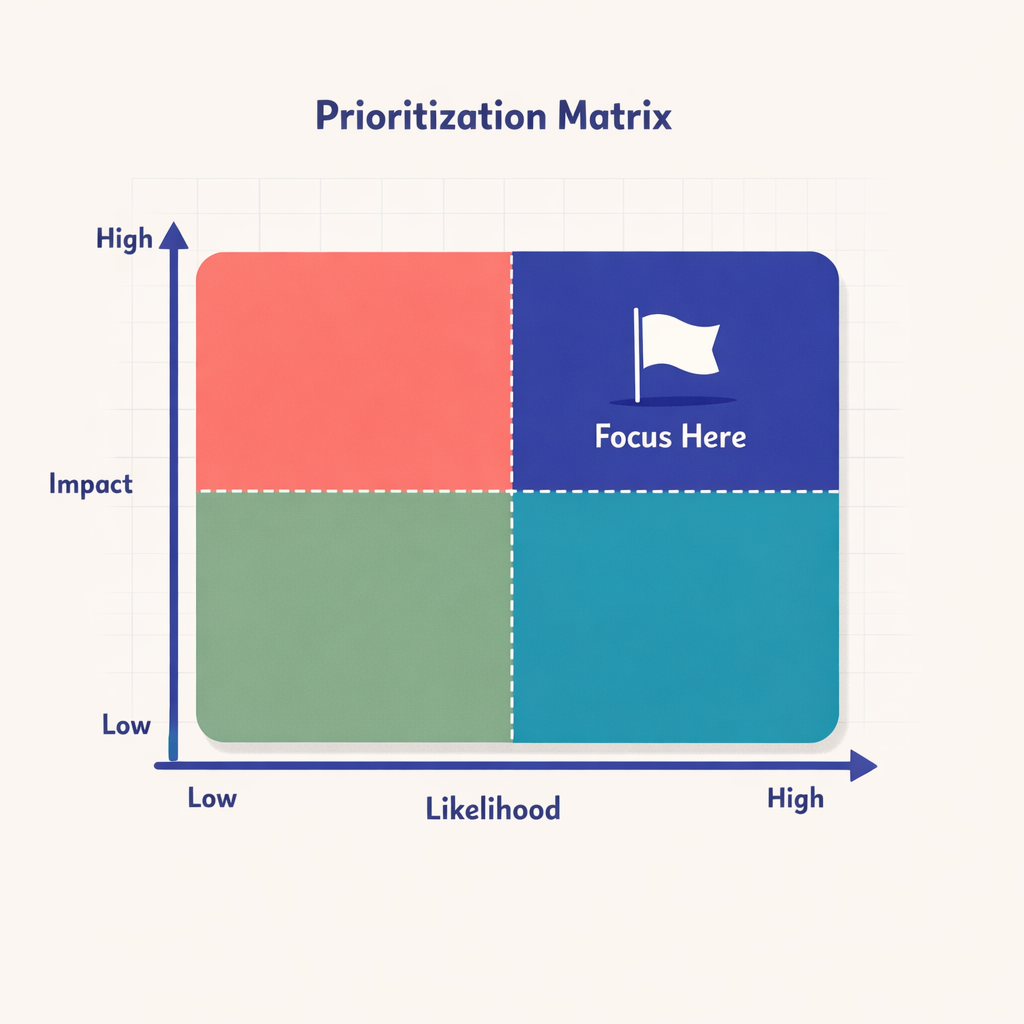 A strategic prioritization matrix diagram for choosing AI automation processes.
Implementing any technological solution within a business requires careful consideration, and AI Process Automation is no exception. With a wide array of processes that can potentially be automated by 2026, adopting a strategic framework for prioritization is essential. The framework we propose employs a matrix to evaluate two critical factors: Value and Feasibility.
The value proposition of adopting AI for process automation is grounded in two core metrics:
Potential efficiency gains: Assess the extent to which automation can enhance efficiency within the process. Efficiency can be quantified in terms of cost savings, time reduction, and improved accuracy.
Strategic importance: Consider the anticipated impact on the organization’s broader strategic objectives. These may include enhancing customer satisfaction, reallocating resources, enabling data-driven decision making, and more.
Conversely, the feasibility of automation depends on:
Technological readiness: Analyze whether current AI technologies and resources are sufficient to effectively automate the process.
Integration complexity: Estimate the challenges associated with incorporating AI automation into the existing workflow. Factors to consider include changes to employee roles, training requirements, necessary infrastructure adjustments, and any potential disruptions to ongoing operations.
A thorough analysis of these metrics for each potential process provides a clear picture of the cost-benefit balance, making prioritization a more focused effort.
According to a framework outlined in "The Business Process Automation Guide", a matrix layout can effectively visualize this assessment. By plotting the selected processes on a graph where 'value' is represented on the x-axis and 'feasibility' on the y-axis, you can identify processes in the top-right quadrant—those high in both value and feasibility—as the ideal candidates for AI automation implementation.
As we approach 2026, having a rigorous, structured approach to AI Process Automation prioritization will expedite your path to automation success. Be mindful that your strategic priorities may shift as technology and business conditions evolve, so maintaining flexibility in your approach is crucial.
Make it a priority to prioritize. The rewards could be transformative for your organization as AI becomes common practice in business operations by 2026.
Identifying high-impact, high-likelihood projects for AI automation relies primarily on two factors: Value and Feasibility. While we have covered how to assess value, the process of establishing feasibility merits further discussion, particularly in the context of AI Process Automation and the anticipated landscape of AI automation in 2026.
Determining feasibility involves evaluating the technical and operational implications of automating a business process with AI. Here are three critical aspects to consider:
| Aspect | Description |
|---|---|
| Technical capability | Ensure that AI technology can successfully automate the process. Some tasks may require AI capabilities that are not sufficiently developed by 2026. |
| Data availability | AI systems require substantial amounts of data for training and operation. It is crucial to assess the availability of high-quality, relevant data for the specific process. |
| Cost and ROI | Weigh the initial costs of implementing AI against the projected return on investment. While AI offers significant efficiency gains, the initial investment may be considerable. |
By comprehensively evaluating both value and feasibility, businesses can effectively identify and prioritize processes for AI automation. This in-depth approach ensures that organizations target operational improvements that align with strategic objectives while optimizing the potential of AI, thus propelling the business into the future of AI automation.
AI workflow automation is set to transform business operations by 2026. It is essential to approach this transition with a detailed, step-by-step plan. Below is a comprehensive checklist designed to assist businesses in implementing AI process automation effectively.
What factors should be considered while selecting processes for AI workflow automation?
How will AI technology impact the workforce?
What are some key challenges in implementing AI Workflow Automation?
By following this comprehensive checklist, businesses can facilitate a smooth and successful transition to AI Automation by 2026, thus revolutionizing their operations for optimal efficiency and effectiveness.
As the digital transformation frontier expands into new territories, understanding AI Process Automation becomes increasingly vital. Below, we address the three most common inquiries regarding the integration of AI workflow automation into business processes:
| Feature | Traditional Automation | AI Workflow Automation |
|---|---|---|
| Focus | Automating routine, repetitive tasks | Making intelligent decisions based on learned data |
| Technology | Primarily Robotic Process Automation | Incorporates AI for advanced decision-making |
| Future Shift | RPA | Transitioning towards Intelligent Process Automation (IPA) |
By 2026, this transition is expected to foster a hyper-efficient ecosystem where AI enhances RPA.
By 2026, AI is anticipated to integrate deeply into various business processes, minimizing manual oversight and significantly enhancing efficiency. The potential applications of AI automation are vast, covering tasks from invoice processing to customer support. Key use cases include:
Implementing AI automation enables businesses to operate continuously, thereby improving efficacy and cost-effectiveness while minimizing errors.
The initial step in integrating AI process automation involves a thorough analysis of your current workflows. Identifying areas characterized by repetitive tasks or those that could be expedited through AI intervention will provide a solid foundation. Coupling this with a feasibility study from an AI technology perspective will facilitate the formulation of an effective automation strategy for 2026.
Implementing AI Workflow Automation is thus an iterative, ongoing process requiring continuous evaluation and refinement to achieve optimal results.
 Illustration of the future of AI Workflow Automation in business processes.
Artificial Intelligence (AI) is on a rapid trajectory to redefine the completion of work and the very nature of jobs themselves. As we approach 2026, AI workflow automation is becoming increasingly critical, representing a transformative shift in how businesses operate. Let us explore this realm of AI innovation and its future implications for enterprise utilization.
The potential of AI workflow automation extends far beyond the confines of Robotic Process Automation (RPA). The combination of cognitive and automated capabilities gives rise to the concept of Intelligent Process Automation (IPA). As we shape the AI Automation landscape for 2026, IPA enhances the standard functionalities of RPA by integrating learning, decision-making, and predictive analysis.
Incorporating AI into workflows enables a higher level of operational efficiency by reducing manual intervention in routine tasks, allowing organizations to reallocate their workforce to more strategic roles.
AI process automation is grounded in 10 fundamental processes that businesses should consider implementing:
| Process |
|---|
| 1. 24/7 customer support via AI bots |
| 2. Automated invoicing and payment processing |
| 3. Efficient AI-guided onboarding |
| 4. Auto-moderation of online content |
| 5. AI-driven lead generation |
| 6. Intelligent document management |
| 7. Automatic quality assurance testing |
| 8. Smart scheduling and resource management |
| 9. AI in compliance for regulatory adherence |
| 10. AI-powered business reporting and analytics |
AI workflow automation does not necessitate an all-or-nothing approach. Therefore, it is crucial to focus on prioritizing areas that offer the most significant potential benefits. A prioritization matrix can be an invaluable tool for strategizing which processes to automate first.
The prudent application of AI process automation provides a robust opportunity for businesses to streamline operations and deliver exceptional value, paving the way for future scalability.
As we stand at the threshold of 2026, the impending integration of AI and automation signals a potential business revolution. The question of "whether" to leverage AI for automation has evolved to one of "how" and "when." Just as the advent of electricity brightened previously dark spaces, AI is poised to illuminate the most obscure corners of business processes with data-driven insights; for those poised for change, the future is bright—and automated.