S
Sagar HebbalePublished on April 15, 2026
22 min read
AI Automation ROI: Calculate and Maximize Your Returns
Unlock the true value of AI investment with effective ROI calculations
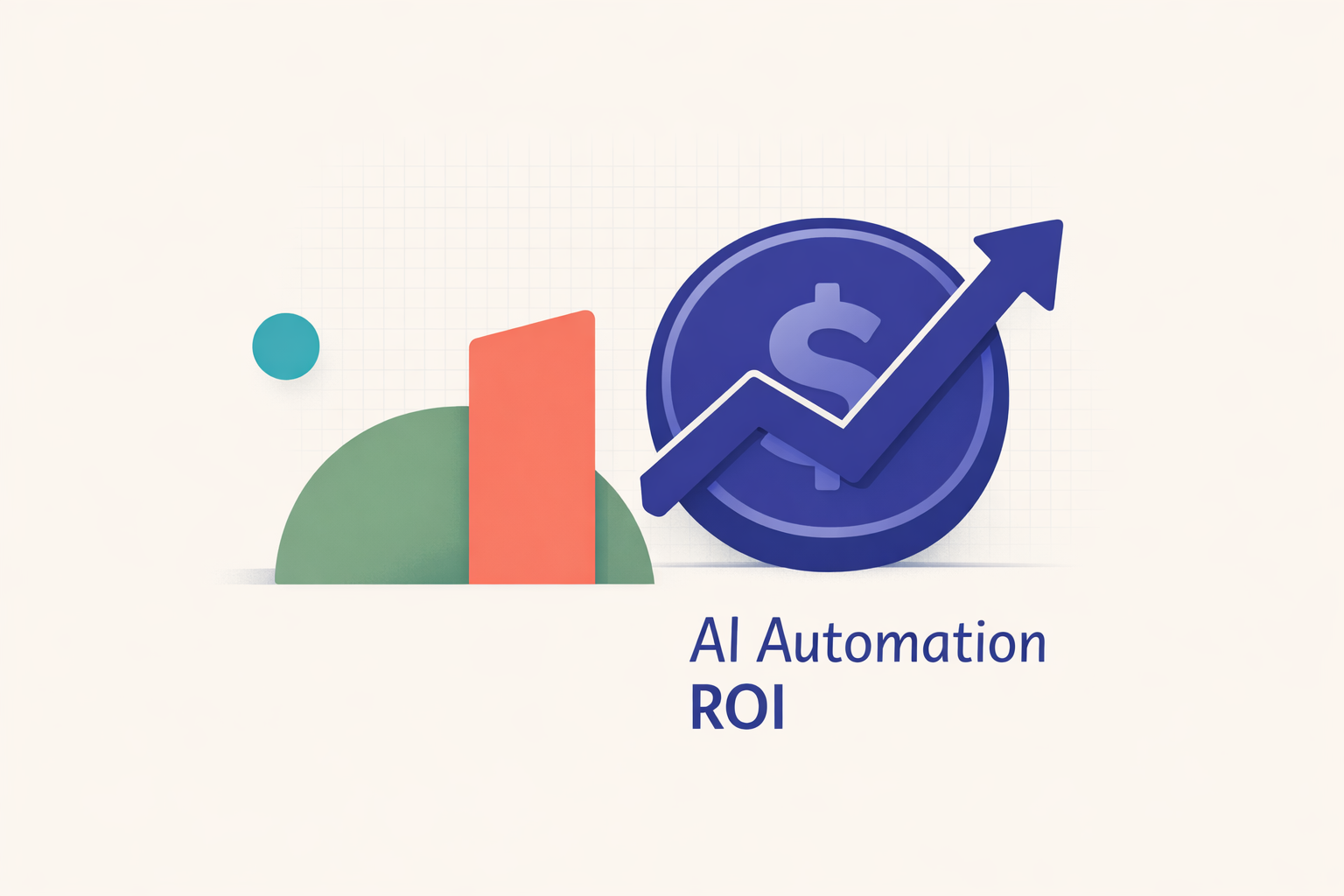
Unlock the true value of AI investment with effective ROI calculations
Header image showing an abstract representation of AI Automation ROI
In the landscape of digital transformation, the emergence of Artificial Intelligence (AI) has profoundly altered business operations, significantly enhancing both efficiency and productivity. The integration of AI-powered solutions has become a vital competitive advantage for innovative companies across diverse sectors. However, to fully harness its potential, it is essential to understand the return on investment (ROI) associated with AI automation. This comprehension is crucial for justifying AI investments and constructing a robust business case for AI automation.
Implementing AI automation strategies necessitates substantial investment; hence, quantifying the ROI is vital to ensuring the cost-effectiveness of these initiatives. The calculation of ROI serves as a valuable financial metric, providing businesses with an analytical framework to assess the value of their AI investments.
To compute AI ROI, one can utilize a straightforward formula:
(Net Profit / Cost of Investment) * 100
The net profit is determined by subtracting the cost of investment from the total gains. The resulting quotient, when divided by the cost of investment, yields the ROI.
When calculating AI automation ROI, it is important to recognize that gains fall into two principal categories:
| Category | Description |
|---|---|
| Direct savings | Savings realized from reduced operational costs due to AI implementation, which may include decreases in labor expenses, minimized error rates, and optimized resource utilization. |
| Indirect gains | Less tangible benefits such as enhanced customer satisfaction, expedited decision-making processes, and increased employee productivity attributable to the time saved through AI automation. |
Understanding AI automation ROI is an invaluable asset in your strategic planning for AI integration. It empowers you to maximize returns and build a data-driven business case to validate AI investments within your organization.
In the following sections of this blog, we will provide an illustrative example of AI ROI calculation, identify common pitfalls to avoid, and explore strategies to maximize the ROI from AI automation projects. Additionally, we will address frequently asked questions related to AI automation ROI.
If you wish to unlock the benefits of AI automation and require assistance in understanding its ROI, contact us today.
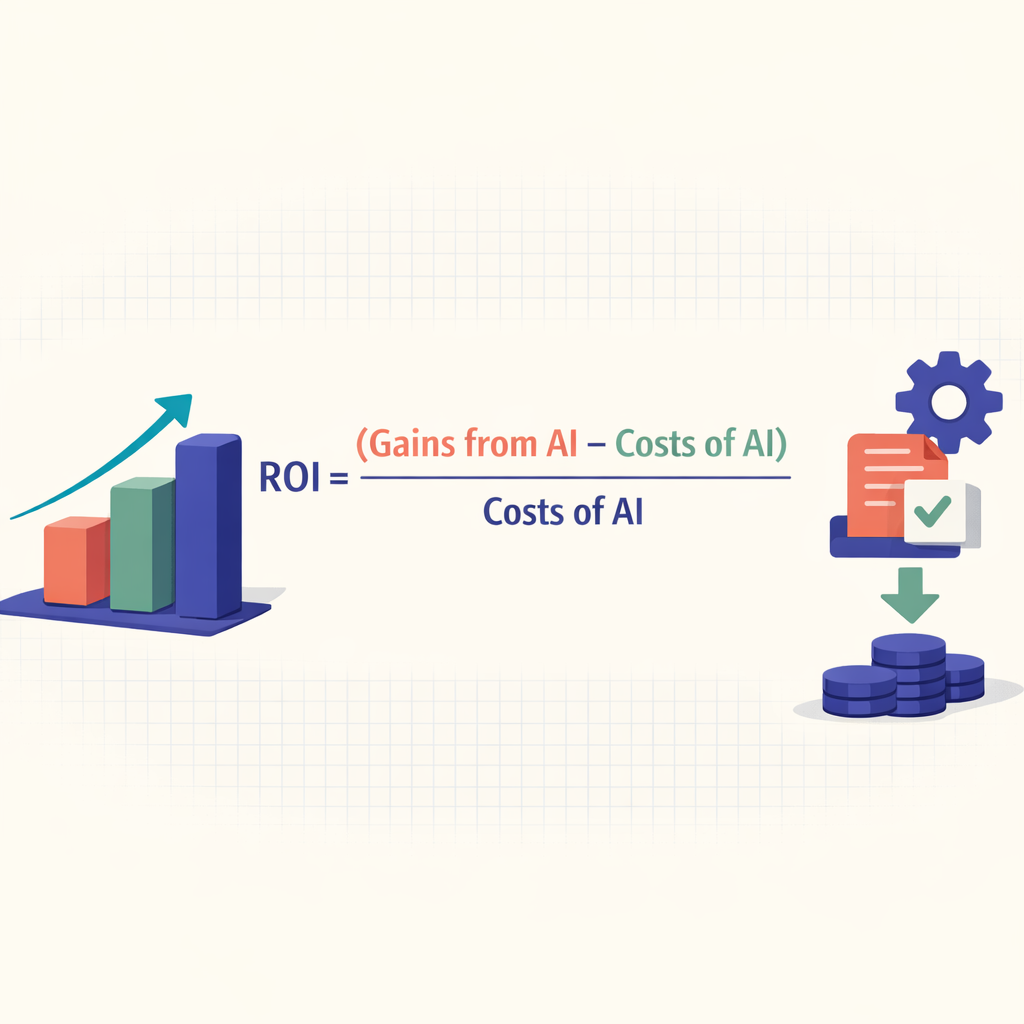 Diagram showing the ROI formula for AI Automation
Unveiling the potential of AI automation in today's digitally driven business landscape requires a clear understanding of AI automation ROI—Return on Investment. You may wonder, "Why is ROI significant in the context of AI automation?" This is an excellent question, and its answer is twofold.
Firstly, AI automation ROI provides a quantitative measure of the financial benefits derived from deploying AI within business operations. In essence, it offers a numerical representation of the success of your AI investment. This insight empowers stakeholders to make data-driven decisions, thereby justifying AI expenditures with a robust business case.
Secondly, an ROI analysis facilitates a clear comparison between the efficiencies and enhancements gained from AI automation and the costs associated with its implementation. This information guides organizations in optimizing critical areas while minimizing downtime, ultimately fortifying the business case for AI.
To better understand how to calculate AI ROI, let's examine the traditional formula: (Net Profit / Cost of Investment) * 100. Here are the essential components of this formula:
| Component | Description |
|---|---|
| Direct Savings | This category reflects reductions in operational costs, including decreased labor expenses, lower error rates, and optimized resource utilization. Accurately incorporating these savings will yield a more precise return on investment, thus reinforcing the business case. |
| Indirect Gains | These encompass non-monetary yet quantifiable enhancements to business performance. This includes improved customer experiences, faster decision-making processes, and increased productivity attributable to time saved by AI interventions. |
| Investment Costs | This encompasses capital expenditure on AI software, hardware, and cloud resources, as well as operational expenditures related to employee wages for AI system maintenance and updates. |
Consider a hypothetical business that has saved $100,000 in direct savings and realized an additional $50,000 in indirect gains per year through AI automation. The total cost of implementing the AI system was $120,000. The ROI would be calculated as follows:
[ \text{ROI} = \left(\frac{($100,000 + $50,000) - $120,000}{ $120,000}\right) * 100 = 25% ]
This positive ROI indicates that the company has generated a profit from its AI investment.
By diligently employing the tactics outlined above, you position yourself to maximize the ROI of your AI investment. Begin your AI automation journey today and harness the advantages of improved decision-making and enhanced operational efficiency.
If you would like to explore our AI automation services, please feel free to contact our experts. Alternatively, visit us at /contact?service=ai-automation to initiate a conversation.
ROI, a highly regarded financial metric, is crucial for understanding the cost-effectiveness of AI automation. The formula for calculating AI ROI is relatively straightforward:
[ \text{ROI} = \left(\frac{\text{Net Profit}}{\text{Cost of Investment}}\right) \times 100 ]
In this formula, net profit is calculated by subtracting the cost of investment from the resulting gains. The quotient, when divided by the cost of investment, yields the ROI.
To calculate ROI comprehensively, it is essential to understand the components of 'net profit.' Net profit consists of two primary elements: direct savings and indirect gains.
| Component | Description |
|---|---|
| Direct Savings | These encompass tangible savings in operational costs, such as reduced workforce needs, decreased error rates, and optimized resource utilization. These key aspects highlight the significance of direct savings. |
| Indirect Gains | These represent the intangible benefits derived from AI automation, including enhancements in customer experiences, accelerated decision-making processes, and increased productivity resulting from the time employees save through AI implementation. |
Together, these components provide a comprehensive perspective on the advantages of AI automation, making them fundamental for ROI calculation.
Conversely, the Cost of Investment comprises all expenses associated with the implementation of AI automation. This includes the costs of acquiring and installing AI technology, training employees, and ongoing maintenance expenses. All forms of capital expenditure should be accounted for.
Consider a scenario where a company invests $500,000 in AI automation. The direct savings due to reduced labor costs and increased efficiency amount to $750,000, while indirect gains from enhanced customer satisfaction and improved employee productivity total $250,000. Using our formula, the net profit would be:
[ (750,000 + 250,000 - 500,000) = 500,000 ]
Thus, the ROI would be:
[ \left(\frac{500,000}{500,000}\right) \times 100 = 100% ]
When performing these calculations, there are certain pitfalls to avoid:
These common mistakes can undermine the accuracy of AI ROI calculations; therefore, it is essential to proceed with care and attention.
By meticulously calculating the return on investment for your AI automation initiatives, you can build a compelling business case for adopting AI technologies. With proper planning and implementation, your ROI will serve as a testament to productivity improvements and cost-efficiency.
Note: For assistance in identifying your specific AI automation needs and maximizing ROI, please reach out through this contact link for an in-depth consultation.
When developing a compelling business case for AI automation, it is essential to understand and precisely quantify both the direct savings and indirect gains associated with AI ROI.
Direct savings represent the immediate reduction in costs that AI automation introduces within an organization:
| Savings Category | Description |
|---|---|
| Workforce Optimization | AI technologies can automate repetitive, time-consuming tasks, allowing businesses to reduce labor costs. |
| Decreased Error Rates | As machines, AI systems are not prone to human errors, leading to enhanced accuracy in task execution and, consequently, fewer mistakes that require costly rectification. |
| Resource Utilization | By automating manual processes and enhancing operational efficiency, AI improves resource utilization, resulting in reduced waste. |
In addition to the aforementioned direct savings, AI automation also delivers indirect gains. Although these benefits may not manifest as immediate cash inflows, they exert a long-term and substantial impact on a business:
Calculating the return on investment from AI necessitates consideration of both direct savings and indirect gains. These components underscore the effectiveness of AI and substantiate the rationale for AI investment.
Accurately calculating AI ROI is fundamental to constructing a persuasive business case for AI automation. This process shapes a concrete strategy for integrating AI technologies into business operations and provides critical insights into how much value AI can add to the organization and how to maximize these returns. For more information or to begin implementing AI, please visit /services/ai-automation and /services/ai-workflow-automation. For personalized assistance from our AI experts, contact us at /contact?service=ai-automation.
Investment costs are crucial in calculating the Return on Investment (ROI) for AI automation, thereby forming a well-informed business case for its implementation. These costs predominantly encompass software development and purchase, infrastructure setup, project implementation, ongoing support, and continuous training and innovation. Each of these components directly influences the ROI of AI, shaping the ultimate figure derived from the following formula:
[ \text{ROI} = \left(\frac{\text{Net Profit}}{\text{Cost of Investment}}\right) \times 100 ]
Investment costs in AI automation can be categorized into three overarching phases: Initial Costs, Running Costs, and Supplementary Costs. Let’s explore these in detail:
Initial Costs: Initial costs encompass expenses incurred during the establishment of an AI system. This investment may involve hiring a professional team for software development and creating an optimal environment for AI deployment. If a pre-built solution is purchased, this cost includes the software itself and its installation. Recent studies indicate that these costs typically account for a significant portion of the total AI investment.
Running Costs: Once an AI system is operational, running costs become relevant. These may include recurring expenses such as regular software updates, system maintenance, and fees related to data storage and processing.
Supplementary Costs: Beyond the evident expenses, additional costs may arise. This often presents itself as the need for employee training to ensure effective utilization of AI solutions. Furthermore, costs associated with ongoing research and enhancements should also be factored into the total investment in AI.
Understanding these cost elements will enhance your ability to calculate the ROI of AI more accurately.
To illustrate this further, consider an example scenario. If the initial investment in an AI solution amounts to $300,000, resulting in $50,000 in annual savings, the ROI can be calculated as follows:
[ \text{ROI} = \left(\frac{50,000 \times 1}{300,000}\right) \times 100 = 16.67% ]
However, the overall picture may shift significantly when potential indirect benefits—such as increased customer satisfaction and accelerated decision-making—are considered.
In the process of calculating AI ROI, businesses frequently overlook the broader context of indirect gains. Moreover, they may miscalculate the true cost of investment or neglect to include future expenses.
Awareness of these pitfalls is essential, as inaccurate or incomplete accounting of costs can lead to misleading ROI calculations, ultimately affecting the justification for AI automation investments.
In conclusion, comprehending the investment costs associated with AI automation is a critical component in the ROI calculation framework. This understanding enhances clarity regarding the financial outlook and aids in the decision-making processes for businesses considering AI integration.
Contact us at /contact?service=ai-automation for insights tailored to your business.
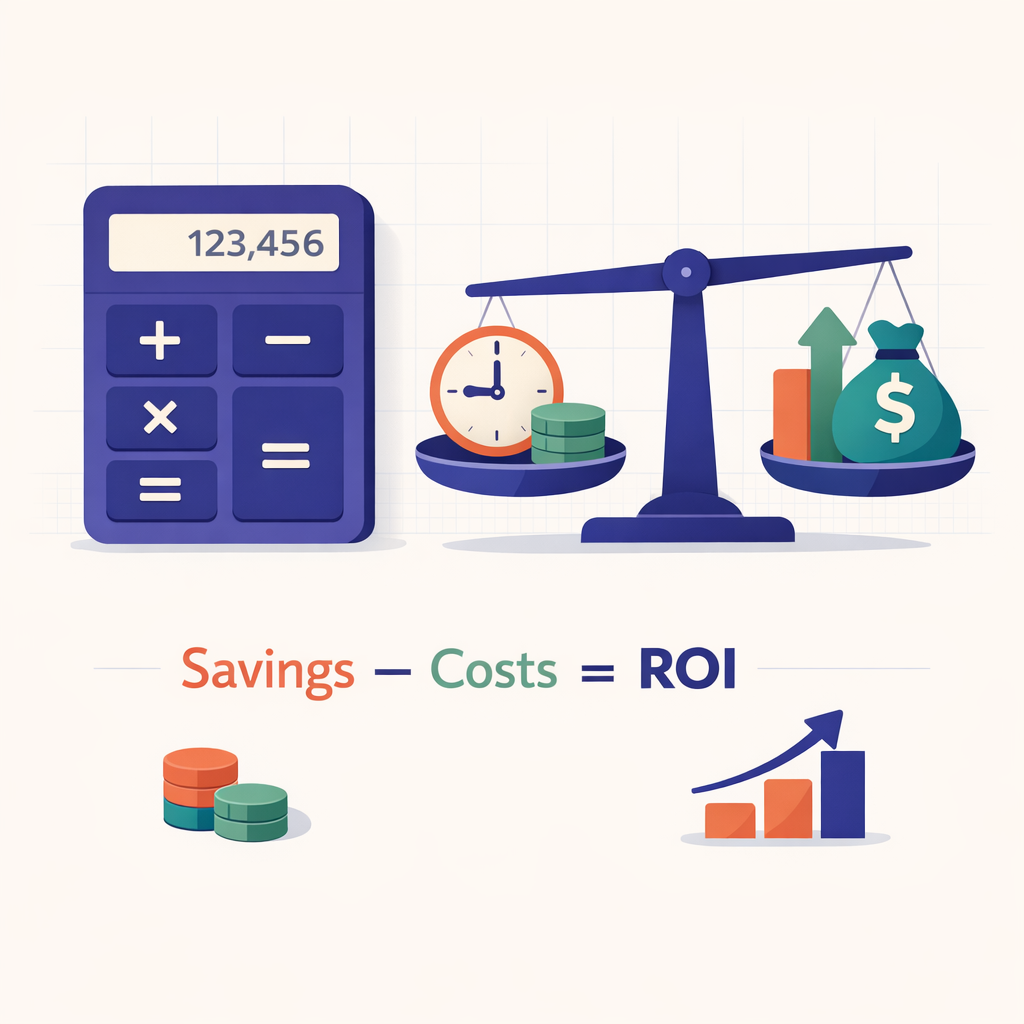 Illustration showing a conceptual example of AI automation ROI calculation
Let’s explore a practical example to provide clarity on how to calculate ROI for AI investments, specifically in the context of optimizing customer support operations.
Assume a business has recently implemented AI automation to manage customer queries, thereby alleviating the workload on human customer service representatives.
| Description | Amount |
|---|---|
| Annual savings in labor costs | $100,000 |
| Reduction in error rates and customer complaints, leading to loss mitigation | $50,000 |
Total Direct Savings: $150,000
| Description | Amount |
|---|---|
| Enhanced customer experience resulting in increased sales | $70,000 |
| Freed-up time thanks to AI enabling employees to concentrate on strategic initiatives | $60,000 |
Total Indirect Gains: $130,000
At this juncture, the ROI formula is expressed as:
(Direct Savings + Indirect Gains - Cost of Investment) / Cost of Investment) * 100
= ($280,000 - Cost of Investment) / (Cost of Investment) * 100
The costs associated with the AI automation system include:
Total Cost of Investment: $100,000
Substituting this figure into our ROI formula yields:
(Direct Savings + Indirect Gains - Cost of Investment) / Cost of Investment) * 100
= ($280,000 - $100,000) / $100,000 * 100
= 180%
In this scenario, the return on investment for AI is 180%, which signifies a substantial enhancement to the company's bottom line.
Still have questions? Let's address a few:
Considering AI automation? We are poised to guide you through every phase. Contact us for expert assistance at /contact?service=ai-automation.
When establishing a business case for AI automation to justify investment, it is essential to calculate AI ROI accurately. However, many businesses succumb to common mistakes that undermine the value of their AI automation ROI assessments. Understanding these pitfalls can help you avoid them, ensuring a precise calculation of the return on investment.
Direct savings—such as reduced operational costs and a minimized labor workforce—are critical components in calculating AI ROI. Nevertheless, businesses often either underestimate or overestimate these savings. It is imperative to arrive at a realistic estimate of direct savings by considering all aspects of operational costs that AI automation might influence.
Many organizations neglect to factor in the indirect benefits that AI automation can provide, including improved customer experiences and expedited decision-making processes. While these gains may not have an immediate impact on the bottom line, they are vital for generating long-term value and should be incorporated into the ROI calculation.
Investment costs encompass more than just the initial expenditure on AI automation tools; they also include ongoing expenses such as support, training, and infrastructure. Failing to account for these costs can distort the ROI calculation.
A prevalent misconception is the expectation of immediate ROI from AI automation. In reality, the true value of AI emerges from its long-term effects, such as process optimization, improved customer service, and enhanced decision-making capabilities.
| Mistake | Advice |
|---|---|
| Incorrectly Estimating Direct Savings | Avoid underestimating or overestimating potential savings. Aim for realistic estimates. |
| Overlooking Indirect Gains | Acknowledge the long-term value that AI automation brings, such as increased customer satisfaction and more rapid decisions. |
| Misjudging Investment Costs | Ensure ongoing costs are included in your AI ROI calculation. |
| Favoring Short-term Over Long-term Returns | Recognize that the real ROI from AI automation generally manifests over the long term. |
Calculating AI ROI need not be fraught with errors. By recognizing these common mistakes and implementing strategies to circumvent them, you can achieve an accurate assessment of the returns from AI automation.
For further assistance with AI ROI calculation and to understand how AI automation can advantage your business, please do not hesitate to contact us.
: Source regarding the common mistakes in estimating direct savings
: Source about the oversight of indirect gains in AI automation
: Reference detailing the common overlook of investment costs in AI automation ROI calculation
: Study showing how the short-term versus long-term returns mistake affects ROI calculation
Achieving a substantial return on investment (ROI) from AI automation involves more than just successful deployment and operation. To truly maximize the ROI from AI, it is essential to strategically manage both direct savings and indirect gains while effectively controlling investment costs.
Direct savings represent the tangible cost reductions that result from AI implementation, including minimized labor costs, reduced error rates, and optimized resource utilization. A key strategy to amplify these savings is the judicious automation of processes, which can yield significant cost reductions. Examples include:
Although often more difficult to quantify, indirect gains can frequently surpass direct savings. These gains stem from enhancements in business processes, improved customer experiences, and increased productivity. Strategies to maximize indirect gains include:
Investment costs encompass the initial purchase, implementation, and ongoing maintenance of AI systems. To keep these costs in check, consider the following approaches:
To achieve a viable ROI, it is crucial to continually evaluate the performance of your AI automation against established business objectives. Regular adjustments based on analytical data can enhance AI automation ROI, reinforcing the justification for AI investment.
Ongoing assessments should occur frequently, ideally on a quarterly basis. ROI is not static; it can fluctuate based on various factors, including market trends, customer behaviors, and strategic shifts.
Direct savings play a crucial role in shaping your AI automation business case, as they provide a tangible justification for the costs associated with the investment. Every dollar saved directly contributes to an increase in your ROI.
Indirect gains are typically intangible and more challenging to quantify, leading to their frequent oversight. However, over the long term, benefits such as improved customer experience can significantly influence AI ROI.
In the process of substantiating a business case for AI automation to justify investment, a variety of questions frequently emerge. Here, we address three of the most common queries regarding AI automation ROI.
To calculate AI ROI, you can utilize the following formula:
(Net Profit / Cost of Investment) * 100
Net profit is defined as the difference between the gains—both direct savings and indirect gains—from AI automation and the associated cost of investment. Direct savings refer to operational cost reductions, such as workforce minimization, decreased error rates, and optimized resource utilization. Indirect gains, on the other hand, encompass enhancements in customer experience, increased decision-making speed, and productivity improvements resulting from time freed by AI.
Recognizing potential pitfalls in calculating the return on investment for AI can help you avoid skewed results. Some common mistakes include:
To maximize your return on investment in AI, focus on enhancing both direct savings and indirect gains while effectively managing investment costs. This involves not only reducing operational expenses but also leveraging the value added through improved customer experiences and enhanced decision-making capabilities. Implementing strategic initiatives, such as continuous learning and adjustment programs for your AI system, can help ensure sustained—and potentially increased—operational efficiency.
In conclusion, understanding the intricacies of AI automation ROI and its calculation is vital not only from a financial perspective but also for integrating AI as a strategic tool effectively. A precise calculation contributes significantly to presenting a robust business case and predicting the profit potential of your AI initiatives.
For further information and professional guidance on implementing AI in your business, please visit our AI services page at AI Automation and AI Workflow Automation, or contact us directly at Contact Us.
 Conceptual image representing the maximization of AI automation ROI
Understanding and applying Return on Investment (ROI) is essential for making informed decisions regarding AI deployments. Calculating AI ROI allows businesses to objectively evaluate the profitability of their investments, thereby establishing a data-driven business case for AI automation.
The formula for calculating ROI in AI automation—(Net Profit / Cost of Investment) * 100—is critical in assessing the success of an AI initiative. It provides a quantifiable figure that justifies AI investment. This formula considers two primary components:
These benefits are then compared against the cost of investment.
Direct savings and indirect gains constitute the net profit side of the ROI equation. Conversely, investment costs encompass all expenses related to the deployment and operation of AI technology.
This blog has presented an example calculation to clarify the process of determining AI ROI. Importantly, it also addresses common pitfalls, such as overestimating savings or underestimating costs.
The overarching objective should be to maximize ROI, which requires effective strategizing and management of both the gains (direct and indirect) and the costs associated with AI implementations.
In summary, measuring and maximizing your AI automation ROI is a critical component of your AI journey. Grasping how to calculate AI ROI accurately can deliver a tangible metric reflecting the business value that AI can provide.
If you are prepared to invest in AI automation and seek guidance on measuring and optimizing your returns, or if you require assistance in developing a robust AI automation business case, we encourage you to reach out to us. Please visit our services page or request an AI workflow automation consultation. For a more in-depth discussion about your AI needs, please contact us directly.
Maximize your investment in AI and create an impact that is both meaningful and measurable.