I
Imversion TeamPublished on April 14, 2026
15 min read
AI automation agency: 12 Clear Signs Your Business Needs Help
Identify when to hire an AI automation agency for optimal efficiency.
Identify when to hire an AI automation agency for optimal efficiency.
If you are asking do i need an ai automation agency, the answer is simple: yes, if repetitive work, missed follow-ups, slow reporting, or disconnected systems are already hurting revenue, customer experience, or team capacity. You should decide when to hire ai automation agency support the moment those issues stop being occasional and start becoming operational.
I see this hesitation often. Companies know automation could help, but they delay because the starting point feels blurry, the tooling market feels noisy, and internal teams are already overloaded. At Imversion Technologies Pvt Ltd, I’ve observed that businesses usually reach for an ai automation agency only after friction becomes expensive -- not when the first warning signs appear. In my work designing AI systems and automation architecture at Imversion Technologies Pvt Ltd, one pattern keeps repeating: teams start by asking which model or tool to buy, but once I push them to map the workflow step by step, the real blocker is usually process design and system ownership. Not the AI.
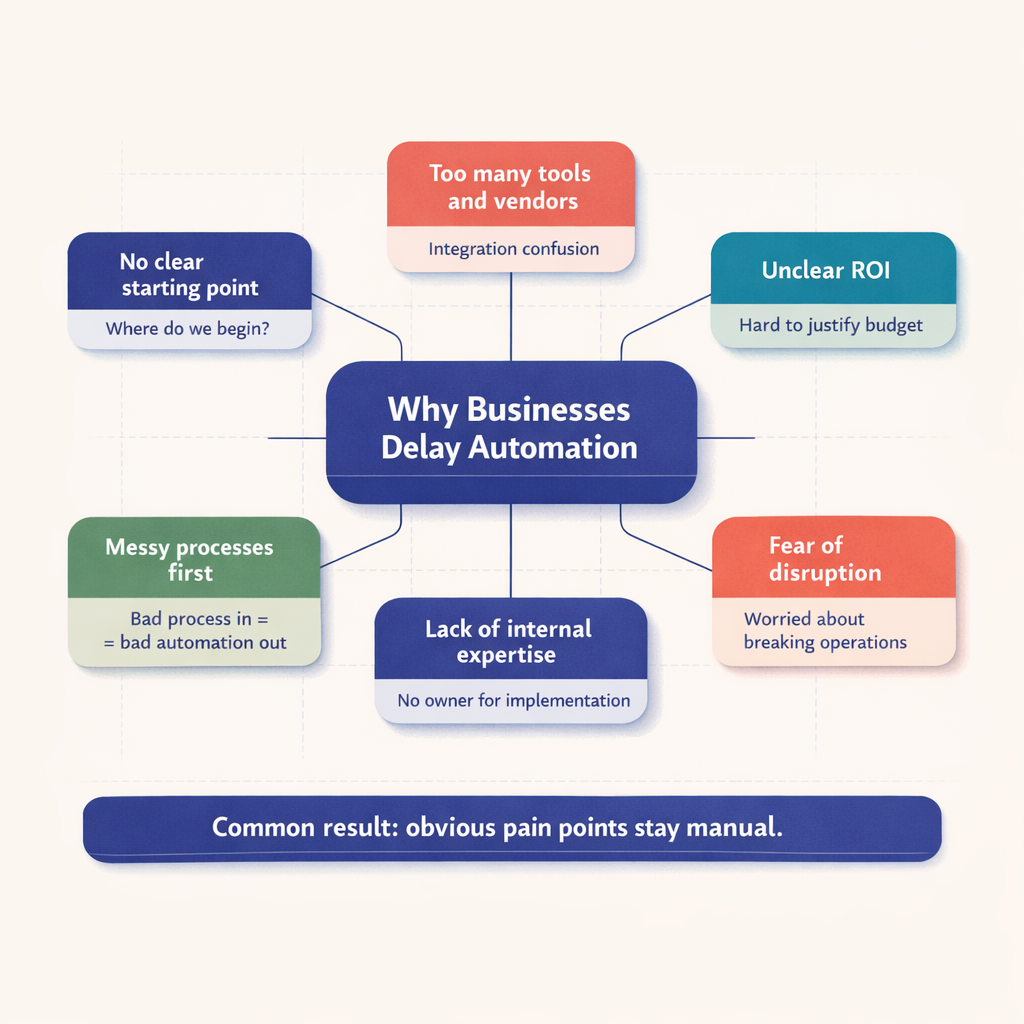
Central map diagram titled Why Businesses Delay Automation with six connected barriers: no clear starting point, unclear ROI, messy processes, tool confusion, lack of expertise, and fear of disruption
That delay is exactly what this article is built to fix.
I’m going to break down 12 clear signs, grounded in real operational scenarios, that indicate your business needs outside help with automation. I’ll also give you a simple 0-12 scoring model, show how to interpret your score, and outline the next step for each level of urgency. This decision should not be based on hype. It should be based on operational reality.
And that is where most teams get it wrong.
Most companies do not avoid automation because they dislike efficiency. They avoid it because they do not know where to begin. The pain is obvious. The path is not.
I see six blockers repeatedly.
First, priorities are unclear. Leadership says, “We should use AI,” but nobody defines which process matters most. So the team debates ideas instead of fixing a real bottleneck. Second, they fear buying the wrong tools. Fair concern. A bad software choice creates integration debt, budget waste, and frustration that lingers.
Third, systems are disconnected. Sales uses one platform, support uses another, operations tracks work in spreadsheets, and reporting lives in someone’s head. Automation cannot produce strong outcomes on top of weak process architecture. I believe this strongly: architecture defines product success.
Fourth, there is no internal owner. Everyone supports the initiative in theory. No one owns the workflow mapping, implementation sequence, exception handling, or post-launch measurement. So the project drifts.
Fifth, process documentation is weak. Teams often say a workflow exists, but what actually exists is tribal knowledge. People know how work gets done. The business does not. That gap matters.
Sixth, ROI feels uncertain. Leaders ask for a guaranteed number before action. But automation maturity usually starts with process clarity, baseline metrics, and one focused pilot -- not a giant transformation deck.
An ai automation agency should act as both strategy partner and implementation partner. I do not see a serious business automation agency as a tool reseller. I see it as a team that maps opportunity, designs workflows, connects systems, delivers pilots, builds governance, and measures outcomes against business goals.
At Imversion Technologies Pvt Ltd, that practical framing matters. A pattern I see often is that companies do not need more AI ideas. They need someone to decide what to automate first, how to integrate it into existing operations, and how to make it stick. In my experience, the useful early work is rarely glamorous -- workflow mapping, exception logic, permissions, fallback paths, system boundaries. But that is what makes automation survive contact with real operations.
Execution wins. Every time.
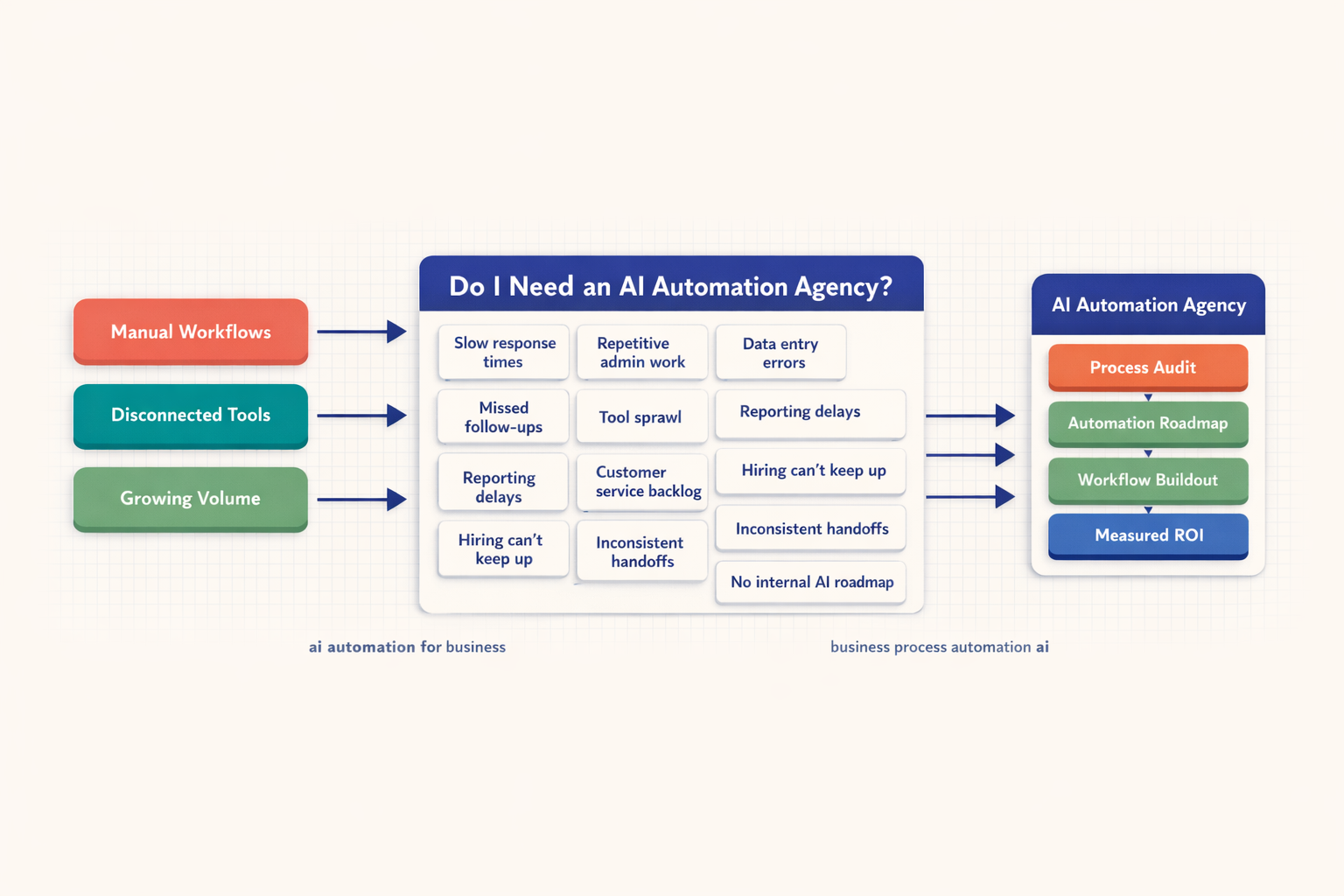 Workflow diagram showing manual workflows, disconnected tools, and growing volume leading to twelve business pain signals, then flowing into process audit, automation roadmap, workflow buildout, and measured ROI
If your team spends hours on invoice entry, order updates, CRM logging, or document classification, the process is already a candidate for automation. That time drain compounds fast. It usually hides inside “normal operations.”
A common scenario is finance or operations staff copying invoice data into an ERP, then updating status in email or Slack. The operational impact is obvious: high labor cost, preventable errors, and burnout from low-value work. This is classic business process automation ai territory.
Yes -- and if inbound leads sit in inboxes, web forms, or disconnected spreadsheets for hours or days, you are losing revenue before sales even starts. Response time is not a small optimization. It shapes conversion.
I often see web inquiries come through a form, get forwarded manually, and then wait for assignment. A stronger workflow might route HubSpot leads into the CRM, score them, notify the right rep in Slack, and trigger follow-up tasks automatically. Without that, lead decay becomes normal.
If support agents answer the same FAQ-style questions all day, your service model is too dependent on manual repetition. Customers feel it before leadership does.
Think of Zendesk or Intercom queues filled with password resets, policy questions, shipment checks, and basic troubleshooting. The operational impact includes slower first-response time, inconsistent answers, stressed teams, and fewer resources for complex cases. Good ai automation for business can triage, suggest responses, and create chatbot handoff flows without removing human judgment where it matters.
Disconnected systems create hidden costs. Sales, marketing, support, finance, and operations end up maintaining different versions of the truth.
I see this in businesses using separate tools for CRM, billing, support, and project tracking, with employees manually transferring data between them. The result is duplicate work, broken handoffs, data mismatch, and reporting errors. At Imversion Technologies Pvt Ltd, I’ve found this is often the real issue underneath “we need AI.” Once I trace the workflow architecture, the request for AI usually turns into a need for system integration, event-driven automation, and cleaner ownership boundaries.
Spreadsheets are useful. They are not a scalable operating model.
When critical processes live in Excel or Google Sheets -- lead trackers, onboarding checklists, approval logs, fulfillment queues -- version confusion and manual updates create fragility. The operational impact is poor visibility, lost accountability, and a growing chance that one missed cell affects customer delivery.
If managers spend hours every week compiling KPIs from multiple systems, reporting is not supporting decisions. It is delaying them.
A familiar scenario is an ops lead exporting CRM data, finance data, support tickets, and fulfillment numbers into a weekly dashboard by hand. By the time the report is ready, the decisions are already late. Automation can pull, normalize, and surface those metrics continuously. That is where an ai automation agency starts creating impact fast.
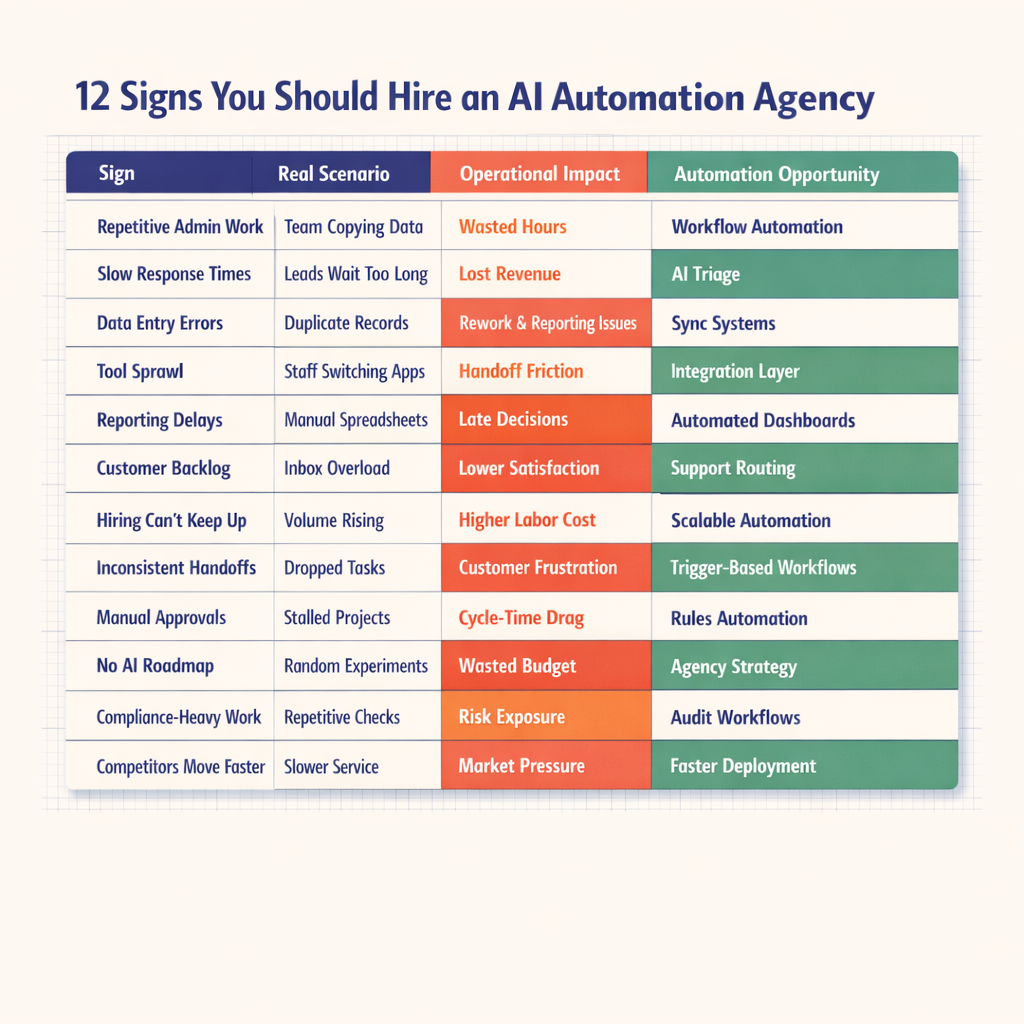 Four-column table listing twelve business signs alongside real scenarios, operational impacts, and automation opportunities such as repetitive admin work, reporting delays, customer backlog, and lack of an AI roadmap
Hiring should expand capability, not patch broken workflows. If order volume, support demand, or back-office requests rise and your only answer is more manual staffing, you have an operational design problem.
I see this pattern often: businesses add coordinators, assistants, or analysts because requests keep increasing, but the underlying workflow remains unchanged. The impact is rising cost without proportional throughput. This is often when to hire ai automation agency support stops being optional.
When outcomes depend heavily on individual employee habits, your process is unstable. One person updates records perfectly. Another skips fields. A third uses a personal checklist no one else can see.
That inconsistency shows up in onboarding, approvals, follow-ups, customer communication, and internal escalations. The operational impact is uneven quality, training difficulty, and hard-to-debug errors. Process variation spreads quietly, which is why it is one of the most underestimated signals.
Manual processes create control gaps. Control gaps become risk.
A common scenario involves approvals tracked through email, policy acknowledgments stored in scattered folders, or access provisioning handled informally during onboarding. The operational impact includes missing records, weak audit trails, avoidable compliance exposure, and stress during reviews. In regulated or contract-sensitive environments, even one weak workflow can justify action immediately.
This sign matters more than most leaders admit. Buying a tool or testing a model does not equal implementation.
I regularly see teams experiment with copilots, chatbots, or workflow tools, then abandon them because the systems were never integrated into daily work. No ownership. No redesign. No success metric. At Imversion Technologies Pvt Ltd, my view is direct: if pilots are not tied to workflow change and measurable outcomes, they stay demos. I’ve spent enough time in AI implementation to know the failure mode is predictable -- a promising proof of concept gets attention, but nobody defines triggers, guardrails, exception handling, or who owns the system after launch. So it dies in the gap between idea and operation.
Growth reveals what inefficiency hides. A workflow that feels manageable at low volume often breaks under real scale.
You might see slower fulfillment, delayed approvals, growing ticket backlogs, or managers spending more time coordinating than leading. The operational impact is service bottlenecks, revenue leakage, and customer frustration exactly when the business should be accelerating. Strong systems should be planned early. Not after the strain becomes visible.
This is the clearest sign of all. If nobody inside the business has the time, mandate, or technical depth to map workflows, integrate systems, manage rollout, and track results, the initiative will stall.
Sagar Hebbale is my name, and this is the point I push hardest on: ideas are cheap. Execution is where value appears. A pattern I’ve seen in the second half of growth is that leaders know the pain, teams want relief, but no one can carry implementation across product, ops, data, and change management. That is exactly where an ai automation agency or business automation agency creates real business value.
Use this simple model. Give yourself 1 point for each sign that clearly applies to your business today. Not next quarter. Not after a planned hire. Today.
Your total score will fall between 0 and 12. Be strict. If a problem appears repeatedly and affects operations, count it. If it is occasional and contained, do not.
This is the better framing for do i need an ai automation agency. Not “Are we innovative enough?” The real question is whether operational friction is now costly enough that outside implementation help will produce a faster, cleaner result.
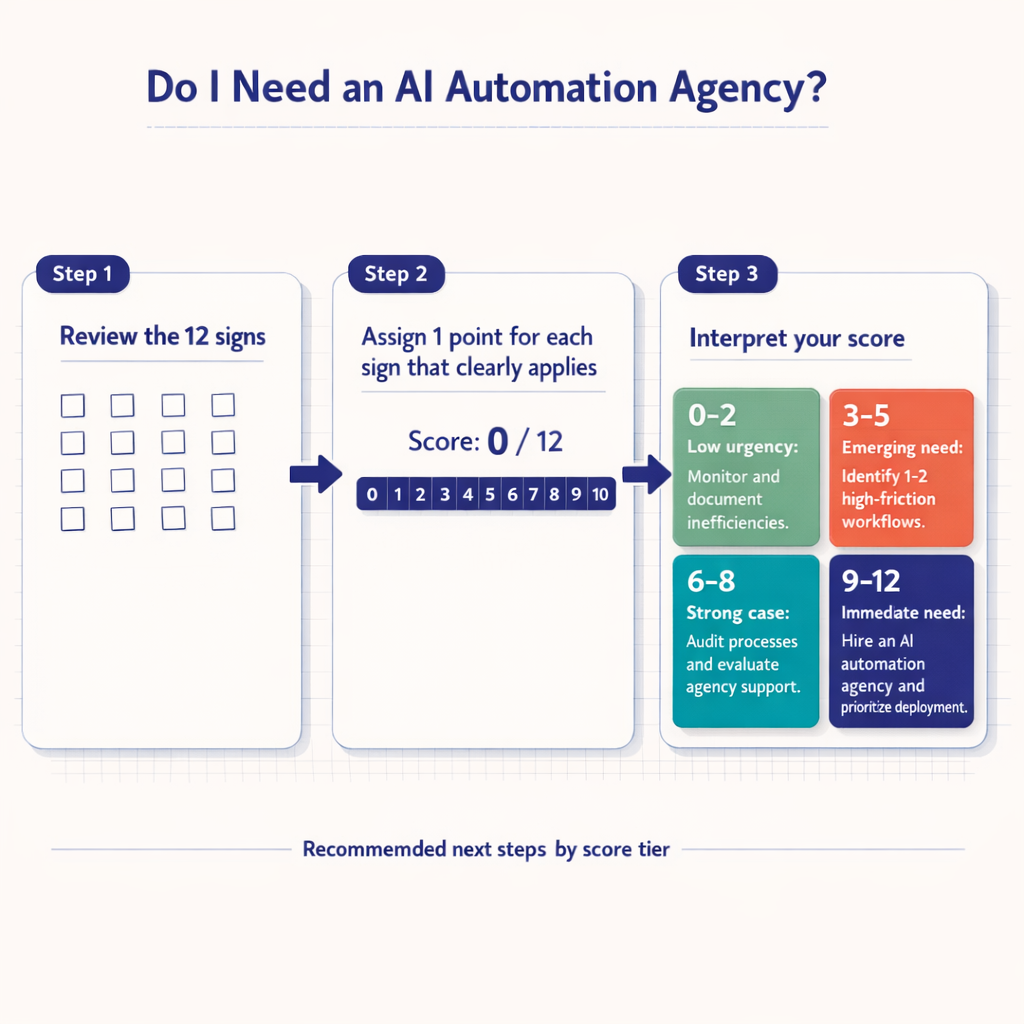 Three-step scoring diagram showing twelve checklist boxes, a 0 to 12 score counter, and four interpretation tiers from low urgency to immediate need with recommended next steps
You probably do not need a full ai automation agency yet. Start by documenting two or three recurring workflows, measuring time lost, and identifying one low-risk automation candidate. Keep it simple.
You are entering the zone where ai automation for business can create visible gains. Audit systems, map bottlenecks, and shortlist one pilot use case -- lead routing, support triage, or reporting are good starting points.
This is often when to hire ai automation agency support. I would recommend calculating current process costs, cleaning core data sources, and building a phased roadmap around the highest-friction workflows first.
At this point, delay is expensive. You need structured implementation, integration, governance, and measurable rollout. At Imversion Technologies Pvt Ltd, my advice in cases like this is direct: prioritize workflows tied to revenue, customer response time, compliance, and operational backlog, then execute in phases with clear ownership and success metrics. In my experience, businesses that treat this like a staged architecture program -- not a one-off tool purchase -- move faster and with less rework.
Technology should solve real problems.
If your score is high, act now.
An ai automation agency is responsible for turning business goals into working systems, which includes process mapping, system integration, automation design, testing, governance, training, and measurement. The real value is not in installing software but in making sure automations fit daily operations, handle exceptions, and produce measurable business outcomes.
If workload is rising but output quality, response speed, and visibility are getting worse, the issue is often process design rather than staffing. AI automation is worth evaluating when teams are spending more time routing work, updating records, or chasing information than performing high-value tasks that require judgment.
A company should hire an ai automation agency when automation work crosses multiple teams, requires integration across systems, or lacks a clear internal owner. External support is especially useful when internal teams are too busy to document workflows, manage rollout, and track performance after launch.
Business process automation ai goes beyond fixed if-then rules by adding decision support, document understanding, classification, summarization, and intelligent routing. Basic workflow automation moves data between systems, while AI-enhanced automation helps handle unstructured inputs and improves how work is prioritized and resolved.
You should prepare a short list of painful workflows, the systems involved, current manual steps, approximate volumes, and the business impact of delays or errors. Bringing baseline metrics such as response time, processing time, backlog size, or error rates makes it much easier to identify high-value automation opportunities quickly.