S
Suvam SwainPublished on April 15, 2026
20 min read
React vs Next.js 2026: Which Framework Should You Choose?
Explore the differences, benefits, and use cases of React and Next.js in 2026.
Explore the differences, benefits, and use cases of React and Next.js in 2026.
Hero image illustrating the comparison between React and Next.js for the year 2026
In the evolving landscape of web development in 2026, JavaScript frameworks play a pivotal role, particularly in the ongoing debate surrounding "React vs Next.js 2026." Both frameworks stem from Facebook's extensive product suite: React, a JavaScript library focused on user interface development, and Next.js, a React-based framework renowned for its server-side rendering capabilities. Whether you are an experienced developer or new to the field, understanding the "React vs Next.js" comparison is essential.
The pressing question often centers around "Should I use Next.js?" This consideration frequently arises from the complexities involved in comparing the two frameworks. Although they are interconnected, the distinctions between "Next.js and React" lie in their unique functionalities, intended use cases, and particularly in how they implement web page creation.
React is fundamentally designed as a client-side rendering (CSR) model, which facilitates efficient real-time interactions, making it ideal for dynamic web applications. However, because of its CSR nature, React may initially lead to longer page load times—creating challenges, particularly regarding Search Engine Optimization (SEO).
Enter Next.js. It resolves the time-to-first-render issues inherent in React by providing hybrid rendering capabilities. These capabilities encompass advanced CSR, server-side rendering (SSR), and static site generation (SSG), thereby catering effectively to modern market demands. The enhanced functionalities not only significantly improve page load performance but also substantially bolster SEO outcomes.
In the subsequent sections, we will thoroughly explore their core differences, including rendering models (CSR, SSR, SSG), performance metrics, SEO implications, developer experience, scalability, and ecosystem considerations. Together, we will delve into specific use cases and discuss when to select each framework, along with migration considerations and the top three frequently asked questions on this topic.
Stay tuned as we navigate the developer conundrum of 2026, working towards a conclusion on whether to opt for Next.js or continue with our reliable React for upcoming web development projects. The insights, comparisons, and discussions presented here will equip you with the knowledge necessary to make informed choices in this rapidly changing digital landscape.
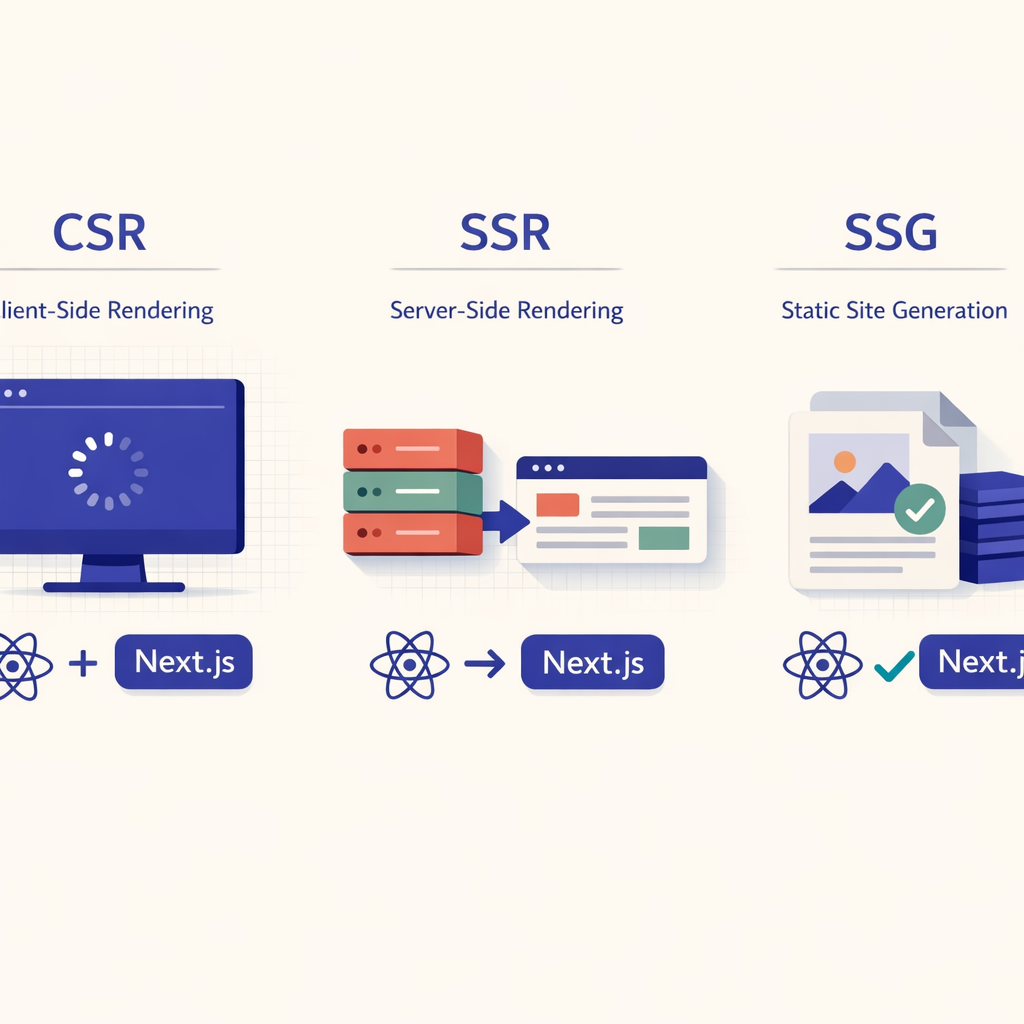 Illustration depicting Client Side Rendering, Server Side Rendering, and Static Site Generation in React and Next.js.
As we delve deeper into our discussion on "React and Next.js in 2026," it's essential to clarify their core differences to assist in your decision-making process. Here, we will examine the key specifications of each framework, including their rendering models, performance implications, SEO impact, and other considerations that may lead you to ask, "Should I use Next.js or React?"
Despite their common foundation, React and Next.js differ significantly in various aspects. React primarily focuses on building user interfaces and streamlining the development of web applications. This focus on versatility makes React widely applicable for both single-page and multi-page applications.
Next.js, on the other hand, is built on React and incorporates additional infrastructure-like features. In the context of a "Next.js vs React" comparison, it is particularly noted for its server-side rendering (SSR) capabilities, which enhance SEO performance and improve page loading times.
The differences in rendering models can significantly influence your application's performance. When using React, developers often find that initial page loads may be slower due to its client-side rendering. This limitation can adversely affect your SEO strategy.
In contrast, Next.js transcends CSR by providing options for server-side rendering (SSR) and static site generation (SSG). This flexibility enables developers to pre-render pages either at build time (SSG) or on each request (SSR), thereby enhancing both SEO and user experience (UX).
In terms of scalability, both frameworks offer robust possibilities, although their use cases tend to diverge.
| Use Case | Preferred Framework |
|---|---|
| High-traffic, data-intensive projects | Next.js |
| Lightweight applications needing real-time updates | React |
Additionally, their ecosystems vary concerning server rendering and build system setup. In Next.js, these features come out-of-the-box, simplifying the development process. Conversely, React requires a manual setup, allowing developers greater flexibility and control.
Understanding the primary strengths of both solutions will help you in your "Next.js vs React" decision. If your priorities include SEO, quick initial page load, and a streamlined server-side experience, opt for Next.js. However, if your main focus is on creating dynamic, interactive UIs with real-time updates, React may be the more suitable choice.
Every project has unique requirements, so choose your framework wisely. As 2026 unfolds, anticipate both React and Next.js to remain key players in the web development landscape. Stay tuned for further insights in this intriguing React vs Next.js comparison.
As we explore the "React vs Next.js 2026" debate, a key aspect to consider is the rendering model used by each framework and its impact on a web application's performance, SEO, and overall user experience.
React primarily employs a Client-Side Rendering (CSR) model. This approach facilitates efficient updates and rendering in response to data changes, enabling real-time interactions that contribute to a smooth, seamless user experience. However, there are some drawbacks to be aware of:
Next.js addresses some of the limitations associated with CSR in React by offering more advanced rendering options: Server-Side Rendering (SSR) and Static Site Generation (SSG).
Should I use Next.js?
Next.js vs React: When to use each?
Are there significant considerations for migrating from React to Next.js?
Although both React and Next.js originate from the Facebook product line, their performance impacts differ significantly. If you find yourself asking, "Should I use Next.js or stick with React?" in 2026, this section provides an analytical perspective to help you make an informed decision.
As we consider the landscape of 2026, any analysis of "React vs Next.js" must address the performance implications of each framework.
| Framework | Rendering Model | Performance Impact | SEO Impact |
|---|---|---|---|
| React | Client-side rendering | Offers efficient updates and rendering responses but results in slower initial page loads. | Limits SEO potential due to challenges in crawling CSR sites. |
| Next.js | Hybrid rendering (SSR & SSG options) | Delivers faster initial page loads, significantly enhancing performance. | Provides robust SEO support with improved crawling capabilities. |
In the "React vs Next.js comparison," SEO impact plays a crucial role. Let's examine how these two contenders perform in terms of SEO.
React: As React primarily utilizes a client-side rendering model, it may struggle to support SEO effectively. This limitation arises because search engines often have difficulty crawling and indexing CSR sites, which can negatively influence rankings.
Next.js: In contrast, Next.js excels in SEO support due to its hybrid rendering capabilities. Its SSR and SSG models pre-render content on the server, making it easier for search engine bots to crawl and index pages. This advantage can enhance your site's visibility and positively affect organic traffic.
In conclusion, when weighing "Next.js vs React," it is evident that Next.js outperforms React regarding performance and SEO support, owing to its advanced rendering capabilities. However, it is essential to consider these factors alongside other considerations such as your project requirements, development resources, and familiarity with each framework. Ultimately, the best tool is the one that empowers you to create the most effective product.
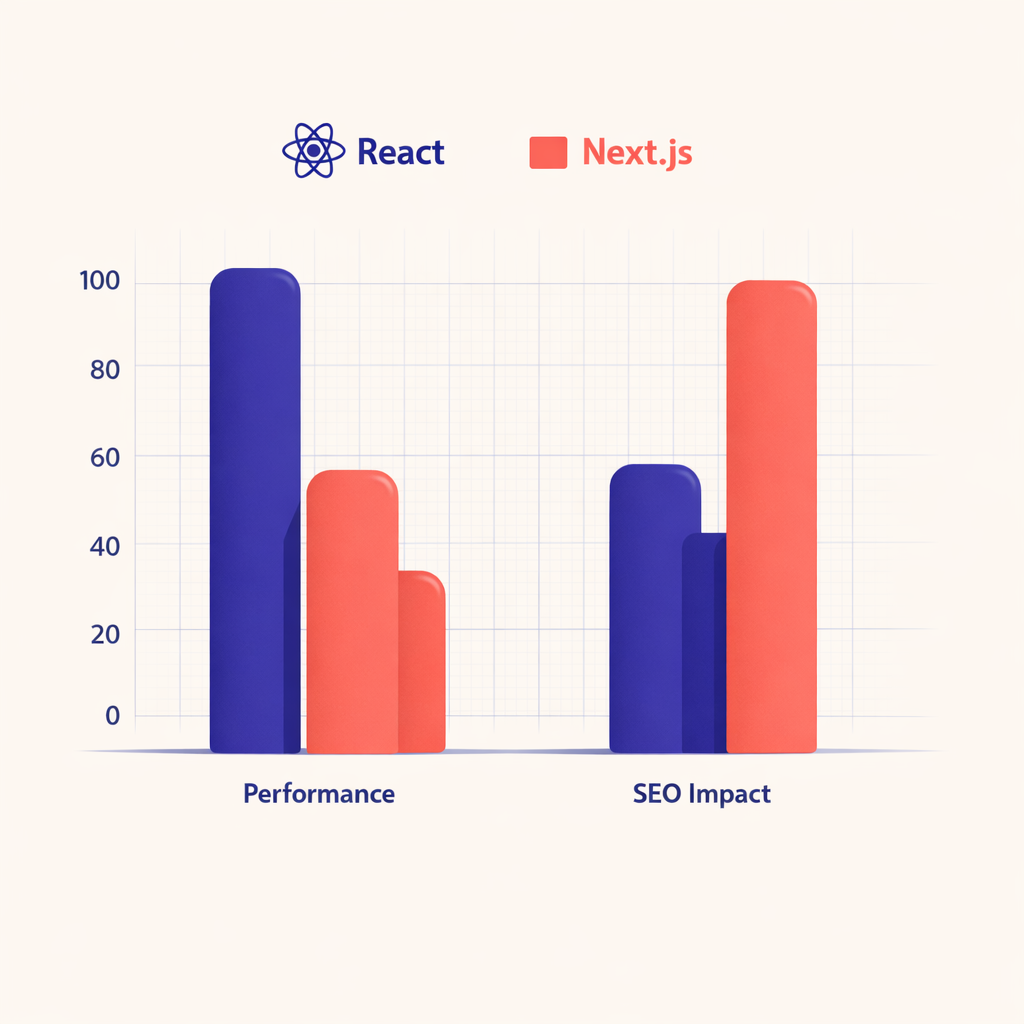 Bar chart depicting the performance and SEO impact of React vs Next.js
In the "React vs Next.js 2026" debate, the developer experience deserves significant attention. A good developer experience extends beyond technology performance; it encompasses how easy a technology is to learn and adopt, the richness of its tooling and ecosystem, and the strength of community support available to its users. In this section, we explore these factors as they relate to our comparison of React and Next.js.
React
Next.js
When considering the question, "Should I use Next.js or React?" community support plays a crucial role. Both frameworks share a foundation with Facebook and have strong developer communities:
The ecosystems surrounding both React and Next.js are extensive. With a variety of packages available—such as Material-UI, Ant Design, Styled Components, Redux, and MobX—developers can create rich, interactive applications.
Both React and Next.js developers enjoy access to a wide range of tooling options. Some popular tools utilized by developers across both platforms include:
Should I use Next.js for small-scale projects?
While Next.js can certainly be used for small-scale projects, it particularly excels in large applications due to its built-in optimizations for performance and scalability.
Can I migrate a project from React to Next.js?
Yes, this is feasible. However, you'll need to account for reformatting components to align with Next.js's file-based routing system, setting up server-side rendering, and revising state management solutions.
Next.js vs React: which is easier to learn?
React may present a shallower learning curve for developers new to modern JavaScript. However, Next.js may be easier for those already familiar with React to adopt.
As we continue to navigate the “React vs Next.js 2026” debate, a balanced analysis reveals that both frameworks can significantly enhance your projects. The decision between React and Next.js will ultimately hinge on your project's specific needs, the scale of your application, and your team's expertise.
Scalability and ecosystem are critical considerations in the comparison between React and Next.js, influencing key factors such as page load times, user experience, and SEO. But how do their use cases differ, and when should you choose Next.js over React, or vice versa? Let's explore.
Modern applications must handle significant traffic loads while maintaining optimal performance. Therefore, the scalability potential of your chosen platform can have a considerable impact on your project.
| Framework | Scalability Features |
|---|---|
| React | React's modular design enables the development of large applications with reusable components, making it a scalable solution. With Client-Side Rendering (CSR), it efficiently manages DOM rendering even as data changes. However, complex applications may experience slower initial page load times, which can negatively affect user experience and SEO scores. |
| Next.js | Built on React, Next.js enhances scalability by incorporating Server-Side Rendering (SSR) and Static Site Generation (SSG) alongside CSR. These models accelerate initial page loading, effectively addressing one of React's primary challenges. Additionally, Next.js is designed for SEO-optimized multi-page applications, further enhancing scalability. When considering whether to use Next.js, this feature presents a compelling reason to opt for it. |
The richness of a technology's ecosystem—encompassing tools, libraries, community support, and learning resources—can significantly influence the decision between Next.js and React.
| Framework | Ecosystem Characteristics |
|---|---|
| React | Boasting a large developer community and an extensive array of libraries and tools, React provides rich resources for learning and problem-solving. This mature ecosystem is one of React's most significant strengths. |
| Next.js | Although Next.js's ecosystem may not be as expansive as React's, it is steadily growing. It integrates seamlessly with many popular React libraries and offers built-in solutions for routing and SSR, which would typically require additional packages in React. |
Understanding the specific use cases of these technologies can offer valuable insights when comparing React and Next.js.
| Framework | Ideal Use Cases |
|---|---|
| React | React excels in building dynamic single-page applications (SPAs) and user interfaces. Its CSR model supports real-time data updates, making it well-suited for interactive applications such as data dashboards, real-time chat applications, and in-browser games. |
| Next.js | If SEO is a priority, or if you are developing a large, scalable multipage application, you may wonder, "When should I use Next.js?" The answer is precisely in these scenarios. With its built-in SSR and SSG capabilities, Next.js is ideal for e-commerce sites, blogs, and news websites. |
In the ongoing "React vs Next.js 2026" discourse, transitioning between these two technologies demands careful consideration, particularly if your current project is firmly rooted in either framework. Here are the key factors to keep in mind when migrating between React and Next.js.
Evaluating your need to migrate is the crucial first step. Are you facing SEO challenges due to Client-Side Rendering (CSR) in React? Or are you experiencing slower initial page load times? Small adjustments to your React code may resolve these issues without requiring a full transition. However, if server-side rendering (SSR) or static site generation (SSG) could provide significant benefits for your application, migrating to Next.js merits serious consideration.
Though both React and Next.js share similar coding paradigms, transitioning from one to the other necessitates certain modifications. Generally, the core logic remains intact; however, Next.js employs a specific file-based routing system that may necessitate restructuring your component hierarchy. It's essential to assess whether the migration process will enhance or detract from your current codebase's maintainability and performance.
In the "Next.js vs React" comparison, Next.js typically excels with its built-in SSR and SSG capabilities. Nonetheless, you should carefully weigh whether the advantages of these features outweigh the potential performance drawbacks during the migration, such as increased server load under SSR.
Migration can also disrupt your existing ecosystem. Integrating specific libraries or frameworks may require unique configurations or could even be incompatible when transitioning from React to Next.js. Prior to making the switch, ensure that the community support, documentation, and tools within the Next.js ecosystem can adequately meet your requirements.
A frequently overlooked aspect of the "Should I use Next.js?" question in 2026 involves your development team. Is your team proficient in React but unfamiliar with Next.js? If so, consider the potential costs and time required for training, as well as the adaptation period for your developers.
If, after thorough evaluation, migration appears to be the most viable option, it is strongly recommended to execute the process in phases. Thoroughly test each stage before proceeding to the next. This approach will help mitigate any unintended consequences from the transition and ensure that productivity remains largely uninterrupted.
Let's now address three frequently asked questions in the "React vs Next.js 2026" discourse, which frequently arise in discussions and platforms across the web development community.
Next.js is a powerful choice if your project requires server-side rendering (SSR), static site generation (SSG), and SEO enhancements. Its flexibility in rendering models contributes to improved website performance and user experience. However, if your main focus is on simple user interface design, and your project does not heavily depend on SEO or initial page load speed, opting for React may be the more straightforward choice due to its simplicity.
| Feature | React | Next.js |
|---|---|---|
| Rendering Model | Client-side rendering (CSR) | Server-side rendering (SSR) & static site generation (SSG) |
| SEO | Limited | Enhanced SEO capabilities |
| Performance | Depends on client rendering | Improved due to pre-rendering |
React is a robust JavaScript library specifically designed for building user interfaces, primarily utilizing the client-side rendering model. In contrast, Next.js is a framework built on top of React that offers strong SSR and SSG capabilities. This means that while both are excellent for developing user interfaces, Next.js provides greater advantages in pre-rendering options, SEO improvements, and overall application performance.
Yes, migration between React and Next.js is certainly feasible. However, it requires careful consideration, particularly in assessing the need for a change, the size and complexity of your project, and potentially redefined development practices. Keep in mind the strengths of each framework and ensure that the benefits of migration significantly outweigh the transition costs before proceeding.
 Illustration displaying the process of transitioning between React and Next.js in 2026
As we conclude our exploration of the "React vs Next.js 2026" debate, it's important to remember that the choice between React and Next.js is not a one-size-fits-all solution. Rather, it is a decision informed by the specific needs of your project.
The comparison between React and Next.js highlights distinct strengths that merit careful evaluation. While React excels at creating user interfaces with efficient client-side rendering (CSR), Next.js builds upon this foundation by offering robust server-side rendering (SSR) and static site generation (SSG) capabilities. This versatility gives Next.js a significant edge for projects where search engine optimization (SEO) and initial page load speed are critical. However, React's effectiveness for real-time interactions and its capacity for efficient data updates should not be underestimated.
| Feature | React | Next.js |
|---|---|---|
| Performance | Suitable for real-time interactions and efficient data handling. | Choose Next.js for enhanced SEO and quicker initial page loads through advanced SSR and SSG. |
| Developer Experience | May offer a more approachable learning curve, depending on team skills. | Provides a steeper, yet ultimately rewarding, learning path. |
| Scalability | Effective for smaller projects. | Excels in larger-scale projects due to its rendering flexibility. |
It is crucial to assess your project's requirements, the SEO advantages, scalability considerations, and any impacts on developer experience before making a transition.
In summary, the "React vs Next.js 2026" discussion emphasizes that the decision between these two technologies ultimately hinges on the specifics of your project. By analyzing these factors and understanding how each framework applies to your use case, you will be better equipped to make an informed choice. Stay abreast of the evolving features and improvements in both technologies, as they continuously strive for enhanced performance and developer experience.
Whether you opt for Next.js's powerful server-side rendering and rich SEO capabilities or lean toward React's efficient client-side rendering for dynamic content, both tools offer unique strengths that promise excellent web development opportunities in 2026.