S
Sagar HebbalePublished on April 15, 2026
16 min read
How to Build Custom AI Agent for Your Business Success
A step-by-step guide on custom AI agent development for enhanced automation and analytics.
A step-by-step guide on custom AI agent development for enhanced automation and analytics.
Hero image showing AI tools for building custom AI agents
Decoding the complexities of Artificial Intelligence (AI) and integrating it into your business is no longer just a trend; it has become essential for ensuring your business remains relevant and competitive. The capability to build a custom AI agent will empower your organization to automate various tasks, enhance customer service, and leverage data analytics for informed decision-making.
This blog is designed to equip you with the knowledge necessary to create your own AI agent, making the process accessible even if you are not an AI expert. With a focus on business relevance, practical insights, and a logical progression, we will guide you through the development of a custom AI agent.
We'll begin by establishing the necessary prerequisites. Defining the scope of your AI functionality and assessing the quality of data available for training your AI agent are critical initial steps. Will your AI agent focus on customer service, data analytics, or automated operational workflows? Your objectives will dictate how to build a custom AI agent that aligns with your unique business needs.
Next, we will explore the appropriate AI agent architecture to implement. Below is a comparison of different architectural types:
| Architecture Type | Characteristics |
|---|---|
| Behavior-driven (ReAct) | Prioritizes responsiveness to behavior patterns. |
| Goal-driven (Plan-Execute) | Centers on achieving specific objectives. |
| Multi-agent system | Employs multiple agents to boost efficiency. |
We will guide you on when and why to choose one architecture over another.
An essential consideration in the creation of an AI agent is selecting the optimal Learning Logic Model (LLM). The LLM serves as the core of an AI agent, enabling it to make data-driven decisions.
Following that, we will walk you through the AI design tools that can aid your endeavor. From memory management and establishing guardrails to ensure your AI remains within defined boundaries, to comprehensive testing methods that verify your AI functions as intended, we will cover all aspects necessary for development.
Finally, we will discuss potential pitfalls to help you prepare for challenges you may encounter while building an autonomous agent. We will also address frequently asked questions to debunk myths and misunderstandings, facilitating a smoother AI integration process.
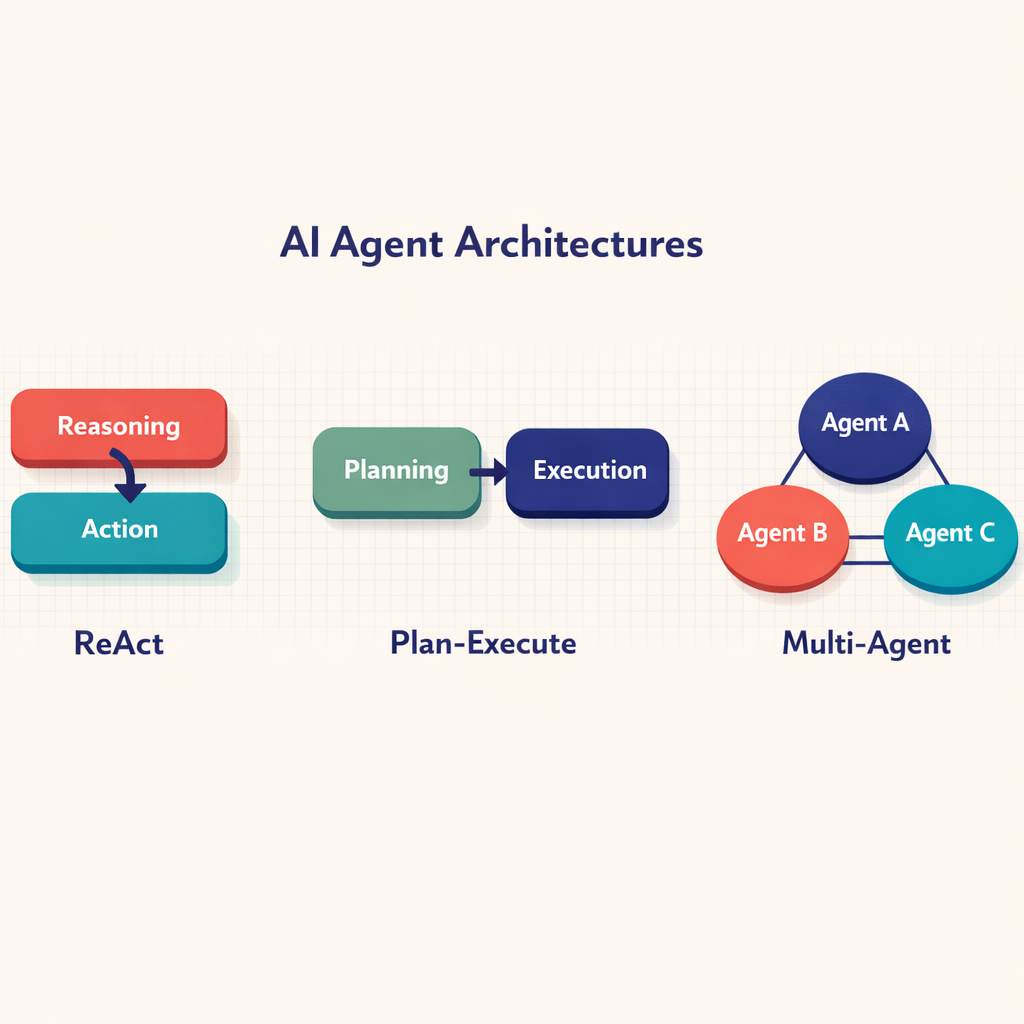 Identifying different types of AI agent architectures
The rapidly evolving landscape of Artificial Intelligence (AI) has initiated a transformative wave, prompting businesses to explore innovative ways to enhance their operations. Central to this endeavor is the development of AI agents, specifically tailored to meet unique business needs. This process, known as custom AI agent development, is crucial for organizations seeking to create effective AI agents.
An AI agent is a computational entity that interacts with its environment to achieve defined objectives. It operates by observing its environmental state and executing actions based on a specified algorithm within its architecture. This framework enables the machine to learn, make decisions, and perform tasks that align with predetermined business requirements. As a result, businesses can automate processes, improve customer service interactions, and conduct intelligent data analysis.
A fundamental consideration in the custom AI agent development process is establishing the prerequisites:
Once the prerequisites are established, the next step is selecting the appropriate AI agent architecture. The chosen architecture defines the behavior and learning capacity of the AI agent. When building a custom AI agent, you have several options to consider:
| Architecture Type | Description |
|---|---|
| ReAct | Behavior-driven |
| Plan-Execute | Goal-oriented |
| Multi-Agent | Multiple AIs operating in conjunction |
Following the selection of architecture, the next step is choosing the Learning Logic Model (LLM). The LLM primarily dictates the agent's decision-making processes. Common LLMs include decision trees, logistic regression, and artificial neural networks.
The subsequent phases involve selecting AI design tools, configuring memory, establishing guardrails, and conducting thorough testing. Be mindful of common pitfalls, such as overfitting the model, and ensure that your AI agent is closely aligned with your business objectives.
In conclusion, developing a custom AI agent necessitates a systematic approach, beginning with the establishment of prerequisites and culminating in rigorous testing. This tailored approach ensures that your AI agent is well-aligned with your business requirements and poised to revolutionize your operations, delivering intelligent solutions in real-time.
If you're looking to build a custom AI agent, it's crucial to establish your prerequisites upfront. These foundational elements will guide your project and significantly enhance your chances of successful implementation.
First and foremost, clearly define the scope of your project. Begin by asking yourself what functions you want your AI agent to perform. Will it be utilized for customer service, data analysis, or automating operational processes? This critical step establishes a clear direction for your custom AI agent development.
Analyzing your existing data is essential. To effectively build a custom AI agent, identify high-quality, relevant data for training. Evaluate your data based on its quality and relevance to the specific roles you envision for your AI agent.
Establish a suitable environment conducive to AI agent development. This includes:
The next step involves determining the most suitable AI agent architecture. This strategic choice directly influences how the AI agent behaves and learns. Here are various architectures to consider:
| Architecture Type | Description |
|---|---|
| ReAct | A behavior-driven setup that responds effectively to its environment. |
| Plan-Execute | A goal-driven architecture that ensures tasks are completed successfully. |
| Multi-Agent | This architecture allows multiple AIs to collaborate and interact in pursuit of common objectives. |
A Learning Logic Model (LLM) enables your AI agent to make data-driven decisions. Types of LLMs to consider include:
Your choice will largely depend on the nature and complexity of the tasks you want your AI agent to perform.
Finally, anticipate potential challenges, formulate mitigation strategies, and establish guardrails. This includes identifying possible pitfalls and implementing a robust testing protocol to ensure the agent performs as expected.
By laying these foundations at the start of your journey to create an AI agent, you position your business for successful AI integration. Remember, adequate planning is essential when embarking on the path to building a custom AI agent. This endeavor requires significant time and resource investment, making wise planning beneficial in the long run.
In the forthcoming sections, we will address common questions in our FAQ segment and explore the practical steps involved in designing and building your custom AI agent.
When embarking on the development of a custom AI agent, selecting the appropriate architecture is a critical step. The chosen AI agent architecture serves as the backbone, significantly influencing how your AI agent learns and behaves, and consequently affecting its efficiency and speed.
There are several options to consider, each offering unique advantages depending on your specific requirements. We will explore three primary types: the ReAct (behavior-driven) architecture, Plan-Execute (goal-driven) architecture, and Multi-Agent (collaborative AI) architecture.
ReAct, short for Reactive, encompasses AI agent architectures that predominantly respond to environmental stimuli. A ReAct AI's behavior is dictated by specific, pre-programmed responses to identifiable triggers.
Benefits:
Drawbacks:
Next, we have the Plan-Execute architecture. In this model, an AI agent is designed with a predefined goal in mind. It continuously formulates and updates its plan based on changes within its environment to achieve the desired outcome.
Benefits:
Drawbacks:
Lastly, the multi-agent architecture involves multiple AI agents collaborating to tackle various segments of a larger problem, resulting in faster and more efficient solutions.
Benefits:
Drawbacks:
As you begin your journey in custom AI agent development, consider numerous factors, including design tools, your chosen Learning Logic Model (LLM), data management strategies, and testing frameworks. Prioritizing business efficiency and customer satisfaction is essential; ensure you address these elements systematically while developing your AI agent.
In the subsequent sections, we will explore other critical aspects of AI agent creation, providing you with a comprehensive understanding of the entire process.
In conclusion, the AI agent architecture you select can significantly influence the performance of your AI agent, distinguishing between one that functions adequately and one that delivers exceptional results for your business. Make your choice judiciously, keeping in mind your business goals, scope, and limitations. With strategic planning, the development of autonomous agents can play a pivotal role in driving your business forward.
 Testing and implementation of AI agents
The Learning Logic Model (LLM) plays a critical role in the development of custom AI agents, as it enables the agent to make decisions based on the data it processes. The selection of an appropriate LLM is heavily influenced by the specific use cases for which you intend to deploy your AI agent. In this article, we will focus on three popular types of LLMs that are commonly employed to build autonomous agents:
| Model Type | Description |
|---|---|
| Decision Trees | A widely used method for classification and prediction tasks, offering outputs based on a tree-like structure of decisions. This model serves as an excellent entry point for AI agents that manage binary decisions. |
| Logistic Regression | A statistical technique that predicts a binary outcome. It is particularly useful for creating AI agents designed for predictive analysis. |
| Artificial Neural Networks | Especially valuable for autonomous agents due to their capacity to learn and improve over time. These networks are ideal for addressing complex tasks that your AI agent may encounter. |
Selecting the ideal LLM for your AI agent architecture can be a complex process, but the essential factor to consider is the nature of the task and the volume of data you possess. It is important to understand the strengths and weaknesses of each model and to align them with your defined use case and the specific requirements of your business.
Remember, there is no universal solution for choosing an LLM. The key lies in understanding the unique capabilities of each model and how they align with your individual project needs. This is just one step in the journey toward successfully building a custom AI agent.
Creating a custom AI agent may initially appear daunting, but with meticulous planning, it becomes an achievable task. Having established your AI architecture and language model (LLM) in previous discussions, we are now poised to delve into the specifics of implementing your custom AI agent. During this phase, the precise execution of each development stage is crucial to ensuring that the final AI agent effectively performs its designated functions.
When constructing an AI agent, selecting the appropriate design tools is essential. Consider the following options:
| Tool Type | Options | Notes |
|---|---|---|
| Programming Languages | Python, Java, C++, among others | Each language has its strengths; for instance, Python is celebrated for its simplicity and extensive machine learning libraries, making it a preferred choice in AI development. |
| Machine Learning Frameworks | TensorFlow, PyTorch, Scikit-learn | These libraries facilitate the creation of complex models, streamlining development processes. |
| AI Platforms | Google Cloud AI, IBM Watson, DataRobot | Platforms may be cloud-based or on-premise, depending on project requirements. |
An AI agent requires a database to store and retrieve information as it performs its tasks. Considerations should include data volume and the speed at which the agent will access this data. Options may range from SQL databases for structured data to NoSQL databases for unstructured data.
Establishing guardrails involves defining the operational boundaries within which the AI agent will function. These boundaries should not be overly restrictive, as this can hinder the agent’s learning capabilities. Conversely, allowing too much flexibility may lead to the emergence of undesirable behaviors.
Testing is a vital stage in the development process. Here are key aspects to evaluate when testing your custom AI agent:
Throughout the development of autonomous agents, you may face various pitfalls, such as complexities in AI behavior, overfitting, and underfitting, all of which can adversely affect performance. Being cognizant of these potential challenges will enable you to navigate them more effectively.
FAQ:
In conclusion, developing an AI agent entails more than merely selecting an architecture and a learning logic model. Proper implementation and rigorous testing are pivotal in creating a reliable and robust AI agent that meets your business needs.
As you embark on your journey to build a custom AI agent, you are likely to encounter a variety of questions. To provide you with a head start, we have compiled the three most frequently asked questions regarding custom AI agent development.
Defining the scope of your AI agent involves a clear understanding of the business goals you aim to achieve with AI. Consider the following factors during this process:
Selecting the appropriate AI agent architecture is critical in determining your AI's behavior and learning capabilities. Important factors to consider include:
These considerations will assist you in choosing between various architectures, including ReAct, Plan-Execute, and multi-agent structures.
Yes, several pitfalls may impede the successful development of your AI agent. Common examples include:
Initiating a project to create an AI agent can indeed be daunting. However, with informed preparation and a clear understanding of the required processes, the task becomes manageable. Equip yourself with knowledge to streamline your AI agent development journey.
 FAQs about building custom AI agents
This blog has provided a comprehensive step-by-step guide to constructing a custom AI agent. We explored the detailed process of establishing prerequisites, defining the project scope, and selecting the ideal AI agent architecture and Learning Logic Model (LLM) tailored to your specific business needs. Our examination of essential design tools, the significance of integrating memory, the establishment of effective guardrails, and the implementation of rigorous testing methodologies—while highlighting potential pitfalls—aims to empower you in your custom AI agent development journey.
Creating a custom AI agent extends beyond mere routine automation; it involves developing a tool that seamlessly integrates into your existing ecosystem to:
Although perfecting the custom AI agent development process may initially seem daunting, the substantial benefits to your business's efficiency and versatility make the investment of time and resources worthwhile.
Our journey does not conclude here; consider this as a compass to guide you. The realm of AI offers a vast ocean of opportunities—let's set sail and uncover the infinite possibilities for business enhancement.